The conversation about sleep and mental health almost always runs one direction: mental health problems disrupt sleep. Anxiety keeps you awake. Depression fragments your sleep architecture. PTSD compresses REM. This is well documented, clinically important, and reflected in every major mental health guideline published in the last two decades.
The bidirectional version — that poor sleep itself worsens mental health — is also well established. Sleep deprivation doesn't just make you tired. It measurably degrades mood regulation, amplifies anxiety responses, impairs cognitive function, and over sufficient time, is associated with elevated rates of depression and anxiety disorders. This is not controversial and is not where this piece is headed.
The less-examined question is different: can the environment in which you sleep affect not just sleep quality but mental health over time? Not through stress or worry, but through chemistry. Through what accumulates in a closed bedroom during eight hours of sleep. Through what the surfaces you spend a third of your life on are releasing into the air you breathe while your brain's clearance systems run.
This question sits at the intersection of three separate bodies of research, none of which has yet been combined into a definitive study. What follows is an honest account of what each says, where they converge, and — critically — what remains unstudied.
The established link — sleep and mental health
Start with what is not in dispute. The National Institute of Mental Health has documented the bidirectional relationship between sleep and mental health as a clinical foundation: sleep problems can be both a symptom of mental health conditions and a contributing factor to their development. Peer-reviewed
The mechanisms are increasingly understood. During sleep, the brain undergoes active maintenance that waking hours don't permit. The glymphatic system — first described in detail in 2013 by Maiken Nedergaard's lab at the University of Rochester — is the brain's waste-clearance mechanism, operating primarily during sleep. Cerebrospinal fluid moves through channels around blood vessels, flushing metabolic waste products including proteins associated with neurodegeneration (amyloid-beta among them) out of brain tissue. Matthew Walker's Why We Sleep (2017) brought this finding to a general audience, documenting how glymphatic clearance during sleep constitutes the brain's nightly maintenance operation. Peer-reviewed
The evidence on sleep deprivation and psychiatric outcomes is substantial. Meta-analyses in the peer-reviewed literature have documented that chronic sleep restriction is associated with elevated rates of anxiety disorders, major depression, and impaired emotional regulation. Experimental studies show that even a single night of sleep deprivation measurably impairs the prefrontal cortex's ability to regulate amygdala responses — the neural architecture of anxiety. Longitudinal studies document sleep disturbance as a predictor of depression onset: Baglioni and colleagues' 2011 meta-analysis of 21 longitudinal studies found that people with insomnia have roughly twice the risk of later developing depression (pooled odds ratio 2.10, 95% CI 1.86–2.38). Peer-reviewed
None of this is contested. It is the foundation on which the more tentative questions that follow rest.
The emerging question — environmental chemistry and mental health
The sleep environment introduces a separate variable that the clinical literature on sleep and mental health has largely set aside. The bedroom during sleep is not passive air. Research published in 2024 in Environmental Science & Technology documented the bedroom as a distinct chemical microenvironment — what Embr refers to as the Sleep Micro Environment (SME). The study measured volatile organic compounds (VOCs) accumulating in bedroom air during sleep. The researchers found compounds at concentrations elevated above daytime levels and noted directly that the findings "can potentially have implications for the health status and cognitive ability" of the occupants. Peer-reviewed
This does not establish harm. But it establishes that the bedroom during sleep is a VOC-accumulation environment worth studying seriously.
The second line of evidence comes from occupational medicine, and it is more established. Workers in high-VOC occupational environments (painters, industrial solvent workers, dry cleaners, shoe manufacturers) have been studied for neuropsychiatric effects for decades. The Agency for Toxic Substances and Disease Registry (ATSDR) toxicological profile for toluene, one of the solvents commonly identified in mattress off-gassing, documents neurological effects at occupational exposure concentrations including CNS depression, cognitive impairment, and mood changes. Multiple peer-reviewed studies in occupational medicine have found elevated rates of neuropsychiatric symptoms, including depression, anxiety, and cognitive difficulties, in workers chronically exposed to organic solvents at concentrations common in industrial settings. Peer-reviewed
The gap between these findings and a residential sleep environment is significant. Occupational exposure concentrations are typically orders of magnitude higher than the concentrations measured in bedroom air studies. This is not a small caveat — it is a fundamental limitation in how directly the occupational evidence maps onto the sleep environment question. The honest statement is that the occupational literature establishes a mechanism (VOC exposure can produce neuropsychiatric effects at sufficient concentrations) but does not establish that residential bedroom air VOC levels are sufficient to trigger that mechanism. Inferred
The third finding is the most speculative, and we tag it accordingly. The glymphatic system operates during sleep. The sleep environment introduces chemical compounds into the breathing zone during precisely the window when the brain's clearance systems are running. Whether there is any interaction between environmental VOC exposure during sleep and glymphatic function is not yet studied. The question is theoretically coherent — it asks whether introducing low-level chemical compounds into a system running active neural clearance has any effect on that clearance. But it is a hypothesis, not a finding. Speculation
What the framing requires: The research does not establish that residential mattress off-gassing causes mental health conditions. What it does document is: (1) a bidirectional relationship between sleep quality and mental health; (2) that the bedroom is a VOC-accumulation environment during sleep; and (3) that occupational VOC exposure at higher concentrations has documented neuropsychiatric associations. The gap between these three findings and a causal claim about sleep environment chemistry and mental health is significant — and honest about what the science currently supports. Inferred
The first responder context
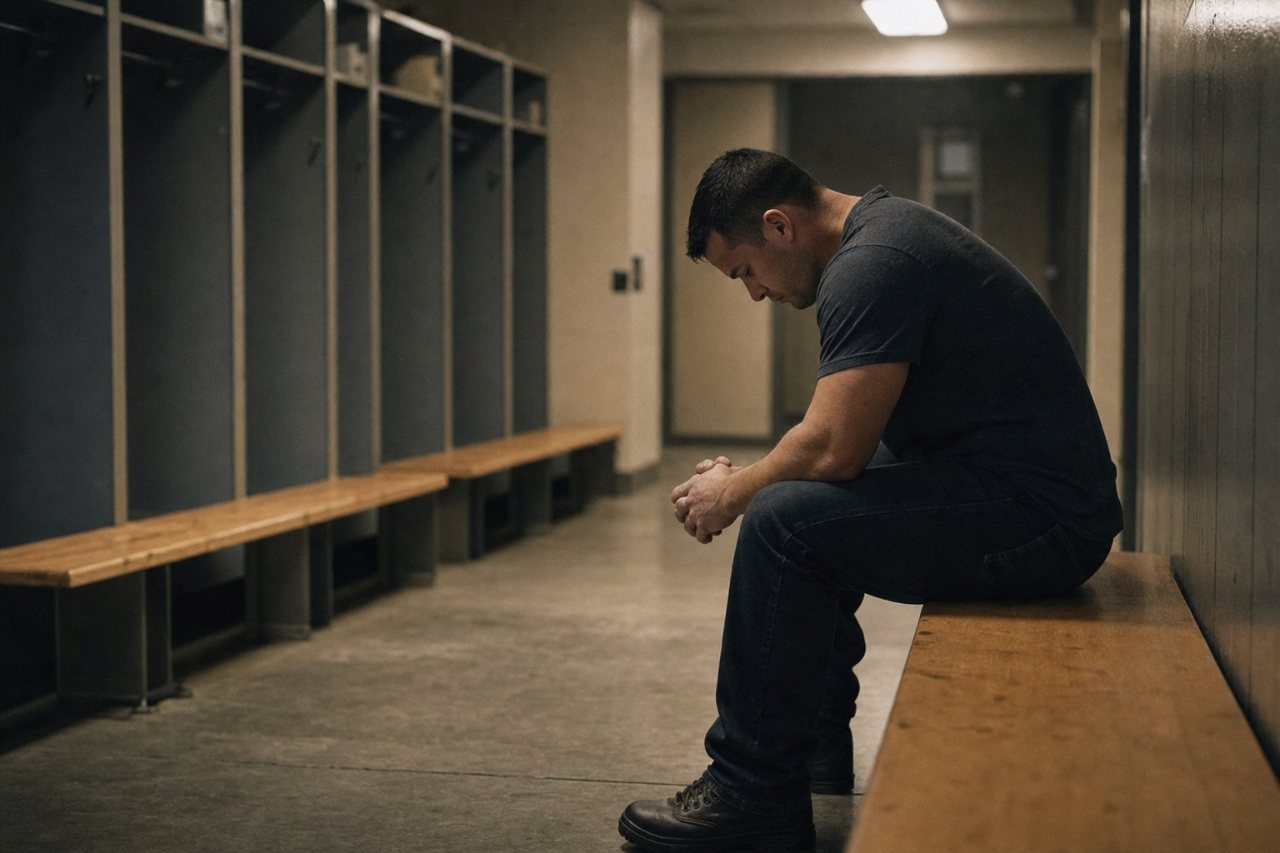
If the general question about sleep environment chemistry and mental health is under-studied, it is even more under-studied for the population with the most pressing reason to ask it. Before going further, the guardrail for this whole section: the elevated mental-health burden among firefighters has documented causes — occupational trauma, shift work, and the culture around help-seeking. Nothing below displaces those. This is not a claim that the bedroom explains any part of it. It is a narrower observation that one variable, the chemistry of the sleep-recovery window, has never been looked at for this population — and that the not-looking is worth naming.
First responders, firefighters in particular, carry an extensively documented mental health burden. Similar take-home chemical exposure dynamics, including how outdoor occupational chemicals move into sleep environments, are documented in studies of agricultural chemical exposure and sleep. The epidemiological record is not ambiguous. A 2016 meta-analysis by Stanley and colleagues found that firefighters die by suicide at rates exceeding line-of-duty deaths in many jurisdictions. Studies across multiple countries document elevated rates of PTSD, depression, and anxiety disorders in firefighter populations compared to the general public. The occupational drivers are well documented: chronic trauma exposure, shift work disruption of circadian rhythms, organizational culture that historically discouraged help-seeking, and the physiological effects of high-stress activations. Peer-reviewed
Separately, the evidence on firefighter chemical body burden has grown substantially. Firefighters are occupationally exposed to combustion products, PFAS from aqueous film-forming foam (AFFF), and the off-gassing of burning synthetic materials. Multiple recent bioaccumulation studies have documented elevated PFAS concentrations in firefighter serum compared to the general population — with the highest levels in those with the longest service and the most AFFF exposure. NIOSH and the International Association of Fire Fighters (IAFF) have both documented the occupational chemical exposures that make this population distinctive. Peer-reviewed
Sleep is the primary recovery window. It is when the body runs its maintenance processes, when the brain clears accumulated waste, when the stress response systems of the prior shift are — or are not — adequately resolved. The quality of that window matters more for a population under chronic high-stress occupational load than for the general public.
Here is the intersection that the existing research has not examined: a population with elevated baseline chemical body burden, documented vulnerability to neuropsychiatric conditions, and a sleep recovery window that takes place in an environment that may add to cumulative chemical load. The question is not whether mattress chemistry causes PTSD in firefighters. The question is whether the chemistry of the sleep surface during the primary recovery window has been evaluated for a population where every detail of that recovery window has documented significance.
It has not. That absence of research is itself worth naming — as a gap to be filled, not as evidence of an effect. The honest status is "unstudied," which is different from "harmful"; we are pointing at a question no one has answered, not implying we know the answer. Inferred
Framing note: We are not claiming that mattress chemistry causes PTSD or depression in firefighters. We are documenting that: (1) first responders carry elevated chemical body burdens from occupational exposure; (2) sleep is the primary recovery window; and (3) the chemistry of the sleep surface during that recovery window has not been seriously studied for this population. Inferred
What is and isn't established
This section exists because we think transparency about the limits of evidence is a form of respect for the reader. Here is our honest accounting.
What IS established:
- Sleep quality and mental health are bidirectionally linked. Poor sleep worsens mood, anxiety, and depression. Mental health conditions disrupt sleep. This is in every clinical guideline. Peer-reviewed
- Occupational exposure to VOCs and organic solvents at high concentrations is associated with neuropsychiatric symptoms including depression, cognitive impairment, and mood disorders. This is occupational medicine, not speculation. Peer-reviewed
- The bedroom during sleep is a VOC-accumulation environment. The 2024 ACS study documented this directly. Peer-reviewed
- Firefighters have elevated rates of PTSD, depression, anxiety, and suicide. Peer-reviewed
- Firefighters carry elevated PFAS and chemical body burdens from occupational exposure. Peer-reviewed
What IS NOT established:
- That residential mattress or bedroom VOC concentrations are sufficient to cause mental health conditions in otherwise healthy adults. The gap between occupational exposure concentrations and residential measurements is significant and should not be minimised. Inferred
- That mattress chemistry specifically — as opposed to other indoor VOC sources — makes a meaningful independent contribution to bedroom air chemistry outcomes. Inferred
What HAS NOT BEEN STUDIED:
- The sleep environment chemistry specifically for high-exposure populations — firefighters, people with multiple chemical sensitivity, those with high cumulative environmental load.
- Whether the glymphatic clearance window during sleep is affected by VOC exposure in the breathing zone during sleep.
- Whether the chemical body burden effect on mental health outcomes is modifiable through changes to the sleep environment.
What Embr is doing: Documenting these gaps publicly. Developing tools and a measurement framework that treats the sleep environment as a variable worth tracking, particularly for high-exposure populations. We are not in the business of telling you to be afraid of your bedroom — we are in the business of making sure the right questions get asked with rigor and honesty.
Practical steps — what's reasonable to do now
Given what is established, what is plausible, and what remains unstudied, here is the reasonable response for different populations.
For everyone: Prioritise sleep quality through the basic mechanics that the clinical literature robustly supports — consistent sleep and wake times, adequate duration (7–9 hours for adults per NIH guidelines), and a sleep environment that supports rather than disrupts sleep. These interventions have the strongest and most direct evidence base for mental health outcomes of anything on this list. Peer-reviewed
On ventilation: The precautionary case for ventilating the bedroom is strongest in the context of the 2024 ACS finding. Opening a window or using fresh air ventilation rather than recirculated HVAC air is a low-cost, low-effort intervention that addresses bedroom air accumulation directly. For those in climates or buildings where this is practical, it is the single most evidence-adjacent intervention for sleep environment air quality. Inferred
On sleep surface chemistry: The precautionary case for a lower-emission sleep surface is strongest for high-exposure populations — first responders, people with documented chemical sensitivity, pregnant individuals, and young children. It is weakest for healthy adults in otherwise low-exposure environments. This is not a binary judgment; it is a risk-stratification judgment that the existing evidence supports making on that basis. Inferred
For first responders specifically: The most evidence-backed intervention currently available is decontamination before sleep. The occupational health literature on reducing chemical body burden after shift is clear: showering and changing clothes before entering sleeping areas reduces dermal and inhalation re-exposure. Keeping turnout gear and work clothing out of the bedroom entirely is the recommendation supported by the body burden literature. This is not speculation — it is the existing evidence base for chemical exposure management applied consistently to the sleep window. Peer-reviewed
On tracking: For anyone who makes changes to their sleep environment and wants to evaluate the effect, tracking mood, cognitive clarity, and sleep quality before and after changes is the only way to generate signal from the experience. No tool currently exists to do this rigorously for the sleep environment specifically — building that tool is part of what Embr is here to do.
The question of whether the sleep environment affects mental health is under-researched relative to its potential importance. The populations with the most to gain from answering it — first responders, people with high cumulative exposure, those with chemical sensitivity — are the same populations most underserved by the existing research and product landscape. That is exactly the work Embr is here to do. To read more about the foundational concept underlying this research, see our Sleep Micro Environment hub.
This article is part of the Embr Sleep & Health pillar. Evidence tags throughout — Peer-reviewed, Inferred, Speculation — reflect our commitment to honest framing. Our methodology and editorial standards are published openly.
Frequently asked questions
Can your bedroom environment affect your mental health? +
The research establishes a bidirectional relationship between sleep quality and mental health. Separately, occupational literature documents neuropsychiatric associations with VOC exposure at elevated concentrations. A 2024 study in ACS Environmental Science & Technology found the bedroom during sleep is a VOC-accumulation environment distinct from the rest of the home. The research does not currently establish that residential sleep environment chemistry causes mental health conditions — but the question is under-studied relative to its potential importance, particularly for high-exposure populations. Inferred
Does mattress off-gassing affect mood or anxiety? +
There is no published clinical study directly examining mattress off-gassing and mood in residential settings. The occupational medicine literature documents mood, cognitive, and neuropsychiatric associations with solvent and VOC exposure at workplace concentrations — detailed in the ATSDR toxicological profile for toluene. Whether the lower concentrations typical in residential settings are relevant to mood is not currently established. Inferred
Why do firefighters have high rates of depression and PTSD? +
Multiple peer-reviewed studies document elevated rates of PTSD, depression, anxiety, and suicide in firefighter populations. The primary documented contributors are occupational trauma exposure, shift work disruption of circadian rhythms, and occupational chemical exposure. A 2016 meta-analysis by Stanley et al. found suicide rates exceeded line-of-duty deaths in many jurisdictions. The potential contribution of sleep environment chemistry to this picture has not been directly studied — a gap Embr considers worth naming and investigating. Inferred
What is the glymphatic system? +
The glymphatic system is the brain's waste-clearance mechanism, operating primarily during sleep. It clears metabolic waste products and potentially neurotoxic proteins — including those associated with Alzheimer's disease — from brain tissue. The system was first described in detail in 2013 by Xie and colleagues. Research on how sleep environment chemistry might interact with glymphatic function during sleep is in early stages. Speculation
What can I do to improve my sleep environment for mental health? +
The most evidence-backed steps: prioritise sleep quality through consistent schedules and adequate duration (7–9 hours); ventilate the bedroom with fresh air rather than relying solely on HVAC recirculation; and for first responders specifically, decontaminate before sleep — showering after shift and keeping work clothing out of sleeping areas. This last recommendation is supported by occupational health literature on reducing chemical body burden. Peer-reviewed
- National Institute of Mental Health, "Sleep and Mental Health." nimh.nih.gov Regulatory
- Walker, M. (2017). Why We Sleep: Unlocking the Power of Sleep and Dreams. Scribner. (Glymphatic system discussion, Chapter 6.)
- Xie L et al. (2013). "Sleep drives metabolite clearance from the adult brain." Science 342(6156):373–377. science.org Peer-reviewed
- [Citation removed — this duplicated the entry above. Both named Science 342(6156):373–377, which is one paper: Xie L et al. (2013), “Sleep Drives Metabolite Clearance from the Adult Brain.” “Sleep initiated fluid transport in the murine glymphatic system” is a description of that work, not its title.]
- Alhola, P. & Polo-Kantola, P. (2007). "Sleep deprivation: Impact on cognitive performance." Neuropsychiatric Disease and Treatment 3(5):553–567. pmc.ncbi.nlm.nih.gov PMID 19300585 Peer-reviewed
- Baglioni, C. et al. (2011). "Insomnia as a predictor of depression: A meta-analytic evaluation of longitudinal epidemiological studies." Journal of Affective Disorders 135(1–3):10–19. pubmed.ncbi.nlm.nih.gov Peer-reviewed
- Molinier B, Arata C, Katz EF, Lunderberg DM, Ofodile J, Singer BC, Nazaroff WW, Goldstein AH. (2024). "Bedroom Concentrations and Emissions of Volatile Organic Compounds during Sleep." Environmental Science & Technology 58(18):7958–7967. PMID 38656997. PMC11080066. Study conducted at a single Oakland residence; occupant bioeffluents identified as dominant VOC source. Peer-reviewed
- ATSDR. Toxicological Profile for Toluene. Atlanta: Agency for Toxic Substances and Disease Registry. atsdr.cdc.gov Regulatory
- van Valen E, Wekking E, van der Laan G, Sprangers M, et al. (2009). "The course of chronic solvent induced encephalopathy: a systematic review." NeuroToxicology, 30(6): 1172-1186. PMID 19538991 Peer-reviewed
- Stanley, I.H., Hom, M.A. & Joiner, T.E. (2016). "A systematic review of suicidal thoughts and behaviors among police officers, firefighters, EMTs, and paramedics." Clinical Psychology Review, 44: 25-44. DOI 10.1016/j.cpr.2015.12.002 Peer-reviewed
- Caban-Martinez A, D.B. et al. (2022). "Per- and polyfluoroalkyl substances (PFAS) serum concentrations among firefighters with occupational AFFF exposure." Environmental Research 216:114650. pubmed.ncbi.nlm.nih.gov Peer-reviewed
- NIOSH. Firefighter Cancer: Reducing Exposures. National Institute for Occupational Safety and Health. cdc.gov/niosh Regulatory
Discussion