At a glance
| Chemical family | Fluorotelomer alcohol — volatile PFAS precursor (8:2 fluorotelomer alcohol, transforms to PFOA) |
| CAS number | 678-39-7 |
| Classification | Not classified by IARC. Biotransforms to PFOA (IARC Group 1 carcinogen) in the body. EPA included in PFAS Action Plan. Not a POP itself but transforms to one |
| Where you encounter it | Stain-resistant and water-repellent coatings on textiles and carpets; food packaging with grease resistance; indoor air from treated products; transforms to PFOA in the environment and in the body |
| Sleep micro-environment relevance | Off-gasses from stain-resistant carpet, upholstery, and treated textiles in the bedroom. One of the dominant PFAS species in indoor air. Volatile precursor to PFOA |
Regulatory & certification status
| European Union | REACH registered. Subject to the proposed EU universal PFAS restriction (under development). Not individually restricted under Annex XVII. Transforms to PFOA, which is restricted under the POP Regulation. Regulatory |
| United States | EPA PFAS Action Plan includes fluorotelomer compounds. EPA PFOA Stewardship Program (2006-2015) committed major manufacturers to eliminate PFOA and precursors including long-chain FTOHs. PFAS National Primary Drinking Water Regulation (2024) addresses PFOA/PFOS. Regulatory |
| Canada | Subject to the Prohibition of Certain Toxic Substances Regulations (long-chain PFAS). Under ongoing assessment. Regulatory |
| International | Not IARC classified. Transforms to PFOA (IARC Group 1; Stockholm Convention POP). Part of the broader global PFAS regulatory wave. EPA PFOA Stewardship Program targeted elimination. Regulatory |
What it is
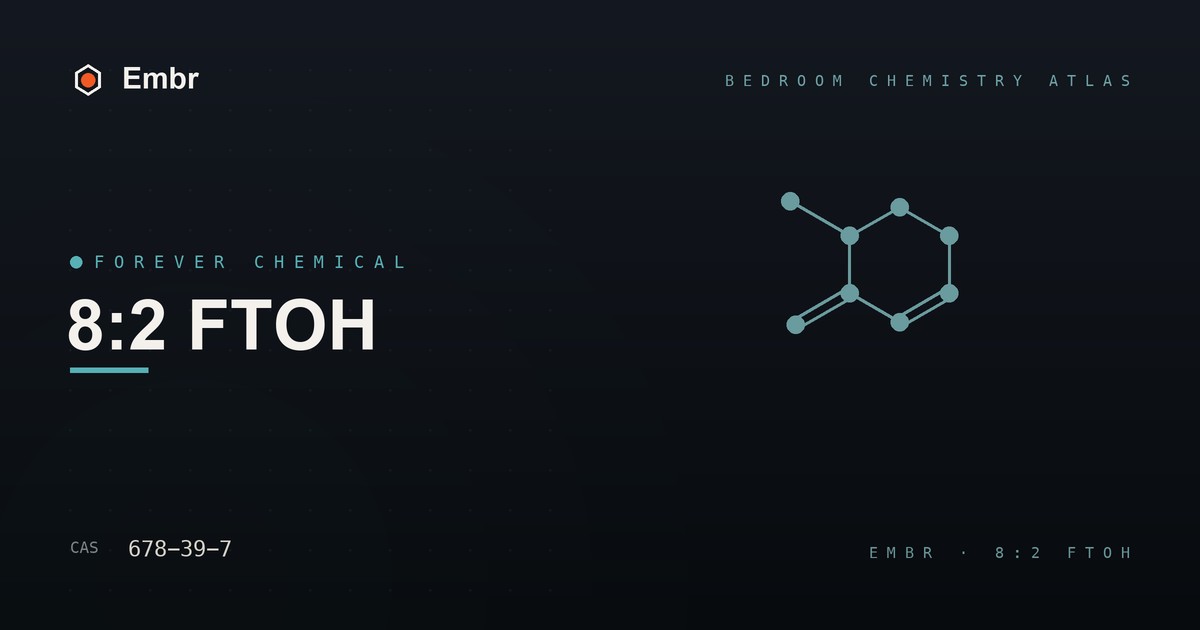
8:2 FTOH is a fluorinated alcohol with an eight-carbon perfluorinated chain and a two-carbon non-fluorinated segment bearing a hydroxyl group. It is used as a raw material and intermediate in the production of fluorotelomer-based coatings that impart stain resistance, water repellency, and grease resistance to textiles, carpets, and food packaging. Unlike PFOA and PFOS (which are ionic and non-volatile), 8:2 FTOH is volatile and partitions readily into indoor air. IARC has not evaluated 8:2 FTOH, but the critical toxicological issue is its biotransformation: in the human body, 8:2 FTOH is metabolised through a series of intermediates to PFOA, an IARC Group 1 carcinogen and an extremely persistent environmental pollutant. This means that exposure to 8:2 FTOH ultimately contributes to the body burden of PFOA.
Where it shows up in bedding
8:2 FTOH enters the bedroom as a volatile emission from stain-resistant treated products. Carpets treated with fluorotelomer-based stain repellents continuously off-gas 8:2 FTOH into indoor air. Stain-resistant upholstered furniture and treated curtains are additional sources. Some mattress protectors and pillow covers marketed as 'stain-resistant' or 'waterproof' may use fluorotelomer-based coatings. Indoor air studies have consistently found 8:2 FTOH to be one of the most abundant PFAS species in residential air, with concentrations highest in newer homes with recently installed stain-resistant carpeting. During sleep, inhalation is the primary exposure route for volatile FTOHs. Using untreated natural-fibre bedding and removing stain-resistant carpet reduces exposure.
Citations
- Shoeib, M. et al. (2011). Indoor Sources of Poly- and Perfluoroalkyl Substances (PFAS) in Vancouver, Canada: Implications for Human Exposure. Environmental Science & Technology, 45(19): 7999-8005. Source Peer-reviewed
- D'eon, J.C. and Mabury, S.A. (2011). Is Indirect Exposure a Significant Contributor to the Burden of Perfluorinated Acids Observed in Humans? Environmental Science & Technology, 45(19): 7974-7984. Source Peer-reviewed
- EPA. PFAS Action Plan — EPA's Per- and Polyfluoroalkyl Substances (PFAS) Action Plan. Source Regulatory
Frequently asked questions
How does 8:2 FTOH become PFOA in my body?
After you inhale 8:2 FTOH, it is absorbed through the lungs and metabolised in the liver through a series of oxidation steps. The non-fluorinated end of the molecule is progressively oxidised until the fully fluorinated carboxylic acid — PFOA — is produced. This biotransformation has been demonstrated in both animal studies and human biomonitoring. It means that exposure to 8:2 FTOH contributes to your blood levels of PFOA, even without any direct PFOA exposure.
Does stain-resistant carpet release PFAS?
Yes. Carpets treated with fluorotelomer-based stain repellents continuously off-gas volatile PFAS including 8:2 FTOH into indoor air. The emissions are highest when the carpet is new and decline over time, but they persist for the life of the carpet. If you want to minimise PFAS exposure in the bedroom, choose untreated carpet or hard flooring, and avoid products marketed as 'stain-resistant' unless they specify PFAS-free treatment.
Related compounds
Embr is a sleep environment company researching and addressing the chemistry of the bedroom. Research and product development in progress.
Last reviewed 2026-07-08. If you find a factual error, contact us.