At a glance
| Chemical family | Perfluoroether carboxylic acid (PFECA); a fluoropolymer-manufacturing processing aid (emulsifier) developed as a PFOA/APFO replacement |
| CAS number | 919005-14-4 (acid form); 958445-44-8 (ammonium salt). PubChem CID 52915299 (acid) / 87490983 (salt); EPA CompTox DTXSID40881350 |
| Classification | Not evaluated by IARC; NOT among the six PFAS with a final MCL in the EPA 2024 PFAS NPDWR; INCLUDED as a monitored analyte in US EPA UCMR 5 (2023-2025, via EPA Method 533); not listed under California Proposition 65; reviewed by the German Environment Agency (UBA) as a PFOA substitute; within scope of the proposed EU universal PFAS restriction |
| Where you encounter it | Almost exclusively an industrial signal near fluoropolymer manufacturing — documented in the Rhine at low ng/L and in a small fraction of German tap-water samples (~5 ng/L). In the US it is essentially absent: 3 of 10,289 public water systems, maximum 8.1 ng/L (UCMR 5). Not a consumer or household product ingredient |
| Sleep micro environment relevance | Minimal. ADONA is not a bedroom-material additive and is essentially absent from US water. It appears here for completeness within the PFAS family rather than as a meaningful sleep-environment exposure |
| Activated carbon capture | Not applicable for VOC-phase capture. For drinking water, the certified PFAS-removal technologies used for the regulated PFAS (NSF/ANSI 58 reverse osmosis; certified NSF/ANSI 53 for PFAS) would reduce ADONA in the same source. Inferred from general PFAS water-treatment performance; ADONA-specific certification language was not located |
Regulatory & certification status
Where ADONA stands across the major regulatory systems and the certifications a bedroom product might carry. Each row links to the governing instrument; where a jurisdiction has no ADONA-specific measure, that is stated plainly rather than left blank.
| European Union | The German Environment Agency (Umweltbundesamt, UBA) reviewed ADONA's toxicology as a PFOA substitute in its literature review of available PFAS toxicological data (Texte 129/2023). A specific numeric German drinking-water guide value for ADONA was not confirmed and is not asserted here. Under EU REACH, ADONA falls within the scope of the proposed universal PFAS restriction, which remains a draft. Whether ADONA is individually listed as a Substance of Very High Concern was not verified — ECHA's substance pages are not machine-readable from here, so no such listing is claimed. Regulatory — UBA Texte 129/2023 |
| United States | ADONA is NOT among the six PFAS with a final Maximum Contaminant Level in the EPA April 2024 PFAS National Primary Drinking Water Regulation. It IS a monitored analyte in EPA's fifth Unregulated Contaminant Monitoring Rule (UCMR 5), measured by EPA Method 533, with public water system sampling running 2023-2025 — a data-gathering activity, not an enforceable limit. No EPA IRIS or ATSDR toxicity value specific to ADONA was located. Regulatory — EPA UCMR 5 · EPA Method 533 |
| California (Prop 65) | ADONA (CAS 919005-14-4) is not listed under California Proposition 65 — a search of the current OEHHA Prop 65 list returns no entry for it. This is an absence of a listing, not an affirmative safety determination. Regulatory — OEHHA |
| Canada | No ADONA-specific guidance or restriction was located. As a PFAS, it would fall within the scope of Canada's broader class-based PFAS risk-management direction, but no substance-specific measure for ADONA is identified. Treat as an honest absence. Inferred — from the absence of any ADONA-specific Canadian instrument |
| Australia | No ADONA-specific assessment or ban was located. Australia's industrial PFAS restrictions and AICIS evaluations to date have centred on the legacy long-chain PFAS rather than ADONA. Treat as an honest absence. Inferred — from the absence of any ADONA-specific Australian instrument |
| United Kingdom | No ADONA-specific UK measure is identified. UK REACH maintains its own Candidate List separately from the EU and has not been confirmed to name ADONA. Treat as not independently confirmed beyond the absence of a GB-specific listing. Inferred — from the absence of any ADONA-specific UK instrument |
| International | ADONA was not evaluated by IARC and is not listed under the Stockholm Convention on Persistent Organic Pollutants. The Stockholm PFAS listings (PFOS, PFOA, PFHxS and long-chain PFCAs) do not reach this perfluoroether structure. Regulatory — Stockholm Convention |
| Certifications | CertiPUR-US: does NOT address PFAS — its published foam criteria restrict ozone depleters, specified flame retardants, heavy metals, formaldehyde, prohibited phthalates and CMR substances, but PFAS/PFCs are not named or tested. OEKO-TEX Standard 100: regulates PFAS in certified textiles via a total-fluorine limit and a defined PFAS test; ADONA is not individually named but a total-fluorine/total-PFAS approach would capture it. GREENGUARD / GREENGUARD Gold: a low-VOC emissions certification that does not screen for a non-volatile PFAS like this. Industry — CertiPUR-US · OEKO-TEX |
| The 72-hour test window | Largely missed. ADONA is a non-volatile, surface-active perfluoroether acid that partitions to water and surfaces rather than off-gassing, so a short ~72-hour VOC chamber emissions test does not reliably capture it; it is instead measured by targeted PFAS analysis (LC-MS/MS), as in EPA Method 533. Inferred — from the compound's volatility/emission profile versus the VOC focus of short chamber tests |
What it is
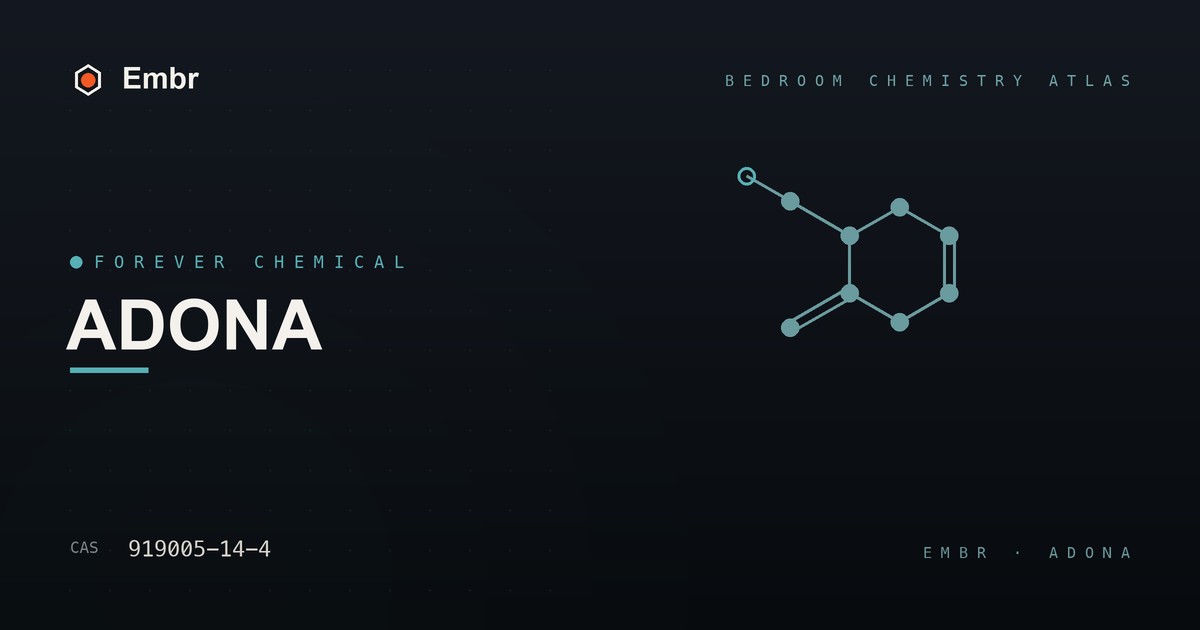
ADONA is 4,8-dioxa-3H-perfluorononanoic acid — molecular formula C7H2F12O4, acid CAS 919005-14-4 (PubChem CID 52915299), most often handled as its ammonium salt, CAS 958445-44-8 (PubChem CID 87490983). Regulatory The name says most of what matters: it is a perfluorononanoic acid backbone interrupted by two ether oxygens (the "4,8-dioxa" positions). Those ether linkages are the point. They break up the long uninterrupted perfluoroalkyl chain that gives legacy PFAS like PFOA their multi-year persistence in the human body.
ADONA was developed by Dyneon, a 3M company, as a fluoropolymer-manufacturing processing aid — an emulsifier used in the polymerization of PTFE and related fluoropolymers — to replace ammonium perfluorooctanoate (APFO) and PFOA. Dyneon completed its APFO phase-out in December 2008, and the ADONA technology launched around 2009. Manufacturer-linked and regulatory-review sources report that ADONA clears the human body far faster than PFOA — on the order of roughly 20 to 40 days versus years. Industry / regulatory review — the faster-clearance and lower-toxicity comparison traces largely to manufacturer studies and the UBA review, and is not a settled independent finding That comparison is the whole commercial rationale for ADONA, which is exactly why it deserves a skeptical read rather than acceptance at face value.
Where you encounter it
From German fluoropolymer manufacturing — the Rhine signal
ADONA is an industrial-fingerprint PFAS. It exists because 3M/Dyneon needed a lower-toxicity emulsifier to replace PFOA/APFO in fluoropolymer manufacture, and its documented environmental footprint is concentrated around German fluoropolymer production, with the Rhine as the source signal. It has been measured in the Rhine at low nanogram-per-litre concentrations and in a small fraction of German tap-water samples. This is a regional manufacturing signature, not a diffuse consumer-product exposure.
Because ADONA is 3M/Dyneon's PFOA-replacement processing aid, it works as a manufacturer fingerprint: downstream of the Gendorf works on Germany's Alz River, ADONA made up roughly 40% of total PFAS (with GenX ~50%) Peer-reviewed — Joerss 2020 — a linear fluoroether signature distinct from Chemours' GenX or Solvay's cC6O4. Reading which replacement ether dominates a plume points to which company's chemistry produced it Inferred from PFAS replacement-marker forensics.
From US drinking water — essentially absent
In the United States, ADONA barely registers. EPA UCMR 5 occurrence data (2023–2025) detected it in just 3 of 10,289 public water systems — about 0.03 percent — at a maximum of 8.1 ng/L. Regulatory That is essentially absent from US tap water. The US monitors ADONA under UCMR 5 as due diligence — to confirm that a European fluoropolymer processing aid has not become a domestic problem — rather than because it is a meaningful American exposure.
Why it exists — the PFOA replacement story
ADONA belongs to the generation of "alternative" PFAS built to answer the PFOA problem. As regulators and manufacturers moved away from the legacy C8 chemistry after 2006, fluoropolymer makers introduced perfluoroether processing aids — ADONA at Dyneon, HFPO-DA (GenX) at DuPont/Chemours — designed to do the same emulsifier job while clearing the body faster. Whether these replacements are meaningfully safer over a lifetime, rather than simply less studied, is the central open question of the entire replacement-PFAS story.
What the research says
A thin, mostly industry-linked toxicology base
The dedicated ADONA literature is thin — this is worth stating plainly. No independent EPA, ATSDR, or IARC hazard value for ADONA was located. The favorable "less toxic than PFOA, faster human clearance" characterization traces largely to manufacturer-linked studies and to the German UBA review (Texte 129/2023), which assessed ADONA as a PFOA substitute. Industry / regulatory review — treat the favorable safety framing as low-evidence, not settled A responsible reading is that ADONA is less studied than PFOA, not demonstrably safe.
German drinking-water detection
Ingold, Kämpfe and Ruhl (2023) detected ADONA in 7 of 89 German tap-water samples at approximately 5 ng/L (DOI 10.1016/j.eehl.2023.08.004). Peer-reviewed The detection pattern is consistent with a compound whose source is regional fluoropolymer manufacturing rather than diffuse consumer use — most samples were clean, a minority carried low concentrations.
Bottled water, food and wildlife screening
A Japanese market survey of bottled water, tea and juice found ADONA below the limit of quantitation in all 54 samples (Igarashi et al. 2021, Chemical and Pharmaceutical Bulletin 69(3):286-290, DOI 10.1248/cpb.c20-00888). Peer-reviewed In wildlife, ADONA has been measured as a PFAS "alternative" analyte in South Korean gull eggs (Wang et al. 2021, Journal of Hazardous Materials 411:125036, DOI 10.1016/j.jhazmat.2020.125036). Peer-reviewed Together these studies sketch a compound that turns up in targeted PFAS-alternative screens but is not a widespread environmental burden outside its manufacturing region.
What helps reduce exposure
For the vast majority of US households, no specific action is warranted. ADONA was detected in only 3 of 10,289 systems at a maximum of 8.1 ng/L. It is not a bedroom-material additive and not a meaningful domestic exposure.
If you already filter for the regulated PFAS, ADONA comes along. The same certified NSF/ANSI 58 (reverse osmosis) and NSF/ANSI 53 (PFAS-certified) drinking-water treatment used for PFOA and the other regulated PFAS reduces ADONA in the same source water. Inferred from general PFAS water-treatment performance See the broader water guidance for how PFAS filtration is chosen and verified.
Check your utility's UCMR 5 results. If you want confirmation rather than assumption, EPA publishes UCMR 5 occurrence data online; for ADONA the near-universal result is non-detect.
What does NOT help
- Treating ADONA as a headline bedroom hazard. It is a European industrial processing aid, not a consumer-product or mattress ingredient.
- Assuming "PFOA replacement" means "safe." The favorable safety story is thin and largely manufacturer-linked; less studied is not the same as demonstrably safer.
- Boiling water. Concentrates rather than removes PFAS.
- Generic uncertified carbon filters. Variable PFAS-reduction performance; certified NSF/ANSI 53 (PFAS) or NSF/ANSI 58 reverse osmosis is what reliably reduces perfluoroether acids.
Open research questions
- Independent (non-manufacturer) toxicology for ADONA — no EPA/ATSDR/IARC hazard value has been located, so the favorable safety comparison rests on a narrow, industry-linked base. Industry — the evidence base is manufacturer-weighted
- Whether the faster human clearance reported for ADONA holds up in independent pharmacokinetic study. Speculation re: independent confirmation of clearance
- Long-term environmental fate near German manufacturing versus the trace levels seen elsewhere. Inferred from the regional-signal detection pattern
- How the replacement-PFAS class as a whole — ADONA, GenX and their siblings — compares to the legacy PFAS it displaced over a full lifetime of exposure. Speculation re: lifetime comparison of replacement PFAS
The Embr Exposure Ledger: 4,8-dioxa-3H-perfluorononanoic acid (ADONA)
One chemical, several public questions, answered from independent datasets and joined here — the environment it shows up in, the body burden it carries, how it is regulated, and what actually reduces it.
Detection and body-burden figures are occurrence data, not a personal measurement or a health diagnosis. Part of the Embr Exposure Ledger — an open, cross-dataset chemical join (download the data), reusable with attribution.
Where you meet Adona across your home
The same compound turns up in more than one place you live. Here's where it shows up in Embr — each links to the full breakdown for that part of your home.
Citations
- US Environmental Protection Agency. Fifth Unregulated Contaminant Monitoring Rule (UCMR 5) — occurrence data 2023-2025. ADONA detected in 3 of 10,289 public water systems, maximum 8.1 ng/L. epa.gov/dwucmr Regulatory — occurrence source
- US Environmental Protection Agency (2019). Method 533: Determination of Per- and Polyfluoroalkyl Substances in Drinking Water by Isotope Dilution Anion Exchange Solid Phase Extraction and LC/MS/MS. EPA 815-B-19-020. epa.gov Regulatory — the UCMR 5 analytical method for ADONA
- National Center for Biotechnology Information. PubChem Compound Summary CID 52915299 (ADONA acid, CAS 919005-14-4) and CID 87490983 (ammonium salt, CAS 958445-44-8). pubchem.ncbi.nlm.nih.gov Regulatory / database — CAS and identity confirmation
- Umweltbundesamt (German Environment Agency) (2023). Literature review and assessment of available toxicological data for PFAS. Texte 129/2023 — includes review of ADONA as a PFOA substitute. umweltbundesamt.de Regulatory — German toxicological review
- Ingold, V., Kämpfe, A. & Ruhl, A.S. (2023). Screening for 26 per- and polyfluoroalkyl substances (PFAS) in German drinking waters with support of residents. Eco-Environment & Health, 2: 235-242. DOI 10.1016/j.eehl.2023.08.004 Peer-reviewed
- Igarashi Y, et al. (2021). Determination of per- and polyfluoroalkyl substances in bottled water, tea and juice on the Japanese market — ADONA below limit of quantitation in all 54 samples. Chemical and Pharmaceutical Bulletin, 69(3):286-290. DOI 10.1248/cpb.c20-00888 Peer-reviewed
- Wang W, et al. (2021). Legacy and alternative per- and polyfluoroalkyl substances, including ADONA, in gull eggs from South Korea. Journal of Hazardous Materials, 411:125036. DOI 10.1016/j.jhazmat.2020.125036 Peer-reviewed
- Joerss H, Schramm TR, Sun L, et al. (2020). Per- and polyfluoroalkyl substances in Chinese and German river water — point source- and country-specific fingerprints including unknown precursors. Environ Pollut 267:114643. DOI 10.1016/j.envpol.2020.115567 Peer-reviewed
- California Office of Environmental Health Hazard Assessment. Proposition 65 List — ADONA (CAS 919005-14-4) is not listed. oehha.ca.gov Regulatory — absence of listing
Frequently asked questions
What is ADONA?
ADONA is 4,8-dioxa-3H-perfluorononanoic acid (acid CAS 919005-14-4; ammonium salt CAS 958445-44-8), a perfluoroether carboxylic acid (PFECA). It was developed by Dyneon, a 3M company, as a fluoropolymer-manufacturing processing aid (an emulsifier) to replace ammonium perfluorooctanoate (APFO) and PFOA. Dyneon completed its APFO phase-out in December 2008 and launched the ADONA technology around 2009. Unlike the general-purpose consumer PFAS, ADONA is an industrial-fingerprint chemical: it exists because manufacturers needed a lower-toxicity emulsifier for making PTFE and related fluoropolymers, and its environmental footprint is concentrated around German fluoropolymer production near the Rhine.
Is ADONA regulated by the EPA?
ADONA is NOT among the six PFAS with a final Maximum Contaminant Level in the EPA 2024 PFAS National Primary Drinking Water Regulation. It IS a monitored analyte in EPA's fifth Unregulated Contaminant Monitoring Rule (UCMR 5), measured by EPA Method 533, with public water system sampling running 2023-2025. UCMR monitoring generates occurrence data to inform future rulemaking rather than establishing an enforceable limit. No EPA IRIS or ATSDR toxicity value specific to ADONA was located, and ADONA is not listed under California Proposition 65.
Where does ADONA come from?
ADONA is a fluoropolymer-processing-aid PFAS — it exists because 3M/Dyneon needed a lower-toxicity emulsifier to replace PFOA/APFO in fluoropolymer manufacture. Its documented environmental footprint is concentrated around German fluoropolymer production, with the Rhine as the source signal. Beyond that region it appears only in trace amounts: low nanogram-per-litre concentrations in the Rhine and in a small fraction of German tap-water samples, and in just 3 of 10,289 US public water systems sampled under UCMR 5. It is essentially absent from US tap water.
Is ADONA in drinking water?
Rarely. EPA UCMR 5 occurrence data (2023-2025) detected ADONA in only 3 of 10,289 US public water systems — about 0.03 percent — at a maximum of 8.1 ng/L. A peer-reviewed German drinking-water screening study detected ADONA in 7 of 89 tap-water samples at roughly 5 ng/L, reflecting its concentration near German fluoropolymer manufacturing. For practical purposes ADONA is not a US tap-water exposure; the US monitors it as due diligence rather than because it is a domestic contaminant.
How is ADONA different from PFOA?
ADONA was designed specifically as PFOA's replacement. Both are perfluorinated carboxylic acids used as emulsifiers in fluoropolymer manufacture, but ADONA is a perfluoroether — it carries ether oxygens in its chain — which manufacturer-linked and regulatory-review sources report clears the human body far faster than PFOA (on the order of weeks rather than years). That clearance and lower-toxicity comparison traces largely to manufacturer studies and the German UBA review, so it should be treated as a low-evidence claim rather than a settled finding. Regulatorily, PFOA has the lowest federal drinking-water MCL of any PFAS (4 ng/L) while ADONA has no federal MCL and is only monitored under UCMR 5.
Should I worry about ADONA?
For US households, ADONA is not a meaningful drinking-water exposure — it was found in only 3 of 10,289 systems at a maximum of 8.1 ng/L. It is a European fluoropolymer-processing-aid PFAS whose footprint is concentrated around German (Rhine) manufacturing. Dedicated toxicology is thin and several favorable claims are manufacturer-linked, so any health characterization should be treated as low-evidence. If you use certified PFAS-removal drinking-water filtration for the regulated PFAS, that same treatment reduces ADONA as well.
Related compounds
Embr is a sleep environment company researching the chemistry of the bedroom. See the methodology page for how this Atlas tags claims by evidence strength. For broader context on PFAS exposure pathways in drinking water, see water.
Last reviewed 2026-07-13. If you find a factual error, contact us.