At a glance
| Chemical family | Chlorotriazine herbicide — a synthetic weed killer applied mainly to corn, sorghum, and sugarcane. Moderately water-soluble and mobile, so it runs off into surface water and leaches to groundwater. Its degradates (desethylatrazine, desisopropylatrazine) travel with it. |
| CAS number | 1912-24-9 |
| Classification | An endocrine disruptor (interferes with hormone signalling). Not classified as a human carcinogen by IARC; EPA currently classifies it as "not likely to be carcinogenic to humans." The central debate is hormonal and developmental effects at low, real-world doses. EPA MCL 3 µg/L (annual average); banned in the EU since 2004. |
| Where you encounter it | Drinking water drawn from Corn Belt rivers, streams, and shallow groundwater — much of Kansas, Missouri, Nebraska, Iowa, Illinois, Indiana, and Ohio. Highest in late spring and early summer after application. |
| Sleep micro environment relevance | Indirect — an ingestion exposure via drinking water, on the Atlas as part of the agricultural tap-water picture the water hub anchors, alongside nitrate. |
| Activated carbon capture | Well removed by activated carbon (an organic molecule that adsorbs readily) and by reverse osmosis. A carbon filter certified to NSF/ANSI 53 for atrazine/pesticides is the standard fix. Inferred from standard herbicide water-treatment engineering; atrazine adsorbs well onto activated carbon |
Regulatory & certification status
Atrazine is the textbook case of the same water being judged very differently on two continents. The rows below give the standards and the seasonal-averaging nuance that matters most.
| United States | EPA enforceable Maximum Contaminant Level of 3 µg/L (0.003 mg/L), assessed as a running annual average. A system can spike above 3 µg/L in spring and still comply if the yearly mean stays under, which is why single high readings don't necessarily mean a violation. California: listed under Proposition 65 as a reproductive toxicant (effective 2016). Regulatory — US EPA |
| European Union | Banned since 2004 (Decision 2004/248/EC), after persistent detections above the EU's blanket 0.1 µg/L ceiling on any single pesticide in drinking water. The EU limit is not health-derived per substance — it is a precautionary "pesticides shouldn't be in drinking water at all" threshold, ~30× stricter than the US number. Regulatory — European Commission |
| World Health Organization | WHO guideline value of 100 µg/L for atrazine (and 0.1 µg/L for its chloro-s-triazine metabolites combined) — far higher than either the US or EU drinking-water figures, reflecting a health-based rather than precautionary derivation. Regulatory — WHO |
| The 72-hour test window | Not applicable. Atrazine is a waterborne ingestion exposure measured by a specialized water-lab pesticide test, unrelated to the VOC-emission chamber tests used for mattresses and foam. Inferred — from the ingestion-via-water route versus the material/VOC focus of product emissions testing |
What it is
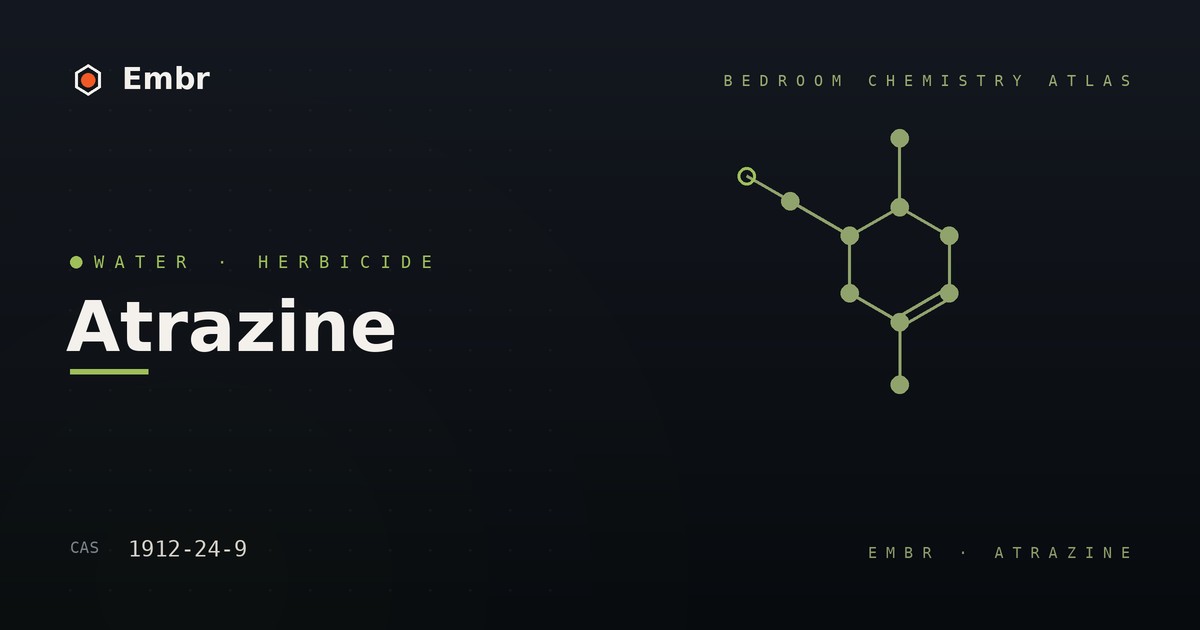
Atrazine is a chlorotriazine — a six-membered ring of alternating carbon and nitrogen atoms carrying a chlorine and two amine side-chains. It kills broadleaf and grassy weeds by blocking photosynthesis, and it has been a mainstay of US corn production since the late 1950s because it is cheap, effective, and works pre- and post-emergence. That very usefulness is the problem: it is applied on an enormous scale, it is water-soluble enough to move, and it breaks down slowly, so it persistently reaches the water people drink.
Its behaviour in the environment is defined by mobility. Atrazine washes off fields in runoff and leaches down to shallow aquifers, and it carries a family of degradates — desethylatrazine and desisopropylatrazine chief among them — that are themselves detected in water and count toward the total triazine load. Because so much of the Corn Belt's drinking water comes from rivers fed by farmland, atrazine is one of the most frequently detected pesticides in US water monitoring.
What makes atrazine contentious is not acute poisoning — it is the low-dose, chronic, hormonal question. Atrazine is an endocrine disruptor, and the argument is whether the concentrations real people drink are enough to nudge hormone-driven development. That is a genuinely unsettled scientific and political fight, which is why the US and EU reached opposite conclusions from overlapping evidence.
Where you encounter it
Corn Belt surface water
The dominant route. Cities that draw from rivers running through corn country — the Missouri, Kansas, Platte, Des Moines, Illinois, and Ohio systems among them — receive atrazine washed off fields. This is why a Kansas City or Topeka resident asking "what's in my water" should have atrazine on the list alongside nitrate: both are agricultural, both are seasonal, both are invisible.
The spring pulse
Atrazine is applied at planting, roughly April to June, and the first heavy rains flush a concentrated pulse into waterways. Surface-water levels therefore spike for weeks to a couple of months and then decline — which is exactly why the EPA limit is written as an annual average, and why filtration matters most in late spring and early summer.
Shallow groundwater and private wells
In heavily farmed areas, atrazine and its degradates also reach shallow wells, though usually at lower and steadier concentrations than the surface-water spikes. A private well in corn country is worth testing for triazine herbicides as part of the same panel as nitrate. Inferred from USGS groundwater pesticide monitoring in agricultural regions
What the research says
The endocrine-disruption evidence
The strongest experimental evidence is in amphibians. Work led by Tyrone Hayes reported that atrazine at low, environmentally relevant concentrations feminized and chemically castrated male frogs — inducing hermaphroditism and, in the 2010 PNAS study, functional females from genetic males. Peer-reviewed — Hayes et al. 2010 The proposed mechanism is induction of aromatase, which converts testosterone to estrogen. These findings, and the industry response to them, are a landmark case in environmental science.
The human evidence and the regulatory split
Human epidemiology on atrazine and outcomes such as birth defects, preterm birth, and menstrual/hormonal changes is suggestive but inconsistent — enough to worry the EU into a ban, not enough for US regulators to conclude harm at permitted levels. Inferred from the divergent US/EU regulatory conclusions drawn from overlapping human data The disagreement is less about the data than about how much precaution to apply to an unsettled low-dose signal.
What helps
Filter with certified activated carbon. Atrazine adsorbs well onto carbon, so a pitcher, faucet, or under-sink carbon filter certified to NSF/ANSI 53 for atrazine/pesticides removes it; reverse osmosis does too. See water filters compared.
Care most in spring. The load peaks in late spring and early summer — that is the window to have a fresh filter cartridge and, if you're sensitive, to prioritize filtered water for pregnancy and infants.
Read your Consumer Confidence Report. US utilities publish annual atrazine averages; a private well in corn country should be tested for triazine herbicides alongside nitrate.
What does NOT help
- Boiling. Atrazine is not removed by boiling; as with other dissolved contaminants, evaporation concentrates it.
- Assuming the annual average tells the whole story. A compliant yearly average can still hide a sharp multi-week spring spike — the average is a regulatory device, not a description of any given week.
- Waiting for a taste or smell. Atrazine is undetectable to the senses at these concentrations; only testing or the utility report tells you.
- Relying on a plain sediment filter. Only activated carbon (or RO) removes atrazine; a mechanical/sediment cartridge does nothing for it.
Open questions
- Whether low-dose, real-world atrazine exposure meaningfully affects human reproductive and developmental outcomes remains the central unresolved question — the crux of the US/EU split. Speculation re: human low-dose effects; the endocrine mechanism is demonstrated in animals
- The combined significance of atrazine plus its degradates plus co-occurring nitrate, as a mixture, is not well characterized. Speculation
- How much the spring spike matters relative to the annual average for developmentally-timed exposures (e.g. early pregnancy) is under-studied. Inferred from the mismatch between annual-average regulation and pulsed exposure
The Embr Exposure Ledger: Atrazine
One chemical, several public questions, answered from independent datasets and joined here — the environment it shows up in, the body burden it carries, how it is regulated, and what actually reduces it.
Detection and body-burden figures are occurrence data, not a personal measurement or a health diagnosis. Part of the Embr Exposure Ledger — an open, cross-dataset chemical join (download the data), reusable with attribution.
Where you meet Atrazine across your home
The same compound turns up in more than one place you live. Here's where it shows up in Embr — each links to the full breakdown for that part of your home.
Citations
- US Environmental Protection Agency. National Primary Drinking Water Regulations — atrazine MCL 3 µg/L (annual average). epa.gov Regulatory
- European Commission (2004). Atrazine withdrawn from the EU market — Decision 2004/248/EC. eur-lex.europa.eu Regulatory
- Hayes TB et al. (2010). Atrazine induces complete feminization and chemical castration in male African clawed frogs. PNAS 107(10):4612–4617. pnas.org Peer-reviewed
- US Geological Survey. Atrazine and degradates in Midwestern streams and groundwater — seasonal Corn Belt occurrence. usgs.gov Regulatory
Frequently asked questions
Is atrazine in my tap water dangerous?
Atrazine is a herbicide and an endocrine disruptor — it interferes with hormone signalling — and it is the second most-used weed killer in US agriculture, so it is widespread in Midwestern drinking water. The EU banned it in 2004 over persistent groundwater contamination, while the US still allows it under a limit of 3 µg/L. The debated concerns are hormonal and developmental effects at low doses; the animal evidence (notably frog studies) is strong, and the human evidence is suggestive but contested. If you're in the Corn Belt, the practical point is that levels spike sharply in late spring after application, and a certified carbon filter removes it.
What is the safe level of atrazine in drinking water?
The US EPA sets an enforceable Maximum Contaminant Level of 3 µg/L (0.003 mg/L) for atrazine — but crucially it is assessed as a running annual average, not a single sample. That means a system can briefly exceed 3 µg/L during the spring application spike and still comply if the yearly average stays under. The EU takes the opposite view: it withdrew atrazine entirely, having enforced a 0.1 µg/L ceiling on any single pesticide in drinking water. So the same water can be "legal" in the US and banned-substance territory in Europe.
Why is atrazine worse in spring?
Atrazine is applied to corn (and sorghum and sugarcane) in the planting season, mostly April through June. Spring rains then wash a pulse of it off fields into streams and rivers, so surface-water concentrations spike for weeks to a couple of months before falling back. Cities that draw from Corn Belt rivers — much of Kansas, Missouri, Nebraska, Iowa, Illinois, Ohio, Indiana — see their highest atrazine in late spring and early summer. This is why the EPA limit is an annual average and why spring is the season to care about filtration.
How do I remove atrazine from water?
Activated carbon works well: atrazine is an organic molecule that adsorbs onto carbon, so a certified carbon block filter (pitcher, faucet, or under-sink) rated for atrazine or "pesticides/herbicides" under NSF/ANSI 53 removes it, and reverse osmosis (which includes carbon stages) does too. This is one of the more filterable contaminants. Match the filter to the spring spike — that is when the load is highest — and change cartridges on schedule, since spent carbon stops adsorbing.
Related compounds
Embr researches the chemistry of where you live — including the agricultural chemicals in Midwestern tap water. See the methodology page for how this Atlas tags claims by evidence strength, the tap-water hub for the other things in your water, and water filters compared for how to remove atrazine.
Last reviewed 2026-07-13. If you find a factual error, contact us.