At a glance
| Chemical family | Polycyclic aromatic hydrocarbon (PAH) — four-ring structure |
| CAS number | 218-01-9 |
| Classification | IARC Group 2B (possibly carcinogenic to humans); EU CLP Carc. 1B (H350) |
| Where you encounter it | Combustion products (tobacco smoke, wood smoke, vehicle exhaust); coal tar; grilled food; household dust in homes with combustion sources |
| Sleep micro-environment relevance | Found in household dust as part of the combustion-derived PAH mixture. One of the weakly carcinogenic PAHs that contributes to the overall cancer risk from PAH exposure |
Regulatory & certification status
| European Union | CLP Carc. 1B (H350). REACH Annex XVII Entry 50 restricts 8 priority PAHs (including chrysene) to 1 mg/kg in rubber and plastic components with prolonged skin contact. Regulatory |
| United States | EPA Priority Pollutant. Clean Water Act listed. California Proposition 65 listed (cancer). Regulatory |
| Canada | CEPA Schedule 1 (toxic substance) as part of the PAH group. Regulatory |
| International | IARC Group 2B (possibly carcinogenic). One of the 8 EU priority PAHs restricted in consumer articles. Regulatory |
What it is
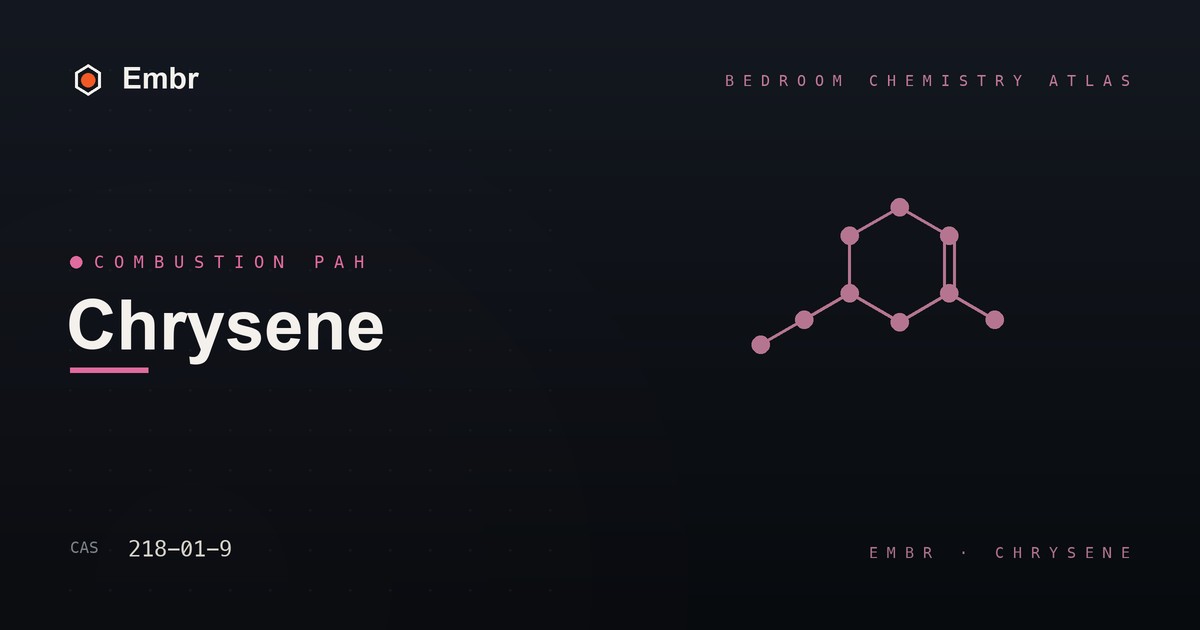
Chrysene is a four-ring alternant PAH. IARC evaluated it in Monograph Vol. 92 (2010) and classified it as Group 2B based on sufficient evidence of carcinogenicity in animals and inadequate evidence in humans. Chrysene has a bay region in its structure, which is associated with carcinogenic activity in PAHs, but its carcinogenic potency is weak compared to benzo[a]pyrene. The EU classifies chrysene as Carc. 1B (H350) under CLP, reflecting a more precautionary approach than IARC. Chrysene is one of the 8 priority PAHs restricted in consumer articles under REACH Annex XVII Entry 50.
Where it shows up in bedding
Chrysene is not an ingredient in bedding products. It enters bedrooms as part of combustion-derived particulate matter and settles in dust. Sources include fireplace and wood stove emissions, tobacco smoke (both secondhand and thirdhand residue on surfaces), and outdoor vehicle exhaust that infiltrates through windows and ventilation. Like other PAHs, chrysene exposure during sleep is primarily through dust ingestion and inhalation of resuspended particles.
The Embr Exposure Ledger: Chrysene
One chemical, several public questions, answered from independent datasets and joined here — the environment it shows up in, the body burden it carries, how it is regulated, and what actually reduces it.
Detection and body-burden figures are occurrence data, not a personal measurement or a health diagnosis. Part of the Embr Exposure Ledger — an open, cross-dataset chemical join (download the data), reusable with attribution.
Citations
- IARC (2010). Chrysene. IARC Monographs Vol. 92. Source Regulatory
- ATSDR (1995). Toxicological Profile for Polycyclic Aromatic Hydrocarbons (PAHs). Source Regulatory
- EU REACH Annex XVII, Entry 50 — PAHs in consumer articles. Source Regulatory
Frequently asked questions
How carcinogenic is chrysene?
IARC classifies chrysene as Group 2B (possibly carcinogenic). Its carcinogenic potency is weak compared to benzo[a]pyrene — the most potent common PAH. The EU takes a more precautionary approach, classifying chrysene as Carc. 1B. In practice, chrysene is one component of a PAH mixture from combustion, and overall cancer risk is driven primarily by the higher-potency PAHs in the mix.
Is chrysene restricted in mattresses?
Chrysene is one of the 8 priority PAHs restricted under EU REACH Annex XVII Entry 50 to 1 mg/kg in rubber and plastic components that come into prolonged or repeated skin contact. This applies to rubber and plastic parts of consumer articles. Chrysene in bedding is primarily a concern from combustion-derived dust contamination, not from the materials themselves.
Related compounds
Embr is a sleep environment company researching and addressing the chemistry of the bedroom. Research and product development in progress.
Last reviewed 2026-07-07. If you find a factual error, contact us.