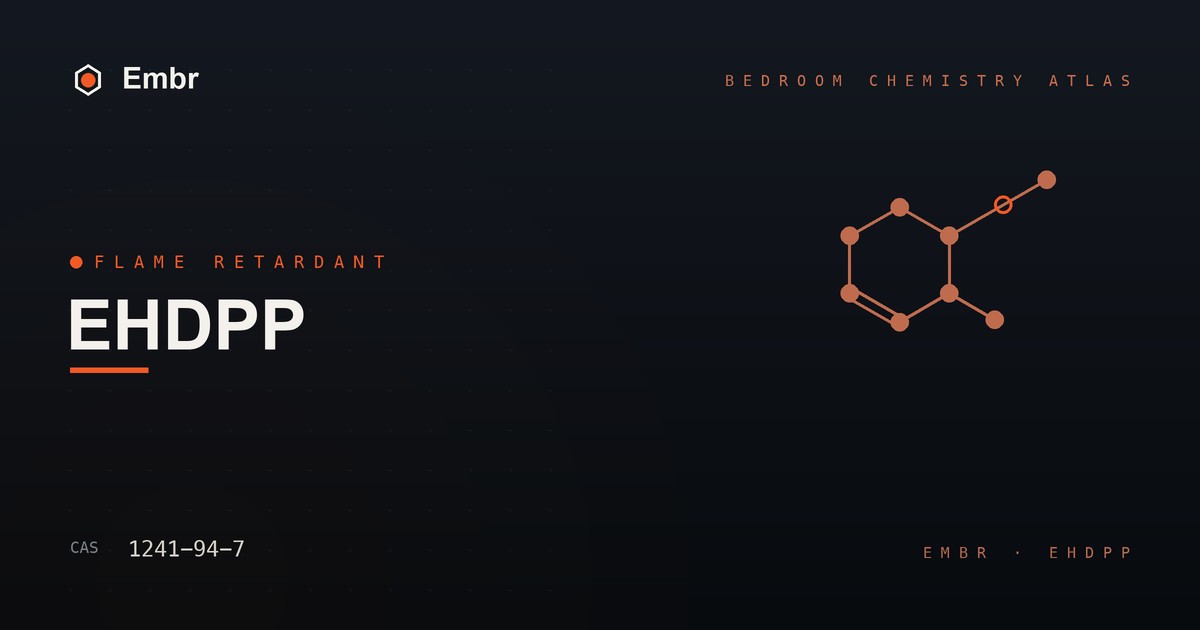
At a glance
| Chemical family | Organophosphate flame retardant and plasticizer (aryl phosphate ester) |
| CAS number | 1241-94-7 |
| Classification | Not classified by IARC. Endocrine-disrupting potential (estrogenic, anti-androgenic, thyroid effects in vitro). Not a carcinogen in available evidence |
| Where you encounter it | Polyurethane foam in furniture and mattresses; component of Firemaster 550; electronics housings; hydraulic fluids; house dust (rising concentrations) |
| Sleep micro-environment relevance | Found in house dust at increasing concentrations as PBDE replacements enter the furniture stock. Direct exposure from PU foam mattresses and upholstered furniture during sleep |
Regulatory & certification status
| European Union | REACH registered substance. Not currently on the SVHC candidate list but under assessment for endocrine-disrupting properties. No specific restriction in consumer products. Regulatory |
| United States | EPA included EHDPP in the OPFR Action Plan (2015) for further assessment. Not specifically restricted. Listed under TSCA inventory. Regulatory |
| Canada | Under assessment as part of the Chemicals Management Plan organophosphate FR grouping. Regulatory |
| International | Not IARC classified. Not a Stockholm Convention POP. Under increasing regulatory scrutiny as a PBDE replacement with endocrine-disrupting potential. Regulatory |
What it is
EHDPP is an aryl phosphate ester — an organophosphate compound used both as a flame retardant and a plasticizer in polyurethane foam, PVC, and other polymers. It is one of four main components of Firemaster 550 (along with TPHP, isopropylated triphenyl phosphate, and a brominated compound), the commercial FR mixture developed by Chemtura (now LANXESS) as a replacement for pentaBDE in flexible polyurethane foam. IARC has not evaluated EHDPP. The available toxicological evidence does not indicate carcinogenicity, but several in vitro studies have found that EHDPP can activate estrogen receptors, inhibit androgen receptors, and interfere with thyroid hormone signalling. The in vivo significance of these findings at human-relevant doses is not yet established.
Where it shows up in bedding
EHDPP enters the bedroom through polyurethane foam in mattresses, sofa cushions, and upholstered furniture that has been treated with Firemaster 550 or similar OPFR mixtures. As foam ages and degrades, EHDPP migrates to the surface and enters house dust. Multiple dust surveys in North American and European homes have detected EHDPP, with concentrations generally rising over the past decade as PBDE-treated foam is replaced. During sleep, exposure occurs through dust ingestion, dermal contact with dust on bedding surfaces, and inhalation of resuspended particles.
Where you meet Ehdpp across your home
The same compound turns up in more than one place you live. Here's where it shows up in Embr — each links to the full breakdown for that part of your home.
Citations
- Stapleton, H.M. et al. (2011). Identification of Flame Retardants in Polyurethane Foam Collected from Baby Products. Environmental Science & Technology, 46(24): 13432-13439. Source Peer-reviewed
- EPA (2015). Flame Retardants Used in Flexible Polyurethane Foam: An Alternatives Assessment Update. Source Regulatory
- ECHA. 2-Ethylhexyl diphenyl phosphate — Substance Information. Source Regulatory
Frequently asked questions
Is EHDPP a carcinogen?
EHDPP has not been classified as a carcinogen by IARC or other major agencies. The available evidence does not indicate carcinogenicity. The primary concern with EHDPP is endocrine disruption — in vitro studies have shown estrogenic, anti-androgenic, and thyroid-disrupting activity, though the significance at real-world human exposure levels is not yet established.
Why is EHDPP increasing in house dust?
EHDPP concentrations in house dust have been rising because it is a component of Firemaster 550 and similar OPFR mixtures that replaced the polybrominated diphenyl ethers (PBDEs) in flexible polyurethane foam. As older PBDE-treated furniture is replaced with OPFR-treated products, the chemical profile of house dust shifts from PBDEs to OPFRs including EHDPP.
Related compounds
Embr is a sleep environment company researching and addressing the chemistry of the bedroom. Research and product development in progress.
Last reviewed 2026-07-08. If you find a factual error, contact us.