At a glance
| Chemical family | Polycyclic aromatic hydrocarbon (PAH) — three-ring structure (contains a methylene bridge) |
| CAS number | 86-73-7 |
| Classification | IARC Group 3 (not classifiable as to carcinogenicity to humans); EPA Priority Pollutant |
| Where you encounter it | Coal tar, diesel exhaust, wood smoke, tobacco smoke, household dust; more volatile than heavier PAHs so partitions more to air than surfaces |
| Sleep micro-environment relevance | Found in indoor air and dust from combustion sources. Lower concern than heavier carcinogenic PAHs but part of the overall PAH exposure during sleep |
Regulatory & certification status
| European Union | Not individually restricted under REACH for consumer articles. Listed under the Water Framework Directive as a priority substance. Regulatory |
| United States | EPA Priority Pollutant. Clean Water Act listed. Regulatory |
| Canada | CEPA Schedule 1 as part of the PAH group. Regulatory |
| International | IARC Group 3 (not classifiable). One of the 16 EPA priority PAHs. Regulatory |
What it is
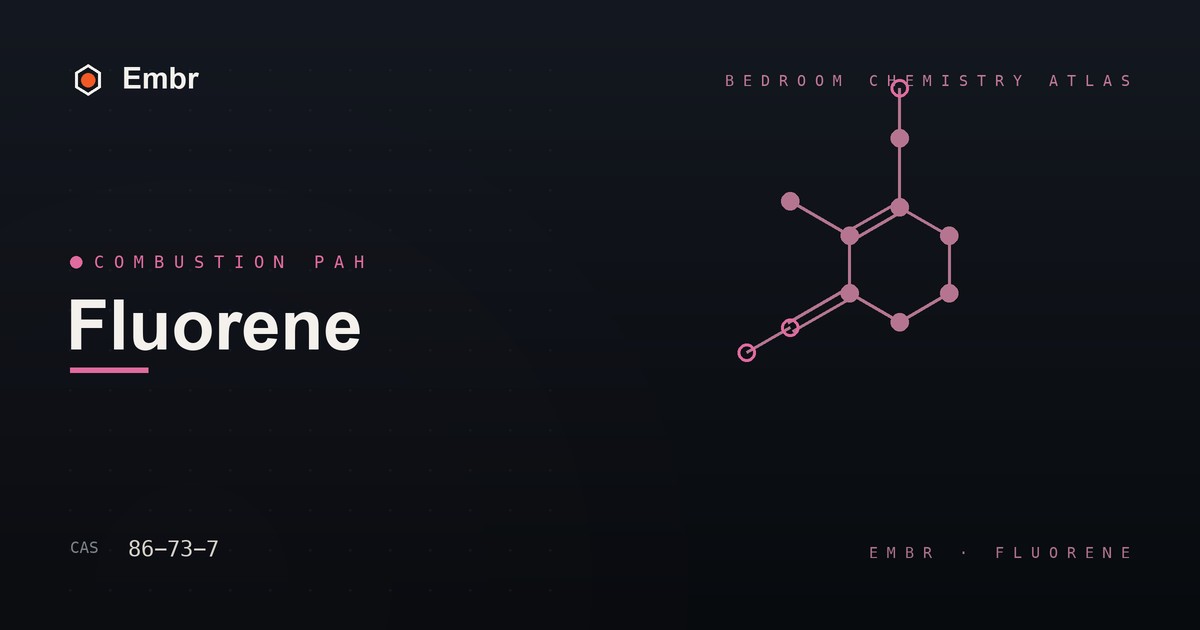
Fluorene is a three-ring PAH that is unusual in having a methylene (CH2) bridge connecting two benzene rings, making it technically a polycyclic aromatic compound rather than a pure benzenoid PAH. It is semi-volatile — lighter than pyrene or benzo[a]pyrene — and partitions between gas and particulate phases in air. IARC classified fluorene as Group 3 in 2010. Fluorene is not considered genotoxic or carcinogenic on its own. It is commonly used in the manufacture of dyes, plastics, and pesticides.
Where it shows up in bedding
Fluorene is not used in bedding. It enters indoor environments through combustion products: vehicle exhaust infiltration, wood and tobacco smoke, and cooking emissions. Because of its semi-volatile nature, fluorene is found both in air and in settled dust. Its relatively low molecular weight means it is metabolised and eliminated from the body more quickly than heavier PAHs. For the bedroom, fluorene is part of the PAH mixture but is not a priority concern on its own.
The Embr Exposure Ledger: Fluorene
One chemical, several public questions, answered from independent datasets and joined here — the environment it shows up in, the body burden it carries, how it is regulated, and what actually reduces it.
Detection and body-burden figures are occurrence data, not a personal measurement or a health diagnosis. Part of the Embr Exposure Ledger — an open, cross-dataset chemical join (download the data), reusable with attribution.
Citations
- IARC (2010). Some Non-Heterocyclic Polycyclic Aromatic Hydrocarbons. IARC Monographs Vol. 92. Source Regulatory
- ATSDR (1995). Toxicological Profile for Polycyclic Aromatic Hydrocarbons (PAHs). Source Regulatory
- EPA. Fluorene — Priority Pollutant Fact Sheet. Source Regulatory
Frequently asked questions
Is fluorene carcinogenic?
No. IARC classifies fluorene as Group 3 (not classifiable). It is not considered genotoxic or carcinogenic. Fluorene is a lighter PAH that is metabolised and eliminated from the body more quickly than the heavier carcinogenic PAHs.
How is fluorene different from fluoranthene?
Despite the similar names, fluorene and fluoranthene are different compounds. Fluorene is a three-ring PAH with a methylene bridge (CAS 86-73-7). Fluoranthene is a four-ring PAH (CAS 206-44-0). Fluoranthene is more abundant in the environment and more persistent. Both are Group 3 (not carcinogenic).
Related compounds
Embr is a sleep environment company researching and addressing the chemistry of the bedroom. Research and product development in progress.
Last reviewed 2026-07-07. If you find a factual error, contact us.