At a glance
| Chemical family | Ultrashort-chain perfluoroalkyl carboxylic acid (PFCA) — the three-carbon (C3) PFCA, one homolog up from trifluoroacetic acid (TFA, the C2 acid). A fully fluorinated two-carbon tail (C₂F₅–) on a carboxylic-acid head; behaves as a strong acid, so in water it is present almost entirely as the perfluoropropanoate anion — exceptionally water-soluble and mobile |
| CAS number | 422-64-0 (perfluoropropanoic acid, PFPrA; also perfluoropropionic acid / pentafluoropropanoic acid; anion: perfluoropropanoate). PubChem CID 62356 |
| IUPAC name & formula | 2,2,3,3,3-pentafluoropropanoic acid; molecular formula C₃HF₅O₂ (i.e. C₂F₅COOH); molar mass 164.03 g/mol |
| Classification | Not individually classified. Not evaluated by IARC; no compound-specific CLP or hazard classification exists. Excluded from EPA drinking-water Methods 537.1 and 533 and from the 29 analytes of UCMR 5; outside the EU Drinking Water Directive sum-of-20; captured only group-wise by the proposed 2023 EU-wide universal PFAS restriction (still under evaluation). No hazard tier is assigned here by analogy to PFOA or PFOS |
| Where you encounter it | Drinking water and the wider water cycle. One of the ultrashort PFAS (with TFA and trifluoromethanesulfonate) that increasingly dominate total PFAS mass in tap water yet fall off standard monitoring panels. NOT a bedroom off-gas, mattress, or foam emission — in water it is a non-volatile anion with no established indoor-air or consumer-textile pathway |
| Removal / activated-carbon capture | Poorly removed. Ordinary granular activated carbon (GAC) and point-of-use anion-exchange remove ultrashort PFCAs poorly (the shortest chains break through first and fastest). Reverse osmosis / nanofiltration is the only point-of-use approach shown to reduce them meaningfully — best available, not perfect. Peer-reviewed — treatment performance from the ultrashort-PFAS water literature |
Regulatory & certification status
Where PFPrA stands across the major regulatory systems and the certifications a bedroom product might carry. The recurring theme is absence: PFPrA is rarely named on its own, and where a jurisdiction has no specific measure that is stated plainly rather than left blank. It is not assigned a hazard tier by analogy to the legacy long-chain PFAS.
| European Union | Not individually classified or restricted. Like TFA, PFPrA is ultrashort and falls outside the EU Drinking Water Directive's sum-of-20 PFAS parameter, so routine EU drinking-water compliance does not capture it. It has no harmonised CLP classification and no substance-specific REACH restriction; it would be caught only group-wise by the proposed EU-wide universal PFAS restriction (submitted 2023, still under evaluation, not adopted). Regulatory — ECHA · EU DWD |
| United States | No federal drinking-water standard. PFPrA is not an analyte of EPA Methods 537.1 or 533 and is not among the 29 PFAS in UCMR 5, so it is invisible to the main national monitoring programs. The 2024 PFAS National Primary Drinking Water Regulation sets enforceable limits for PFOA, PFOS, PFHxS, PFNA, HFPO-DA (GenX) and PFBS — not PFPrA. It is not on the California Proposition 65 list. Regulatory — US EPA UCMR · EPA PFAS |
| Canada | Not individually regulated. Health Canada's drinking-water approach uses a summed objective (0.03 µg/L for the sum of PFAS) rather than per-compound limits, so PFPrA is not named on its own; whether ultrashort acids like PFPrA are captured depends on the analytical method used, and there is no PFPrA-specific Canadian standard. Environment and Climate Change Canada's State of PFAS assessment treats PFAS as a class. Regulatory — Health Canada |
| Australia | Not individually regulated. The Australian Drinking Water Guidelines derive values for a small set of PFAS (PFOA, PFOS, PFHxS, PFBS in the 2025 update); ultrashort PFCAs such as PFPrA are not among the guideline analytes, and there is no PFPrA-specific Australian value. PFAS more broadly are subject to AICIS information-gathering. Regulatory — NHMRC ADWG · AICIS |
| United Kingdom | Not individually classified. GB/UK REACH captures PFAS group-wise, and the Drinking Water Inspectorate applies a tiered guideline to a defined suite of individual PFAS; ultrashort PFPrA sits outside that routinely monitored suite, and there is no PFPrA-specific GB standard. Regulatory — DWI · HSE |
| Certifications | None address it. CertiPUR-US and GREENGUARD/GREENGUARD Gold are foam and low-VOC-emissions programs — they do not screen for a non-volatile waterborne acid. OEKO-TEX Standard 100's total-fluorine screen targets residual PFAS in textiles, not a drinking-water contaminant. No bedroom-product certification meaningfully covers PFPrA, because PFPrA is not a product-borne exposure. Industry — CertiPUR-US · OEKO-TEX |
| The 72-hour test window | Missed entirely. PFPrA is a non-volatile, water-soluble anion, not an off-gassing VOC, so a short ~72-hour emissions-chamber test cannot capture it. It is a drinking-water contaminant measured by targeted aqueous LC-MS/MS, not a bedroom air emission. Inferred — from the compound's non-volatile profile versus the VOC focus of short chamber tests |
What it is
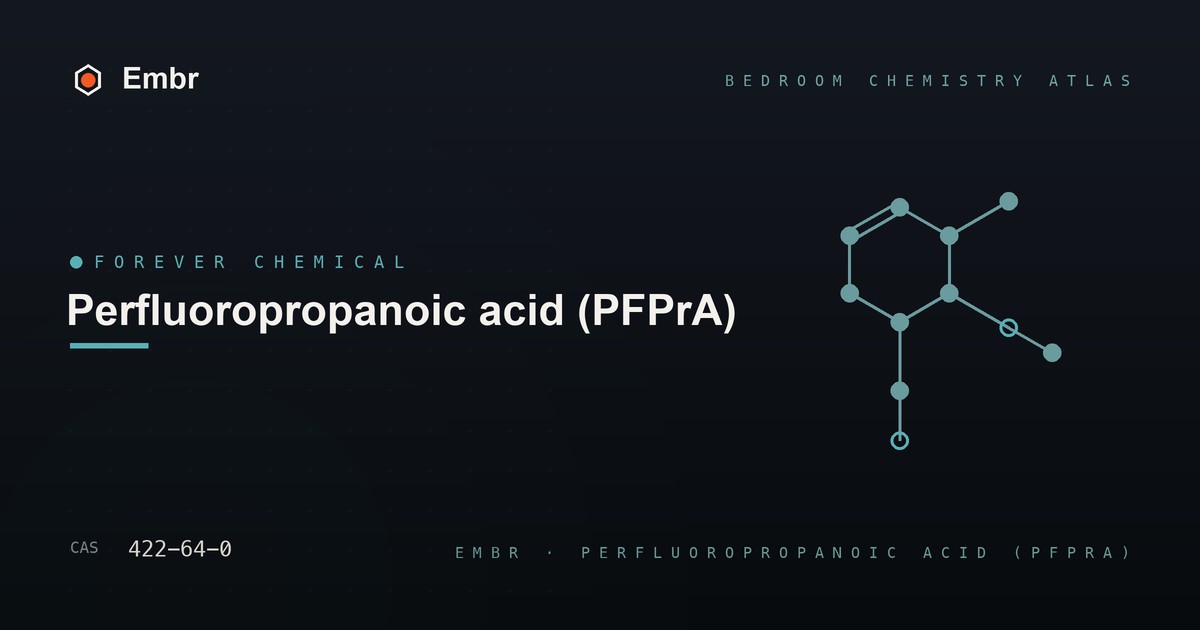
Perfluoropropanoic acid — PFPrA, also called perfluoropropionic or pentafluoropropanoic acid — is the three-carbon member of the perfluoroalkyl carboxylic acid (PFCA) family: a fully fluorinated two-carbon tail (C₂F₅–) capped by a carboxylic-acid group, molecular formula C₃HF₅O₂, molar mass 164.03 g/mol. It is an ultrashort-chain PFAS — the next homolog up from trifluoroacetic acid (TFA), the two-carbon PFCA. Like every PFAS it is built on carbon–fluorine bonds that essentially do not break down in the environment, so it is extremely persistent.
It is also a strong acid: in water it exists almost entirely as the perfluoropropanoate anion, which makes it exceptionally water-soluble and mobile. Those two traits — persistence plus mobility — are what set the ultrashort PFAS apart from the legacy long-chain compounds. PFPrA does not cling to soils or sorbents the way PFOA and PFOS do; it travels with the water. And it travels alongside TFA, the two acids together forming the ultrashort fraction that increasingly dominates total PFAS mass in the water cycle. Because there is no authoritative toxicological classification for PFPrA specifically, this page keeps its health framing narrow: it is a persistence-and-exposure story and a monitoring story, not a hazard-by-analogy story.
Where you encounter it
A water contaminant, not a bedroom off-gas
Most of the Bedroom Chemistry Atlas is about what your mattress, foam, or bedding releases into the air around you overnight. PFPrA is not one of those things. In the anion form it takes in water it has essentially no volatility, and there is no established indoor-air or consumer-textile emission pathway for it. It is worth being blunt about this because it is exactly the kind of compound that gets swept up by loose "PFAS in your mattress" claims: PFPrA is real and it is a PFAS, but it is not something your bed emits. We include it because the chemistry of the sleep environment includes the water you drink, and because PFPrA is a specific, well-documented gap in how that water is monitored.
The monitoring blind spot
The honest framing is a measurement gap. PFPrA is one of a small group of ultrashort PFAS — with TFA and trifluoromethanesulfonate (triflate) — that are frequently the single most abundant PFAS in a water sample, yet are excluded from the standard analytical panels regulators depend on. It is not in EPA drinking-water Methods 537.1 or 533, not among the 29 analytes of UCMR 5, and it falls outside the EU Drinking Water Directive's sum-of-20. The practical consequence is direct: a routine water report can read "PFAS below the limit" while PFPrA is the dominant PFAS actually present — because the method never looked for it. That is a different kind of risk from the off-gassing chemistry elsewhere in this Atlas. The question here is not "what is my mattress emitting?" but "what is my water report not measuring?"
What the research says
Frequently the most-detected PFAS on the panels that look for it
Pelch, McKnight and Reade 2023, in Science of the Total Environment, ran a community-led US pilot: a 70-analyte method plus the total-oxidizable-precursor (TOP) assay across 44 tap-water samples from 16 states. PFAS turned up in 30 of the 44 samples, and PFPrA had the highest detection frequency of any analyte — positive in 24 of the 30 — and was the highest-concentration PFAS in 15 of them. Peer-reviewed Twelve of the 26 PFAS the study found sit outside EPA Methods 537.1/533, and every positive sample held at least one PFAS that UCMR 5 would miss. The study is a clean demonstration of the blind spot: the compound most often present was one the standard methods do not report.
The ultrashort trio can be nearly all of the PFAS present
Neuwald and colleagues 2022, in Environmental Science & Technology, measured 13 German drinking-water sources and found the ultrashort trio (trifluoroacetate, perfluoropropanoate, and trifluoromethanesulfonate) made up 98% of total target PFAS, while adsorbable/total-organofluorine "PFAS-total" sum parameters failed to capture them. Peer-reviewed The authors' own summary of the ultrashort acids as prevalent, overlooked, difficult to remove, and unregulated is a fair description of PFPrA's status. Sadia and colleagues 2023, also in Environmental Science & Technology, found ultrashort PFAS dominated 18 Dutch raw and produced drinking waters at 300–1,100 ng/L (versus 0.4–95.1 ng/L for the longer C≥4 PFCAs), showed no significant difference between surface and groundwater (a groundwater blind spot, since these compounds reach aquifers readily), and saw advanced treatment occasionally produce "negative removal." Peer-reviewed
Under-counted even by the total-fluorine assays meant to catch the unknowns
When targeted methods miss a compound, analysts fall back on total-organofluorine assays to estimate the un-targeted PFAS burden. Those fail for PFPrA too. Pan and Helbling 2023, in Water Research, showed that adsorbable organofluorine (AOF) recovers ultrashort acids at only ~9–25%, and extractable organofluorine (EOF) at ~21–52%. Peer-reviewed So PFPrA is under-measured twice over: off the targeted panels, and poorly recovered even by the total-organofluorine methods designed to catch what the panels miss. Any statement about how much PFPrA is in the water supply is therefore, almost by construction, a floor rather than a true figure.
What helps
For PFPrA specifically, the only point-of-use treatment shown to reduce ultrashort PFAS meaningfully is reverse osmosis (or nanofiltration). Membrane systems reject a large fraction of the ultrashort acids in situations where sorbent-based filters fail. Two caveats keep this honest: performance on the very shortest chains is lower than on legacy long-chain PFAS, and Sadia 2023 documented occasional "negative removal" across treatment steps, so reverse osmosis is best available rather than perfect. Because PFPrA is so mobile and so poorly sorbed, the larger lever sits upstream: reducing sources and protecting source water matters more than any household filter short of RO. If you are already treating for PFAS at the tap and PFPrA is a concern in your region, a certified point-of-use reverse-osmosis system is the intervention with actual evidence behind it.
What does NOT help
- Ordinary carbon (GAC) pitchers and cartridges. Granular activated carbon removes long-chain PFAS reasonably but performs poorly on ultrashort acids, which break through first and fastest. Peer-reviewed — Neuwald 2022, Sadia 2023
- Point-of-use anion-exchange (AIX) resins. Same pattern — the very short chains are the first to break through, so AIX is not a reliable fix for PFPrA.
- Conventional municipal treatment. Coagulation, sand filtration, and chlorination remove essentially none of it.
- Boiling. Does nothing to PFAS and can concentrate it as water evaporates into a smaller volume.
- A clean routine PFAS panel. Not a treatment, but worth stating: "below the limit" on a standard method does not mean PFPrA is absent — the method does not include it.
Open research questions
- Toxicology is sparse. There is no IARC or other authoritative classification for PFPrA and little compound-specific human data; its health significance should not be assumed from PFOA or PFOS by analogy. Speculation — not individually classified; class-analogy explicitly avoided
- The monitoring blind spot means true prevalence is unknown. Because PFPrA is off every routine panel and poorly recovered even by AOF/EOF/TOP, its real occurrence and its total contribution to human PFAS burden are systematically under-measured. Inferred from the recovery and method-coverage findings above
- Sources and trends are under-quantified. Atmospheric degradation of fluorinated gases and refrigerants, fluoropolymer manufacturing, and precursor breakdown all plausibly contribute, and whether PFPrA is rising like TFA is not well studied. Speculation
- Groundwater protection. Sadia's finding of no surface-versus-groundwater difference implies ready aquifer reach; the long-term implications for groundwater-sourced supplies are not yet characterized. Inferred from the observed groundwater occurrence
The Embr Exposure Ledger: Perfluoropropanoic acid (PFPrA)
One chemical, several public questions, answered from independent datasets and joined here — the environment it shows up in, the body burden it carries, how it is regulated, and what actually reduces it.
Detection and body-burden figures are occurrence data, not a personal measurement or a health diagnosis. Part of the Embr Exposure Ledger — an open, cross-dataset chemical join (download the data), reusable with attribution.
Where you meet Pfpra across your home
The same compound turns up in more than one place you live. Here's where it shows up in Embr — each links to the full breakdown for that part of your home.
What actually reduces your exposure
- PFPrA is a drinking-water and environmental exposure, not a mattress off-gas.
- A 'PFAS below the limit' water report does not rule it out — it is excluded from the standard panels.
- Only reverse osmosis reliably removes ultrashort-chain PFAS; standard carbon pitcher/faucet filters do little.
How it’s regulated, by region
| Region | Status | Detail |
|---|---|---|
| United States (EPA) | Unregulated | No MCL; excluded from EPA Methods 537.1/533 and the UCMR 5 monitoring list. |
| European Union | Unregulated (excluded) | Excluded from the Drinking Water Directive 'sum of 20 PFAS'; captured only by the in-progress 2023 EU universal PFAS restriction at the class level. |
Citations
- Pelch KE, McKnight T, Reade A (2023). 70 analyte PFAS test method highlights need for expanded testing of PFAS in drinking water. Science of the Total Environment, 876:162978. DOI 10.1016/j.scitotenv.2023.162978 Peer-reviewed — PFPrA highest detection frequency, off standard panels
- Neuwald IJ, Hübner D, Wiegand HL, Valkov V, Borchers U, Nödler K, Scheurer M, Hale SE, Arp HPH, Zahn D (2022). Ultra-short-chain PFAS in the sources of German drinking water: prevalent, overlooked, difficult to remove, and unregulated. Environmental Science & Technology, 56(10):6380–6390. DOI 10.1021/acs.est.1c07949 Peer-reviewed — ultrashort trio 98% of total target PFAS
- Sadia M, Nollen I, Helmus R, ter Laak TL, Bäuerlein P, Rosier A, van Wezel AP (2023). Occurrence, fate, and related health risks of PFAS in raw and produced drinking water. Environmental Science & Technology, 57(8):3062–3074. DOI 10.1021/acs.est.2c06015 Peer-reviewed — 300–1,100 ng/L, groundwater blind spot, negative removal
- Pan Y, Helbling DE (2023). Revealing the factors resulting in incomplete recovery of perfluoroalkyl acids (PFAAs) when implementing the adsorbable organofluorine (AOF) method. Water Research, 244:120497. DOI 10.1016/j.watres.2023.120497 Peer-reviewed — AOF/EOF under-recover ultrashort PFAS
- National Center for Biotechnology Information (2026). PubChem Compound Summary for CID 62356, perfluoropropionic acid (PFPrA), CAS 422-64-0 — identity, structure and physicochemical identifiers. pubchem.ncbi.nlm.nih.gov Spec — compound identity only
Frequently asked questions
Does my mattress or bedroom release PFPrA into the air?
No. Perfluoropropanoic acid (PFPrA) is not a mattress or foam off-gas and has no established indoor-air or consumer-textile emission pathway. In water it exists almost entirely as the non-volatile perfluoropropanoate anion. Its relevance to the sleep environment is through drinking water, which is why we treat it as a monitoring blind spot rather than an off-gassing chemical. Most of the Bedroom Chemistry Atlas covers what your mattress emits into the air you breathe overnight; PFPrA is the exception that belongs to the water side of the sleep environment.
If my water report says PFAS are below the limit, could PFPrA still be present?
Yes. PFPrA is excluded from EPA drinking-water Methods 537.1 and 533, it is not one of the 29 analytes in UCMR 5, and it falls outside the EU Drinking Water Directive's sum-of-20 PFAS parameter. Because the standard methods do not look for it, a routine panel can read "PFAS below the limit" while PFPrA is the single most abundant PFAS actually present. In one German study the ultrashort trio that includes PFPrA was 98% of the total PFAS measured, yet standard sum parameters failed to capture it. A clean routine result does not rule PFPrA out.
Do water filters remove PFPrA?
Most do not. Ordinary granular activated carbon (GAC) pitchers and cartridges and point-of-use anion-exchange resins remove ultrashort PFAS poorly; the very short chains break through first and fastest. Reverse osmosis (or nanofiltration) is the only point-of-use approach shown to meaningfully reduce ultrashort acids like PFPrA, and even that is best available rather than perfect: performance on the shortest chains is lower than on legacy long-chain PFAS, and one study observed occasional negative removal across treatment steps. Boiling does nothing and can concentrate PFAS as water evaporates.
How is PFPrA related to TFA and the legacy forever chemicals?
PFPrA is the three-carbon (C3) perfluoroalkyl carboxylic acid, the next homolog up from trifluoroacetic acid (TFA), the two-carbon (C2) acid. The two are the dominant ultrashort PFAS and are usually found together at the highest concentrations. Like all PFAS they are extremely persistent because of their carbon-fluorine bonds, but their very short chains make them more water-soluble and mobile than legacy PFOA and PFOS, which makes them both harder to remove and harder to monitor. PFPrA has no individual hazard classification, so its health significance should not be assumed from PFOA or PFOS by analogy.
Related compounds
Embr is a sleep environment company researching the chemistry of the bedroom. See the methodology page for how this Atlas tags claims by evidence strength. For broader context on PFAS exposure pathways, see the 2026 PFAS brief and the water filters compared guide.
Last reviewed 2026-07-14. If you find a factual error, contact us.