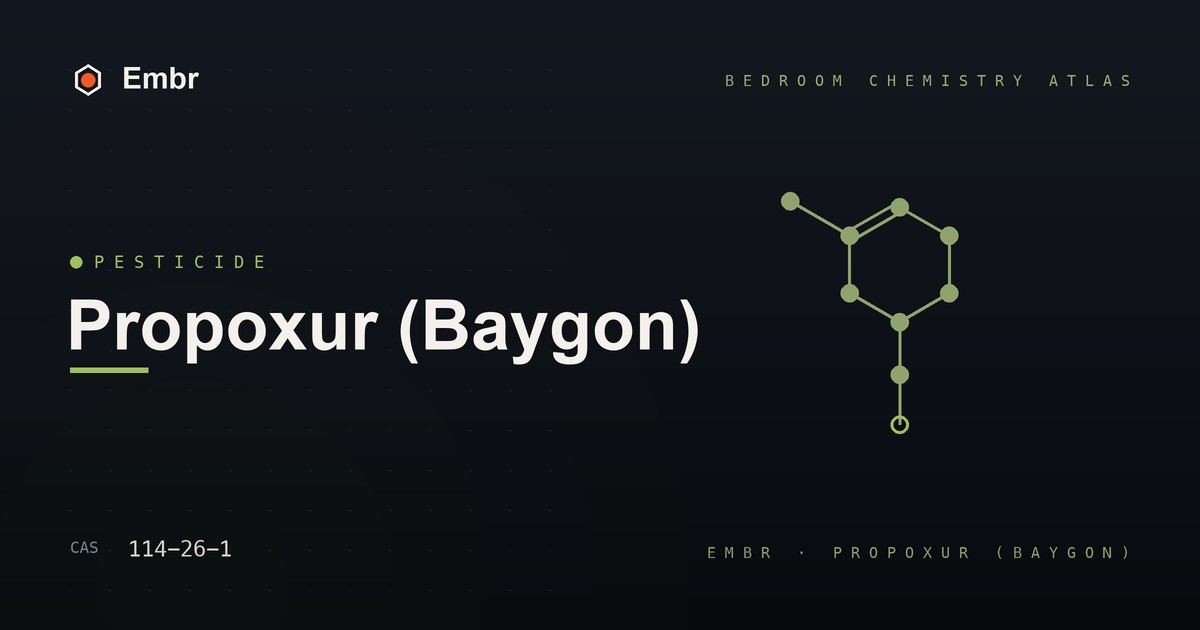
At a glance
| Chemical family | Carbamate — N-methylcarbamate insecticide (2-isopropoxyphenyl methylcarbamate) |
| CAS number | 114-26-1 |
| Classification | IARC Group 2B (possibly carcinogenic to humans, Monographs Vol. 53, 1991). Reversible acetylcholinesterase inhibitor. WHO Class II (moderately hazardous). EPA cancelled most US residential uses |
| Where you encounter it | Cockroach sprays (Baygon); some bed bug and ant products; professional pest control; house dust in treated homes; still available in many non-US markets |
| Sleep micro-environment relevance | Applied directly in bedrooms for cockroach and bed bug control. Found in house dust after application. IARC Group 2B classification makes it one of the higher-concern residential pesticides |
Regulatory & certification status
| European Union | Not approved as a plant protection product. Not authorised for biocidal use. Effectively banned in the EU. Regulatory |
| United States | EPA cancelled most residential uses. Denied a 2013 petition to register propoxur for indoor total-release foggers (citing cancer risk). Some limited professional pest control uses may remain. California: listed under Proposition 65 as a carcinogen (effective 2006). Regulatory |
| Canada | PMRA cancelled most residential uses. Re-evaluation completed. Regulatory |
| International | IARC Group 2B (possibly carcinogenic, Monographs Vol. 53, 1991). WHO Class II (moderately hazardous). Still available as Baygon in many non-US markets. Regulatory status varies widely by country. Regulatory |
What it is
Propoxur is a carbamate insecticide that acts by reversibly inhibiting acetylcholinesterase. It was developed by Bayer and marketed globally under the trade name Baygon for household pest control — particularly against cockroaches. IARC evaluated propoxur in 1991 and classified it as Group 2B (possibly carcinogenic) based on limited evidence of carcinogenicity in animals and inadequate evidence in humans. Tumours observed in animal studies included forestomach tumours in mice and urinary bladder tumours in male rats. Propoxur was widely used in indoor pest control for decades, including in cockroach baits, aerosol sprays, and crack-and-crevice treatments applied in kitchens and bedrooms. The EPA denied a petition to register propoxur for indoor use in total-release foggers in 2013, and most residential uses have been cancelled.
Where it shows up in bedding
Propoxur enters the bedroom directly through pest control application. Cockroach sprays and crack-and-crevice treatments containing propoxur are applied to baseboards, bed frame joints, and room perimeters in bedrooms with cockroach infestations. Some bed bug treatment products also contain propoxur. After application, propoxur residues persist on surfaces and redistribute to house dust. In homes where Baygon or similar products have been used, propoxur is detectable in dust samples for weeks to months. Studies of pesticide exposure in low-income housing have found propoxur among the most commonly detected insecticides in indoor environments, particularly in urban apartments with cockroach infestations.
The Embr Exposure Ledger: Propoxur (Baygon)
One chemical, several public questions, answered from independent datasets and joined here — the environment it shows up in, the body burden it carries, how it is regulated, and what actually reduces it.
Detection and body-burden figures are occurrence data, not a personal measurement or a health diagnosis. Part of the Embr Exposure Ledger — an open, cross-dataset chemical join (download the data), reusable with attribution.
Citations
- IARC (1991). Propoxur. IARC Monographs Vol. 53. Source Regulatory
- EPA (2013). Denial of Petition for Registration of Propoxur for Indoor Use in Total Release Foggers. Source Regulatory
- Whyatt, R.M. et al. (2002). Residential Pesticide Use During Pregnancy among a Cohort of Urban Minority Women. Environmental Health Perspectives, 110(5): 507-514. Source Peer-reviewed
Frequently asked questions
Is Baygon still available?
Baygon (containing propoxur) has been largely withdrawn from the US market after EPA cancelled most residential uses. However, it remains available in many countries outside the US and EU, particularly in tropical regions where cockroach control is a significant household need. If you have Baygon products from international travel or import, be aware of the IARC Group 2B classification.
Why is propoxur classified as a possible carcinogen?
IARC classified propoxur as Group 2B in 1991 based on limited evidence from animal studies — forestomach tumours in mice and urinary bladder tumours in male rats. The evidence in humans was inadequate (neither confirming nor ruling out carcinogenicity). Group 2B means 'possibly carcinogenic to humans' — a lower level of concern than Group 2A (probably) or Group 1 (carcinogenic), but sufficient for regulatory agencies to restrict residential use.
Related compounds
Embr is a sleep environment company researching and addressing the chemistry of the bedroom. Research and product development in progress.
Last reviewed 2026-07-08. If you find a factual error, contact us.