At a glance
| Chemical family | A cyclic ether and volatile organic compound; here, a trace byproduct contaminant of ethoxylated personal-care and cleaning ingredients |
| CAS number | 123-91-1 |
| Classification | IARC Group 2B (possibly carcinogenic); US EPA "likely human carcinogen"; NTP "reasonably anticipated to be a human carcinogen" |
| Where you encounter it | Unlabeled contaminant in shampoos, body washes, bubble bath, liquid soaps, and laundry/dish detergents; also a drinking-water contaminant |
| Sleep micro-environment relevance | Rinse-off product residue on skin (and shower inhalation), plus laundry-detergent residue on bedding; not an intentional ingredient, so never on the label |
| Activated carbon capture | Not the personal lever — product choice (sulfate/PEG-free) and the ingredient label-cues are what reduce it |
Regulatory & certification status
Where 1,4-Dioxane stands across the major regulatory systems and the certifications a bedroom product might carry. Each row links to the governing instrument; where a jurisdiction has no specific measure, that is stated plainly rather than left blank.
| European Union | REACH Substance of Very High Concern, added to the Candidate List on 8 July 2021 on the basis of its carcinogenicity (Article 57(a)). It has a harmonised CLP classification in Annex VI to Regulation (EC) No 1272/2008 (index 603-024-00-5), updated by Commission Delegated Regulation (EU) 2021/849 (17th ATP): Carc. 1B (H350), Flam. Liq. 2, STOT SE 3 and Eye Irrit. 2. It is not on the Authorisation List (Annex XIV). A REACH Annex XVII restriction targeting 1,4-dioxane as a constituent or impurity in surfactants has been proposed (Germany; ECHA call for evidence 2023, dossier expected later), but is not yet adopted. Regulatory — EUR-Lex · ECHA |
| United States | Under federal TSCA, EPA published a final risk evaluation and, on 14 November 2024, a final supplement and revised unreasonable-risk determination concluding that 1,4-dioxane presents an unreasonable risk to human health (cancer and non-cancer risks to workers and occupational non-users, and cancer risk to the general population via drinking water); risk-management rulemaking under TSCA section 6(a) is the required next step. Separately, it is listed under California Proposition 65 as a carcinogen (cancer endpoint), listed 1 January 1988 via the State's Qualified Experts mechanism, with a No Significant Risk Level (NSRL) of 30 µg/day. Regulatory — Federal Register · OEHHA |
| Canada | The 2010 final screening assessment under the Chemicals Management Plan (Challenge, Batch 7) concluded that 1,4-dioxane does NOT meet the criteria in section 64 of CEPA 1999, and it was therefore not added to Schedule 1 (List of Toxic Substances); it is not a CEPA Schedule 1 toxic substance. Health Canada has since published a Guideline for Canadian Drinking Water Quality with a maximum acceptable concentration of 0.050 mg/L (50 µg/L). Note that this 2010 Canadian conclusion predates and contrasts with the U.S. EPA's 2024 unreasonable-risk determination. Regulatory — Government of Canada |
| Australia | 1,4-Dioxane is listed on the Australian Inventory of Industrial Chemicals and has been assessed under the industrial-chemicals scheme (as Priority Existing Chemical No. 7 in 1998 under NICNAS, and subsequently via AICIS, with an evaluation statement dated 30 June 2022). On the basis of that assessment it carries a hazard classification of Carcinogen Category 2 (H351, 'suspected of causing cancer') on the Hazardous Chemical Information System (HCIS) — a less severe category than the EU's Carc. 1B. Regulatory — AICIS |
| United Kingdom | Under GB CLP, 1,4-dioxane (index 603-024-00-5) carries a legally binding harmonised carcinogen classification on the GB Mandatory Classification and Labelling (GB MCL) list, inherited from the EU CLP harmonised classifications the UK retained at the end of the Brexit transition. Whether the GB list currently reflects the EU's Carc. 1B (H350) classification or an earlier retained category could not be confirmed against a primary HSE source, so the exact category is left partial. Regulatory — HSE |
| International | The International Agency for Research on Cancer (IARC) classifies 1,4-dioxane in Group 2B (possibly carcinogenic to humans) — most fully evaluated in IARC Monographs Volume 71 (1999) — on the basis of sufficient evidence of carcinogenicity in experimental animals and inadequate evidence in humans. It is not listed under the Stockholm Convention (POPs) or the Minamata Convention, consistent with its volatility, water-solubility and low bioaccumulation potential. Regulatory — IARC Monographs |
| Certifications | CertiPUR-US: 1,4-dioxane is not named in the foam program rules, which instead prohibit/limit ozone depleters, PBDEs, mercury/lead/heavy metals, formaldehyde, CMR-classified flame retardants, CPSC-regulated phthalates and high VOC emissions. OEKO-TEX STANDARD 100: 1,4-dioxane was added to the limit-value catalogues (Annex 4 and 6) as an SVHC solvent in the 2024 regulations (in force 1 April 2024), though the specific numeric limit value could not be confirmed from the published standard. GREENGUARD/GREENGUARD Gold: a low-VOC emissions certification (CDPH/Section 01350 chamber method) that screens individual VOCs against health-based levels; 1,4-dioxane, being volatile, falls within the class of compounds such a method can in principle capture, but it is not confirmed as a specifically named target analyte. Industry — CertiPUR-US · OEKO-TEX |
| The 72-hour test window | Well captured. 1,4-Dioxane is a genuine volatile organic compound (boiling point ~101 C, vapour pressure ~38 mmHg at 25 C, fully miscible with water), so it off-gasses and a short ~72h chamber VOC emissions test can detect it — unlike non-volatile additives that only migrate into dust. Inferred — from the compound's volatility/emission profile versus the VOC focus of short chamber tests |
What it is
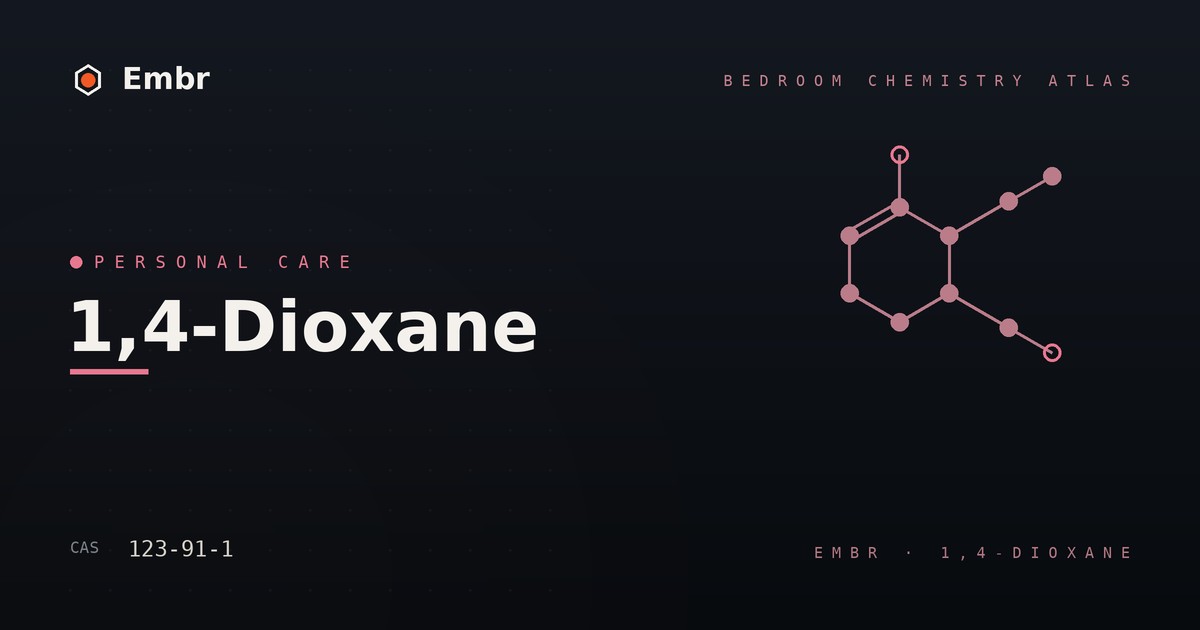
1,4-Dioxane is a small cyclic ether — a clear, faintly sweet-smelling liquid that mixes readily with water. In a sleep-environment context, what matters is not how it is used but how it is made: it is not an ingredient deliberately added to any product, but a byproduct that forms during ethoxylation, the manufacturing step that turns harsh surfactants into the mild, foaming ones used in shampoos and washes. Regulatory — NY DEC 1,4-Dioxane Law Because it is a contaminant rather than an intentional ingredient, it is not required to appear on the label — which is precisely why it slips past most people.
Its hazard standing is consistent across agencies: IARC classifies it Group 2B (possibly carcinogenic), the US EPA calls it a likely human carcinogen, and the National Toxicology Program lists it as reasonably anticipated to be a human carcinogen, based on liver tumors in animal studies. Regulatory — NY DEC 1,4-Dioxane Law
How it relates to the bedroom
Hidden in the products — and the detergent
1,4-Dioxane reaches the bedroom through the everyday cleaning chemistry around it. It is present in shampoos, body washes, bubble bath and liquid soaps built on ethoxylated surfactants — FDA surveys found it up to 279 ppm in finished cosmetics and above 85 ppm even in children's shampoos. Peer-reviewed — Black et al. 2001 The distinctively bedroom-relevant source is laundry detergent: it too is built on these surfactants, and detergent residue remains in laundered sheets and sleepwear that press against skin all night. Rinse-off products leave a small skin residue, and because 1,4-dioxane is volatile, a warm shower puts some into the air you breathe. Inferred — ethoxylated-surfactant products including laundry detergent are dioxane sources; detergent residue persists in washed bedding
The honest exposure picture
Calibration matters here, in both directions. On one hand, the levels in products are small — parts per million — and a probable rather than proven human carcinogen. On the other, it is a genuinely avoidable, unlabeled carcinogen exposure, which is why it has drawn regulation. And the most honest point is one of proportion: for people whose tap water is contaminated, drinking water — not personal-care products — usually dominates total 1,4-dioxane exposure, contributing the large majority of intake. Peer-reviewed — Dawson et al. 2022 So products are a real but often secondary lever — worth pulling, especially for children, while keeping the bigger picture in view.
Regulation is now moving it
This is one area where policy is actively shrinking the exposure. New York became the first US state to cap 1,4-dioxane in products: a 2 ppm limit in household cleansing and personal-care products from the end of 2022, tightening to 1 ppm a year later, and 10 ppm in cosmetics. Regulatory — NY DEC 1,4-Dioxane Law Because manufacturers reformulate for the whole market rather than one state, those limits pull product levels down nationally. Inferred — single-market reformulation tends to lower levels broadly
What the research says
- Group 2B / likely carcinogen, unlabeled. A manufacturing byproduct, not an ingredient, so absent from labels. Regulatory — NY DEC
- Real levels in products. Up to 279 ppm in finished cosmetics; over 85 ppm in some children's shampoos. Peer-reviewed — Black et al. 2001
- Water often dominates total exposure. Where tap water is contaminated, it provides most intake. Peer-reviewed — Dawson et al. 2022
- Now regulated in products. New York's 1 ppm limit is pulling the market lower. Regulatory — NY DEC
What helps reduce it
Read for the label cues. Sodium laureth sulfate, "PEG", "polyethylene glycol", "-eth-", "-oxynol-" mark the ingredients under which dioxane forms; sulfate-free and PEG-free products avoid that chemistry. Regulatory — NY DEC 1,4-Dioxane Law
Prioritize children's bath products and your detergent. These are the highest-relevance items for a sleeper, and where cleaner choices pay off most. Peer-reviewed — Black et al. 2001
If your tap water is affected, address that first. Where water is contaminated it is the bigger exposure; certified filtration targets it. Peer-reviewed — Dawson et al. 2022
What does NOT help
- Scanning the label for "1,4-dioxane." It will never be listed; you have to read the surfactant cues instead. Regulatory — NY DEC
- Air purifiers. This is a product-and-water contaminant, not primarily a bedroom-air pollutant. Inferred
Open research questions
- How much laundry-detergent dioxane actually transfers to and persists in washed bedding. Speculation
- The real-world cancer risk of chronic low-ppm product exposure versus the dominant drinking-water route. Speculation
The Embr Exposure Ledger: 1,4-Dioxane
One chemical, several public questions, answered from independent datasets and joined here — the environment it shows up in, the body burden it carries, how it is regulated, and what actually reduces it.
Detection and body-burden figures are occurrence data, not a personal measurement or a health diagnosis. Part of the Embr Exposure Ledger — an open, cross-dataset chemical join (download the data), reusable with attribution.
Citations
- New York State DEC — 1,4-Dioxane Limits for Household Cleansing, Personal Care, and Cosmetic Products (ECL Art. 35/37). 2 ppm (2022) → 1 ppm (2023) in personal-care/cleaning products; 10 ppm cosmetics; a byproduct of ethoxylated ingredients (PEG, laureth sulfate, "-eth-/-oxynol-"), not on labels; linked to cancer. NYSDEC Regulatory
- Black RE, et al. (2001). Occurrence of 1,4-dioxane in cosmetic raw materials and finished cosmetic products. J. AOAC International. Up to 1,410 ppm in raw materials, 279 ppm in finished products, >85 ppm in children's shampoos. Via Consensus. DOI 10.1093/jaoac/84.3.666 Peer-reviewed
- Dawson DE, et al. (2022). Assessment of non-occupational 1,4-dioxane exposure pathways from drinking water and product use. Environ. Sci. Technol.. Where water is contaminated, 75–91% of exposure is from drinking water rather than products. Via Consensus. DOI 10.1021/acs.est.1c06996 Peer-reviewed
Frequently asked questions
What is 1,4-dioxane and why isn't it on the label?
1,4-Dioxane is a clear liquid classified as a probable/possible human carcinogen. In personal-care and cleaning products it is not an ingredient anyone adds on purpose — it forms as a trace byproduct when certain ingredients are made by a process called ethoxylation. Because it is a contaminant rather than an intentional ingredient, US labeling rules do not require it to be listed, which is exactly why it is easy to miss.
Which products contain it?
It turns up in products built on ethoxylated surfactants: shampoos, body washes, bubble bath, liquid soaps, and laundry and dish detergents — including children's products. You can't see it listed, but you can spot the ingredients that hint at it: sodium laureth sulfate, anything with 'PEG', 'polyethylene glycol', 'polyoxyethylene', or '-eth-' or '-oxynol-' in the name. The presence of those ingredients doesn't guarantee dioxane is there, but they are the conditions under which it forms.
Why does it matter in the bedroom?
Two routes touch the sleep environment. Rinse-off personal-care products leave a small residue on skin, and 1,4-dioxane is volatile enough to be inhaled during a warm shower. More distinctively, laundry detergent is a major source — and detergent residue stays in washed sheets and pajamas you sleep against. That said, honesty requires noting that for people on contaminated water supplies, drinking water is usually the larger exposure.
What should I do about it?
Choose products designed to be low in it: 'sulfate-free' or PEG-free formulations avoid the chemistry that creates it, and New York's first-in-the-US limits (now 1 ppm in personal-care and cleaning products) are pushing the whole market lower. Reading for the ingredient cues — laureth sulfate, PEG, '-eth-' — lets you steer toward cleaner options, especially for children's bath products and the detergent that washes your bedding.
Related compounds
Embr is a sleep environment company researching and addressing the chemistry of the bedroom. Research and product development in progress.
Last reviewed 2026-06-27. If you find a factual error, contact us.