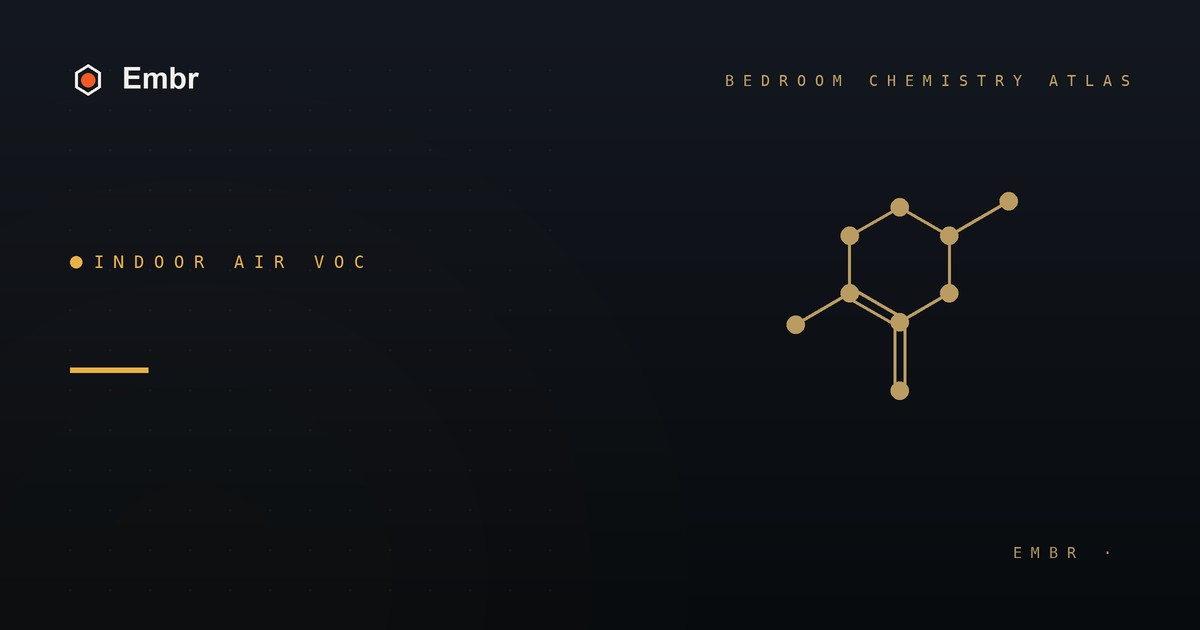
At a glance
| Chemical family | Aliphatic aldehyde — C6 saturated aldehyde (caproaldehyde) |
| CAS number | 66-25-1 |
| Classification | Not IARC classified. Mild irritant to eyes and respiratory tract at elevated concentrations. One of the most common indoor VOCs. GRAS for food use (flavouring agent) |
| Where you encounter it | Indoor air (one of the most common VOCs); emitted from wood products, linoleum flooring, drying oils, and coatings; cooking emissions; lipid oxidation in biological materials |
| Sleep micro-environment relevance | Emitted from wood furniture, linoleum flooring, and coatings in the bedroom. Concentrations elevated in new construction and after renovation. Contributes to total indoor VOC burden during sleep |
Regulatory & certification status
| European Union | REACH registered. CLP Flam. Liq. 3, Skin Irrit. 2, Eye Irrit. 2. No specific indoor air quality limit. AgBB scheme (German) includes hexanal in TVOC assessment for building materials. Regulatory |
| United States | FDA GRAS flavouring agent. No EPA ambient air standard. No OSHA PEL established. Included in EPA indoor air quality studies as a marker VOC. Regulatory |
| Canada | No specific indoor air quality guideline for hexanal. Health Canada includes aldehydes in residential air quality assessments. Regulatory |
| International | Not IARC classified. No WHO indoor air guideline. One of the most frequently detected VOCs in indoor air studies worldwide. FDA GRAS for food flavouring. Regulatory |
What it is
Hexanal (caproaldehyde) is a six-carbon saturated aldehyde produced primarily through the autoxidation of unsaturated fatty acids, particularly linoleic acid. Wood, linoleum (which is made from linseed oil), and drying oil-based coatings contain linoleic acid that oxidises over time to produce hexanal. This makes hexanal a ubiquitous material emission product — it is detected in virtually every indoor air study. IARC has not evaluated hexanal for carcinogenicity, and it is not considered a carcinogen. It is approved as a GRAS flavouring agent in food. At elevated indoor concentrations, hexanal can cause mild irritation to the eyes and upper respiratory tract, though concentrations in typical homes are well below irritation thresholds. Hexanal is also a biomarker of oxidative stress — it is produced during lipid peroxidation of cell membranes.
Where it shows up in bedding
Hexanal enters the bedroom through off-gassing from wood furniture (bed frames, nightstands, dressers), linoleum flooring, and wall coatings or paints containing drying oils. Solid wood and engineered wood products both emit hexanal through the slow oxidation of their natural lipid content. Linoleum flooring is a significant source because it is manufactured from linseed oil, which is rich in linoleic acid. New products emit more hexanal than aged ones, as the available unsaturated fatty acids are gradually consumed. During sleep, bedroom air hexanal contributes to the total aldehyde exposure through inhalation. Ventilation is the most effective measure to reduce indoor aldehyde levels.
The Embr Exposure Ledger: Hexanal
One chemical, several public questions, answered from independent datasets and joined here — the environment it shows up in, the body burden it carries, how it is regulated, and what actually reduces it.
Detection and body-burden figures are occurrence data, not a personal measurement or a health diagnosis. Part of the Embr Exposure Ledger — an open, cross-dataset chemical join (download the data), reusable with attribution.
Citations
- Salthammer, T. et al. (2010). Formaldehyde in the Indoor Environment. Chemical Reviews, 110(4): 2536-2572. Source Peer-reviewed
- WHO (2010). WHO Guidelines for Indoor Air Quality: Selected Pollutants. Source Regulatory
- Wolkoff, P. (2013). Indoor air pollutants in office environments: Assessment of comfort, health, and performance. International Journal of Hygiene and Environmental Health, 216(4): 371-394. Source Peer-reviewed
Frequently asked questions
Why does new furniture smell?
The 'new furniture smell' is largely composed of aldehydes — hexanal, pentanal, and nonanal — produced by the oxidation of natural fatty acids in wood and linseed oil. These compounds are not toxic at typical emission levels but contribute to the characteristic odour of new wood products. The smell fades as the available fatty acids are consumed over weeks to months.
Is hexanal harmful?
At typical indoor concentrations, hexanal is not harmful. It is approved as a food flavouring agent (GRAS) and is present in many foods. At very high concentrations it can cause mild eye and respiratory irritation, but residential indoor levels are well below irritation thresholds. Hexanal is one of many VOCs that contribute to total indoor air quality.
Related compounds
Embr is a sleep environment company researching and addressing the chemistry of the bedroom. Research and product development in progress.
Last reviewed 2026-07-08. If you find a factual error, contact us.