At a glance
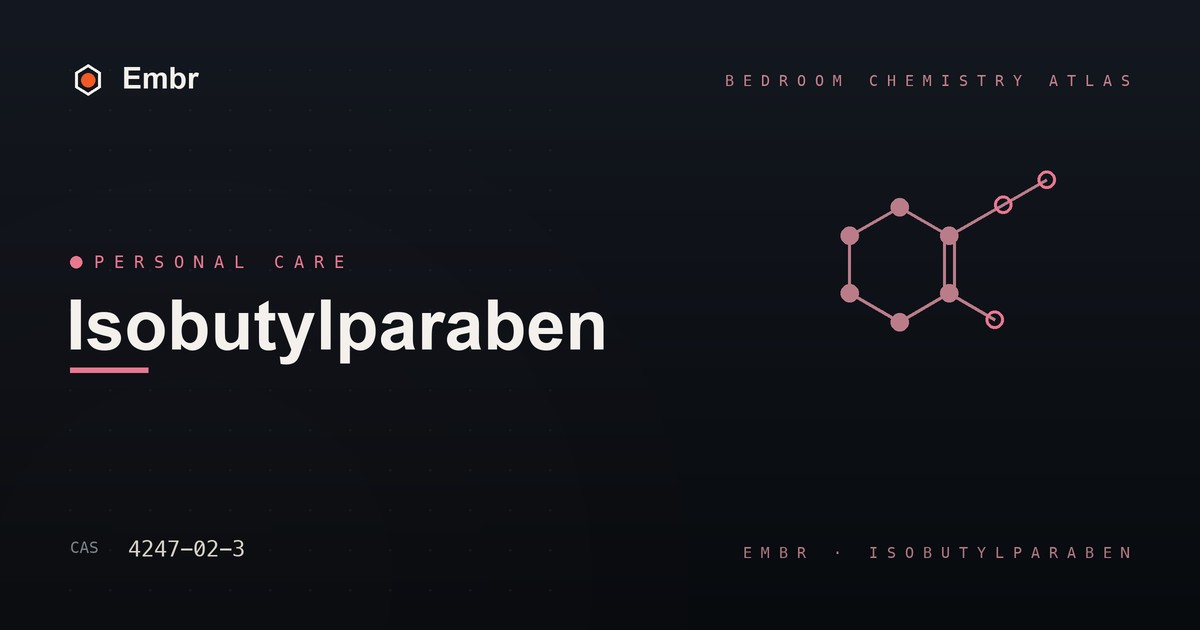
| Chemical family | Paraben — branched-chain (isobutyl ester of 4-hydroxybenzoic acid) |
| CAS number | 4247-02-3 |
| Classification | Not classified by IARC. EU Cosmetics Regulation: not on the approved preservatives list (Annex V) — effectively banned at any concentration. Estrogenic activity stronger than methylparaben and ethylparaben in vitro |
| Where you encounter it | Personal care products (lotions, creams, deodorants, shampoos) — primarily in non-EU markets; transfers from skin to bedding during sleep |
| Sleep micro-environment relevance | Transfers from skin to pillowcases and sheets from personal care products applied before bed. EU-banned but still available in some markets. Part of the cumulative paraben exposure from cosmetics |
Regulatory & certification status
| European Union | Not on the Annex V approved preservatives list under the EU Cosmetics Regulation (EC) No 1223/2009 — effectively banned at all concentrations in cosmetics. The SCCS concluded insufficient safety data existed for isobutylparaben. Regulatory |
| United States | No FDA restriction on isobutylparaben in cosmetics. FDA considers parabens safe as used. The Cosmetic Ingredient Review (CIR) panel reviewed parabens and found them safe at concentrations up to 25% (individually) — though typical use is under 1%. Regulatory |
| Canada | Health Canada Cosmetic Ingredient Hotlist does not restrict isobutylparaben. Permitted in cosmetics. Regulatory |
| International | Not IARC classified. EU ban is the strictest global position. ASEAN Cosmetic Directive follows EU approach. No restriction in the US, Canada, or most other markets. Regulatory |
What it is
Isobutylparaben is the isobutyl ester of 4-hydroxybenzoic acid — one of the longer-chain parabens used as an antimicrobial preservative in cosmetics and personal care products. Parabens as a class have been used since the 1920s for their broad-spectrum antimicrobial activity and low acute toxicity. The safety concern with parabens centres on their weak estrogenic activity — they can bind estrogen receptors and mimic natural estrogens. This activity increases with alkyl chain length: methylparaben is the weakest, followed by ethylparaben, propylparaben, butylparaben, and isobutylparaben. The EU Scientific Committee on Consumer Safety (SCCS) concluded that there was insufficient data to establish the safety of isobutylparaben, and it was removed from the Annex V list of approved preservatives — meaning it cannot be used at any concentration in cosmetics sold in the EU. IARC has not evaluated any paraben for carcinogenicity.
Where it shows up in bedding
Isobutylparaben is not a bedding ingredient. It enters the bedroom through transfer from personal care products: body lotions, facial moisturisers, deodorants, and other leave-on cosmetics applied to skin before bed carry paraben residues that transfer to pillowcases, sheets, and mattress surfaces during overnight contact. In the EU, isobutylparaben has been banned from cosmetics, so this exposure pathway is limited to products from non-EU markets. Studies detecting parabens on hotel and residential bedding have found multiple paraben species, reflecting the mixture of products used by occupants. The amounts are trace-level and below acute toxicological concern, but they contribute to cumulative paraben exposure.
The Embr Exposure Ledger: Isobutylparaben
One chemical, several public questions, answered from independent datasets and joined here — the environment it shows up in, the body burden it carries, how it is regulated, and what actually reduces it.
Detection and body-burden figures are occurrence data, not a personal measurement or a health diagnosis. Part of the Embr Exposure Ledger — an open, cross-dataset chemical join (download the data), reusable with attribution.
Citations
- EU SCCS (2013). Opinion on Parabens — Updated Request for a Scientific Opinion on Propyl- and Butylparaben. SCCS/1514/13. Source Regulatory
- Darbre, P.D. and Harvey, P.W. (2008). Paraben esters: review of recent studies of endocrine toxicity, absorption, esterase and human exposure, and discussion of potential human health risks. Journal of Applied Toxicology, 28(5): 561-578. Source Peer-reviewed
- CIR (2020). Safety Assessment of Parabens as Used in Cosmetics — Final Report. Source Industry
Frequently asked questions
Why is isobutylparaben banned in the EU but not the US?
The EU and US take different regulatory approaches. The EU requires manufacturers to prove safety before approval — when the SCCS concluded that insufficient data existed for isobutylparaben, it was removed from the approved list. The US FDA does not pre-approve cosmetic ingredients (except colour additives) and has not restricted any paraben. The Cosmetic Ingredient Review panel, an industry-funded body, considers parabens safe as used. The two systems reach different conclusions from similar underlying data.
Are all parabens equally estrogenic?
No. Estrogenic activity increases with the length and branching of the alkyl chain. Methylparaben has the weakest estrogenic activity, followed by ethylparaben, propylparaben, butylparaben, and isobutylparaben. However, all parabens are far weaker estrogens than natural estradiol — even the most potent parabens are thousands of times weaker. The debate is whether cumulative exposure from multiple products and multiple parabens produces biologically significant estrogenic effects.
Related compounds
Embr is a sleep environment company researching and addressing the chemistry of the bedroom. Research and product development in progress.
Last reviewed 2026-07-08. If you find a factual error, contact us.