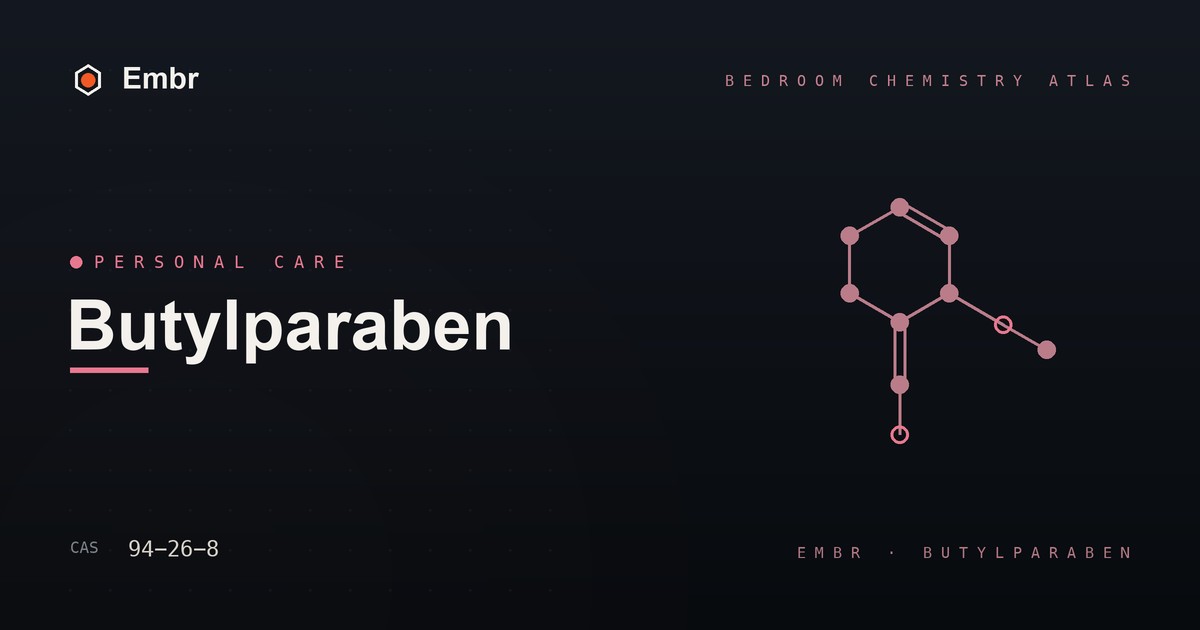
At a glance
| Chemical family | A paraben preservative (butyl ester of 4-hydroxybenzoic acid); the longest-chain of the commonly used linear parabens |
| CAS number | 94-26-8 |
| Classification | Not a carcinogen. The most estrogenic of the everyday parabens; EU-restricted to 0.14% (summed with propylparaben). Human-health risk is scientifically contested |
| Where you encounter it | Lotions, creams, cosmetics and other leave-on personal-care products as a preservative |
| Sleep micro-environment relevance | A leave-on skin-care residue that transfers onto bedding, like the other personal-care entries; a skin-applied product, not a mattress ingredient |
| Activated carbon capture | Not the lever — product choice (paraben-free or shorter-chain parabens) and ordinary laundering address it |
Regulatory & certification status
Where Butylparaben stands across the major regulatory systems and the certifications a bedroom product might carry. Each row links to the governing instrument; where a jurisdiction has no specific measure, that is stated plainly rather than left blank.
| European Union | REACH Substance of Very High Concern: butyl 4-hydroxybenzoate (butylparaben) was added to the Candidate List on 25 June 2020, identified under Article 57(f) for endocrine-disrupting properties (human health). It is not on the Authorisation List (Annex XIV) and carries no Annex XVII restriction. The registration dossier reports no harmonised CLP classification (self-classification only). Separately, under the Cosmetics Regulation (EC) 1223/2009, Commission Regulation (EU) No 1004/2014 caps butylparaben at 0.14% (expressed as the acid, alone or summed with propylparaben) and prohibits it from leave-on products intended for application on the nappy area of children under three years (applicable from 16 October 2015). Regulatory — ECHA · EUR-Lex |
| United States | Butylparaben is NOT listed on California Proposition 65 — verified directly against the official OEHHA Proposition 65 chemical list (machine-readable CSV, ~1,072 entries): no entry for butylparaben, any paraben, hydroxybenzoate, or CAS 94-26-8, for cancer or reproductive toxicity. No federal TSCA risk evaluation, high-priority designation, or significant-new-use rule for butylparaben was identified. California's DTSC Safer Consumer Products program has published a draft Product-Chemical Profile proposing to list certain leave-on products containing preservatives (including butylparaben) as a Priority Product; this is a draft proposal, not an adopted regulation. Regulatory — OEHHA |
| Canada | Under the CEPA Chemicals Management Plan, the DRAFT screening assessment of the Parabens Group (published 14 March 2020; 60-day comment period ended 13 May 2020) proposed that butylparaben may be harmful to human health (but not the environment) at current exposure levels, and the Ministers proposed to recommend adding methyl-, propyl-, butyl- and iso-butylparaben to the Schedule 1 List of Toxic Substances, plus adding butylparaben and iso-butylparaben to the Cosmetic Ingredient Hotlist. This remains a draft/proposed conclusion; no final screening assessment or Schedule 1 listing Order for butylparaben was confirmed. Regulatory — Government of Canada |
| Australia | Butylparaben was assessed by NICNAS (now AICIS) under the IMAP framework as part of the parabens group (human-health and environment Tier II assessments). No AICIS/IChEMS ban or scheduling restriction specific to butylparaben was identified; it remains permitted as a cosmetic preservative. Regulatory — AICIS · NICNAS |
| United Kingdom | Butylparaben (butyl 4-hydroxybenzoate) is on the UK REACH Candidate List of Substances of Very High Concern. This is inherited from the EU position: it was added to the EU Candidate List for endocrine-disrupting properties (human health) on 25 June 2020, before the end of the Brexit transition period, so it carried over into the UK REACH Candidate List when that regime took effect on 1 January 2021. It has no GB CLP harmonised classification (self-classification only), mirroring the EU position. Regulatory — HSE · ECHA |
| Certifications | CertiPUR-US: not addressed — its criteria screen flexible-polyurethane-foam-relevant chemistries classified as carcinogenic/mutagenic/reprotoxic (CMR) plus heavy metals (e.g. lead, mercury); no paraben or antimicrobial preservative is named. OEKO-TEX Standard 100: restricts some preservative/biocide chemistries by name (e.g. pentachlorophenol, tetrachlorophenol, ortho-phenylphenol, organotin compounds) and, since April 2025, bans 'biologically active products' in baby and mucous-contact articles — but butylparaben is not among its named restricted substances and no butylparaben limit value is published in its criteria. GREENGUARD/GREENGUARD Gold: a low-VOC chemical-emissions certification (testing emissions into air, e.g. to California Section 01350) that does not screen for a low-volatility additive such as butylparaben. Industry — CertiPUR-US · OEKO-TEX |
| The 72-hour test window | Largely missed. Butylparaben is a low-volatility, semi-volatile additive (used as an antimicrobial preservative) that partitions into surfaces and house dust rather than off-gassing into chamber air, so a short ~72-hour VOC emissions chamber test does not reliably capture it; dust or product-content analysis is the appropriate detection route. Inferred — from the compound's volatility/emission profile versus the VOC focus of short chamber tests |
What it is
Butylparaben is a preservative — one of the parabens, the family of esters of 4-hydroxybenzoic acid used to keep cosmetics free of microbial growth. What distinguishes it is chain length. The parabens form a series — methyl, ethyl, propyl, butyl — and their weak estrogenic activity climbs with each added carbon, making butylparaben the strongest of the four common linear members. Peer-reviewed — Boberg et al. 2016 That gradient is why it is treated differently from methylparaben in the regulations.
It is not a carcinogen, and it shares the parabens' very low acute toxicity. The whole debate about butylparaben is about endocrine activity — whether its hormone-like behaviour, real in the laboratory, matters at the doses people actually encounter.
How it relates to the bedroom
The familiar personal-care route
For the sleep environment, butylparaben behaves exactly like the rest of the personal-care family: it is a leave-on preservative in lotions, creams and cosmetics, so an evening skincare routine deposits it onto skin — where a little is absorbed — and onto the bedding that skin then touches. Inferred — leave-on personal-care residues transfer onto bedding, as documented for parabens generally There is nothing exotic about the pathway; the interest is entirely in the toxicology.
Both sides of a contested case
Here the page has to do something it rarely does — present a genuine scientific disagreement fairly. On one side, controlled animal work shows real effects: rats exposed to butylparaben before birth had reduced sperm counts at every dose tested down to 10 mg/kg per day, along with shortened anogenital distance and altered reproductive-organ development — signatures of combined estrogenic and anti-androgenic action. Peer-reviewed — Boberg et al. 2016 On the other side, comprehensive reviews argue that parabens are weakly estrogenic — many orders of magnitude less potent than the body's own estradiol — and that, on a dose-and-potency basis, it is biologically implausible that everyday human exposures would produce estrogen-mediated harm. Peer-reviewed — Golden et al. 2005 Both statements are supported; the disagreement is about how to weigh laboratory potency against real-world dose.
Where the regulators landed
European regulators resolved the tension by splitting the difference, in a way that is itself informative. They cut the permitted level of butylparaben (and propylparaben) to 0.14% — combined — which is less than half the 0.4% allowed for methyl- and ethylparaben, explicitly because of the greater endocrine concern with the longer chains. Regulatory — EU Commission Regulation 1004/2014, Annex V They went further for the most vulnerable, banning butyl- and propylparaben from leave-on products for the nappy area of children under three, and they banned the still-longer isomers (isobutyl-, isopropyl-, benzyl- and others) outright. Regulatory — EU Reg 1004/2014; 358/2014 The message is "permitted for general use at a reduced limit, with extra protection for infants" — a calibrated middle position. Inferred — reading the regulatory structure as a graded, precautionary response
What the research says
- It is the most estrogenic common paraben. Potency rises with chain length; in vivo rat effects on sperm count and anogenital distance. Peer-reviewed — Boberg et al. 2016
- The human risk is contested. Reviews argue parabens are far weaker than estradiol and that real-world harm is implausible. Peer-reviewed — Golden et al. 2005
- The EU restricts it more than methylparaben. 0.14% combined with propylparaben, versus 0.4% for methyl/ethyl. Regulatory — EU Reg 1004/2014
- Extra caution for infants. Banned in nappy-area leave-on products for under-threes; longer isomers banned entirely. Regulatory — EU Reg 1004/2014; 358/2014
What helps reduce it
Read labels if you wish to avoid it. "Butylparaben" is named on ingredient lists; paraben-free products are widely available. Inferred — labelling enables avoidance
Prefer shorter-chain parabens or alternatives where it matters. Methyl- and ethylparaben are the least estrogenic; this is most relevant during pregnancy and for infants. Peer-reviewed — Boberg et al. 2016
Launder bedding normally. The leave-on residue comes off in the wash. Inferred
What does NOT help
- Treating "paraben" as a single scare-word. The parabens differ markedly in potency and regulation; butylparaben is not methylparaben, and lumping them together loses the useful distinction. Peer-reviewed — Boberg et al. 2016
- Air purifiers. Butylparaben is a skin-and-fabric residue, not an airborne pollutant. Inferred
Open research questions
- Whether the in vivo endocrine effects seen in rodents translate to any measurable human outcome at real personal-care exposure levels. Speculation
- The contribution of bedding-transferred parabens to total dermal paraben dose over a night of contact. Speculation
The Embr Exposure Ledger: Butylparaben
One chemical, several public questions, answered from independent datasets and joined here — the environment it shows up in, the body burden it carries, how it is regulated, and what actually reduces it.
Detection and body-burden figures are occurrence data, not a personal measurement or a health diagnosis. Part of the Embr Exposure Ledger — an open, cross-dataset chemical join (download the data), reusable with attribution.
Citations
- Boberg J, et al. (2016). Multiple Endocrine Disrupting Effects in Rats Perinatally Exposed to Butylparaben. Toxicological Sciences. Reduced sperm count from 10 mg/kg/d; shortened anogenital distance; estrogenic and anti-androgenic effects. Via Consensus. DOI 10.1093/toxsci/kfw079 Peer-reviewed
- Golden R, et al. (2005). A Review of the Endocrine Activity of Parabens and Implications for Potential Risks to Human Health. Critical Reviews in Toxicology. Parabens many orders of magnitude weaker than estradiol; estrogen-mediated human harm judged biologically implausible at real exposures. Via Consensus. DOI 10.1080/10408440490920104 Peer-reviewed
- Commission Regulation (EU) No 1004/2014 amending Annex V to Regulation (EC) No 1223/2009 (cosmetic products). Butylparaben + propylparaben restricted to 0.14% (as acid) combined; banned in leave-on nappy-area products for children under three; longer isomers banned by Reg 358/2014. legislation.gov.uk Regulatory
Frequently asked questions
How is butylparaben different from methylparaben?
They are the same family — preservatives that stop microbes growing in cosmetics — but butylparaben has a longer carbon chain, and that matters. Estrogenic potency rises with chain length across the parabens, so butylparaben is the strongest of the common everyday ones, while methylparaben is among the weakest. That difference is why EU regulators allow methylparaben up to 0.4% but cap butylparaben (together with propylparaben) at 0.14%.
Is butylparaben actually harmful?
This is genuinely contested, and the honest answer holds two findings together. In rats, perinatal butylparaben exposure produced real endocrine effects — reduced sperm count and shortened anogenital distance — which is why it draws scrutiny. On the other side, major reviews argue that parabens are many orders of magnitude weaker than the body's own estrogen, making it biologically implausible that everyday exposures cause estrogen-mediated harm in people. EU regulators landed in between: permitted, but at a reduced limit, with extra caution for infants.
How does it reach my bedroom?
The same way the other parabens do. Butylparaben is a leave-on preservative in lotions, creams and cosmetics, so a product applied to skin before bed both absorbs slightly and transfers onto the sheets and pillowcase you then lie against. It is a personal-care residue, not a mattress ingredient — the bedroom is downstream of your skincare shelf.
Should I avoid it?
For the general adult population, EU regulators consider butylparaben safe at the restricted 0.14% limit, so this is a reduce-if-you-prefer compound rather than one to fear. If you want to minimize it — a reasonable choice during pregnancy, or for infants — paraben-free products are easy to find, and the EU already bans butyl- and propylparaben from leave-on products for the nappy area of children under three. Check labels for "butylparaben."
Related compounds
Embr is a sleep environment company researching and addressing the chemistry of the bedroom. Research and product development in progress.
Last reviewed 2026-06-27. If you find a factual error, contact us.