At a glance
| Chemical family | Organochlorine insecticide (gamma-hexachlorocyclohexane) |
| CAS number | 58-89-9 |
| Classification | IARC Group 1 — carcinogenic to humans (non-Hodgkin lymphoma); Stockholm Convention POP (Annex A) |
| Where you encounter it | Formerly used directly on wool and cotton bedding, agricultural textiles, and as a lice/scabies treatment; pharmaceutical exemption only |
| Sleep micro-environment relevance | Extremely persistent in household dust; legacy contamination from decades of domestic insecticide use on bedding |
Regulatory & certification status
Where lindane stands across the major regulatory systems and the certifications a bedroom product might carry.
| Stockholm Convention | Listed under Annex A (elimination) in 2009; pharmaceutical exemption only. Regulatory |
| EU | Banned for all plant-protection and biocidal uses; pharmaceutical exemption withdrawn in most member states. Regulatory |
| US EPA | All agricultural registrations cancelled; pharmaceutical use (1% lotion/shampoo) remains under FDA. Regulatory |
| OEKO-TEX STD 100 | Screened as a chlorinated pesticide; restricted at strict limits. Industry |
What it is
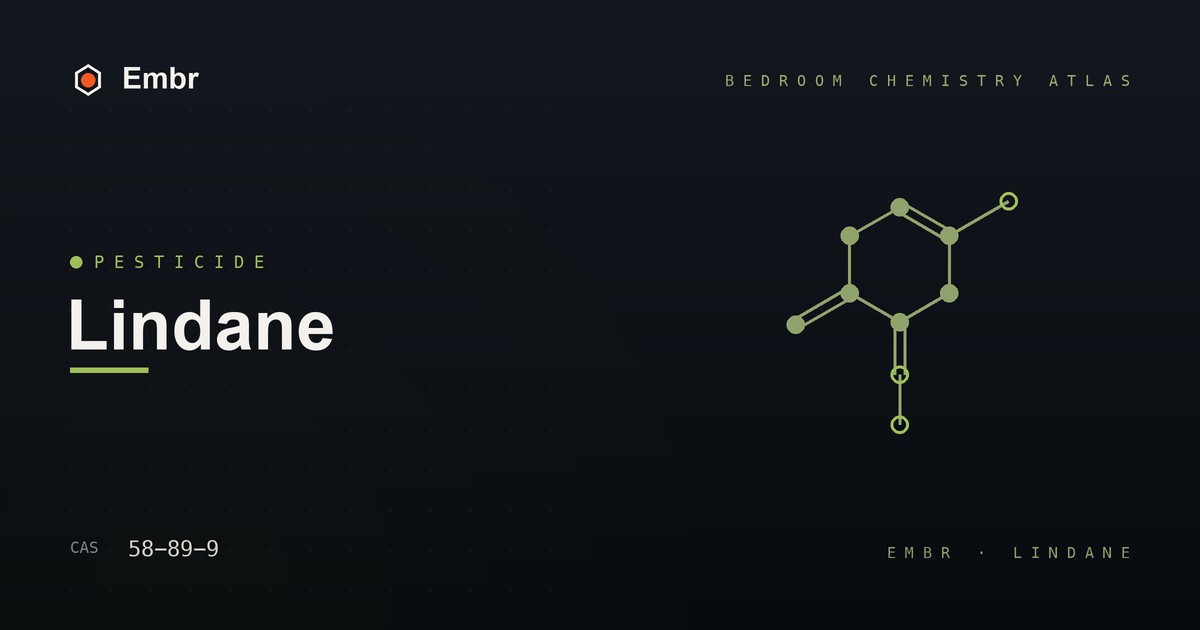
Lindane is a chlorinated cyclohexane — six chlorine atoms arranged around a six-carbon ring. Of the eight possible isomers of hexachlorocyclohexane, only the gamma form has strong insecticidal activity, and it is this isomer that is called lindane. It was one of the most widely used insecticides of the twentieth century, applied to crops, timber, livestock, and — critically for this Atlas — directly to household textiles and bedding.
IARC classified lindane as a Group 1 carcinogen in 2015 (published in Monographs Vol. 113, 2018), based on sufficient evidence for non-Hodgkin lymphoma in exposed human populations, particularly agricultural workers. Regulatory — IARC Monographs Vol. 113 The Stockholm Convention listed lindane under Annex A in 2009, mandating global elimination with a single narrow exemption: pharmaceutical treatment of scabies and head lice, which itself has been withdrawn in most EU member states.
How it relates to the bedroom
A bedding insecticide — applied directly
Unlike many compounds in this Atlas that reach the bedroom incidentally, lindane was applied on purpose to mattresses, wool blankets, and cotton bedding to control moths, bed bugs, and dust mites. This was standard practice from the 1940s through the 1990s in many countries. The compound was also used in household sprays, wood treatments, and agricultural seed dressings — all routes by which it entered the domestic environment.
Extraordinary persistence
Lindane is no longer applied to bedding in any regulated market, but its defining characteristic as an organochlorine persistent organic pollutant is that it does not go away. It is lipophilic — it binds to dust particles, textile fibres, and organic matter in the home environment and resists chemical and biological degradation for decades. Household dust in homes where lindane was historically used, or near former HCH production facilities, still contains measurable levels. Inferred — persistence documented in environmental monitoring but bedroom-specific dust studies are limited
The bedroom context
The bedroom is where lindane's persistence matters most. Dust accumulates on and around the mattress, in carpets, and in soft furnishings — and the sleeper breathes that dust zone for hours each night. The ban stops new input, but the existing contamination endures in the built environment. This is the legacy problem: a compound that was considered safe enough to put on a child's blanket is now classified as a Group 1 carcinogen, and it is still in the dust.
What the research says
- Group 1 carcinogen. Sufficient evidence in humans for non-Hodgkin lymphoma, particularly in agricultural and occupational cohorts. Regulatory — IARC 2018
- Globally banned. Stockholm Convention Annex A (2009) — elimination with pharmaceutical exemption only. Regulatory
- Persistent in indoor dust. Detectable in household environments decades after last application. Inferred
What helps reduce it
Thorough, regular cleaning. Because lindane persists in dust, reducing dust accumulation is the primary mitigation. Damp-wiping hard surfaces and HEPA-vacuuming carpets and mattress surfaces removes the dust reservoir where lindane concentrates.
Replacing legacy textiles. If you have wool blankets, mattresses, or upholstered furniture from the era when lindane was in use (pre-2000s), replacing them removes a potential source of ongoing exposure.
Ventilation. Fresh-air exchange reduces indoor dust concentrations generally, though it does not remove lindane that is bound to surfaces.
What does NOT help
- Activated carbon filtration. Lindane is not volatile at room temperature in the way that VOCs are — it is bound to dust particles rather than present as a gas. Carbon filters target gaseous compounds, not particle-bound contaminants.
- Waiting it out. Unlike VOCs that dissipate over weeks or months, organochlorine POPs persist for decades. Time alone does not solve the problem.
The Embr Exposure Ledger: Lindane (gamma-hexachlorocyclohexane)
One chemical, several public questions, answered from independent datasets and joined here — the environment it shows up in, the body burden it carries, how it is regulated, and what actually reduces it.
Detection and body-burden figures are occurrence data, not a personal measurement or a health diagnosis. Part of the Embr Exposure Ledger — an open, cross-dataset chemical join (download the data), reusable with attribution.
Citations
- IARC (2018). Lindane — Group 1 carcinogen (non-Hodgkin lymphoma). IARC Monographs Vol. 113. Regulatory
- Stockholm Convention on Persistent Organic Pollutants — Lindane listing, Annex A (2009). Regulatory
Frequently asked questions
Is lindane still used on bedding?
No. Lindane is banned globally under the Stockholm Convention for all agricultural and domestic uses. The only remaining legal use is a narrow pharmaceutical exemption for prescription lice and scabies treatments (1% lotion or shampoo), and even that has been withdrawn in most EU countries. It is not applied to any bedding or textile product.
Why is lindane still found in homes?
Because it is extremely persistent. Lindane binds to dust, fibres, and organic matter and resists environmental degradation for decades. Homes where lindane was historically used — or located near former HCH production sites — can still have measurable levels in indoor dust. This is a defining characteristic of organochlorine persistent organic pollutants: the ban stops new input, but the existing contamination endures.
Related compounds
Embr is a sleep environment company researching and addressing the chemistry of the bedroom. Research and product development in progress.
Last reviewed 2026-07-07. If you find a factual error, contact us.