At a glance
| Chemical family | Isocyanate (diisocyanate) — the most-used isocyanate for making polyurethane |
| CAS number | 101-68-8 (4,4'-MDI); also polymeric MDI (pMDI, 9016-87-9) |
| Classification | IARC Group 3 (not classifiable as to carcinogenicity to humans); potent respiratory and dermal sensitizer; a major cause of occupational asthma; OSHA/NIOSH limits in low parts-per-billion |
| Where you encounter it | Rigid polyurethane spray-foam insulation, adhesives, truck-bed liners, wood/engineered-wood products, and some flexible foams; consumer exposure is to finished polyurethane |
| Sleep micro-environment relevance | One of the two isocyanates that build polyurethane foam; lower volatility than TDI; most flexible mattress foam uses TDI, but MDI appears in some constructions and in foam insulation around the home |
| Activated carbon capture | Moderate — reactive and low-volatility; the more persistent off-gassing targets are accompanying VOCs and amine catalysts |
Regulatory & certification status
Where MDI (Methylene Diphenyl Diisocyanate) stands across the major regulatory systems and the certifications a bedroom product might carry. Each row links to the governing instrument; where a jurisdiction has no specific measure, that is stated plainly rather than left blank.
| European Union | Diisocyanates — including 4,4'-MDI — are restricted under REACH Annex XVII entry 74 (added by Commission Regulation (EU) 2020/1149): from 24 August 2023 they may not be used industrially or professionally at a concentration ≥0.1% by weight (individually or combined) unless users have completed mandatory safe-use training. 4,4'-MDI also carries a harmonised CLP classification (Annex VI, Index 615-005-00-9): Carc. 2 (H351), Resp. Sens. 1 (H334), Skin Sens. 1 (H317), STOT RE 2 (H373), Acute Tox. 4 (H332), plus skin/eye/respiratory irritation (H315/H319/H335). MDI is NOT on the REACH SVHC Candidate List or the Authorisation List (Annex XIV); it is regulated via restriction, not authorisation. Regulatory — EUR-Lex · ECHA |
| United States | Under TSCA, EPA published an MDI/related-polyisocyanate Action Plan over uncured-product consumer and bystander exposure and states it is considering rulemaking under TSCA Section 6 (plus possible Section 4 testing and Section 8 reporting), but MDI has NOT been designated a high-priority substance and no TSCA risk evaluation has been completed. The five substances EPA designated high-priority in December 2024 (acetaldehyde, acrylonitrile, aniline, vinyl chloride, and 4,4'-methylene bis(2-chloroaniline)) did not include any diisocyanate. California Proposition 65: MDI is not listed — OEHHA maintains air Reference Exposure Levels (RELs) for MDI but it carries no Prop 65 cancer or reproductive-toxicity listing. Regulatory — US EPA · OEHHA |
| Canada | Added to Schedule 1 of CEPA (the List of Toxic Substances) by Order SOR/2019-115 (registered May 2019), as one of five methylenediphenyl diisocyanates (MDIs) — including 4,4'-MDI (101-68-8) and polymeric MDI (9016-87-9) — found to meet the human-health criterion under paragraph 64(c) (notably respiratory and skin sensitization, with consumer/DIY uncured-product use a focus). This is a FINAL determination; the MDIs were found NOT to meet the environmental criteria 64(a)/(b), and Schedule 1 listing enables risk-management measures rather than imposing an outright ban. Regulatory — Canada Gazette · Government of Canada |
| Australia | Assessed by NICNAS (now AICIS) under the IMAP program (methylenediphenyl diisocyanates — Human health Tier II assessment, covering 101-68-8 and related isomers), which characterises MDI as a respiratory and skin sensitizer with acute inhalation toxicity and irritation, and reviews carcinogenicity. No specific Australian scheduling/ban for MDI was identified, and MDI is not listed on the IChEMS environmental-management Register. Regulatory — AICIS · DCCEEW |
| United Kingdom | Great Britain broadly inherits the EU position. The diisocyanates restriction (REACH Annex XVII entry 74, from Regulation (EU) 2020/1149) was adopted before IP completion day and is retained/assimilated in GB REACH, so an equivalent ≥0.1% safe-use-training requirement applies in GB (HSE-enforced). The GB Mandatory Classification & Labelling list reflects the corresponding harmonised CLP entry for 4,4'-MDI (Carc. 2, Resp. Sens. 1, Skin Sens. 1). Regulatory — UK legislation · HSE |
| International | IARC classifies 4,4'-methylenediphenyl diisocyanate (and polymeric MDI) in Group 3 — not classifiable as to its carcinogenicity to humans (Monographs Vol. 71, 1999; earlier reviewed in Supplement 7, 1987). No global chemicals treaty applies: MDI is reactive and non-persistent, so it is not a Stockholm Convention persistent organic pollutant, and the Minamata Convention (mercury) is not relevant. Regulatory — IARC · IARC Monographs Vol. 71: 4 |
| Certifications | CertiPUR-US: relevant to MDI as a polyurethane-foam feedstock — its program certifies finished flexible PU foam for low VOC emissions plus restricted-substance limits, but its published criteria do not set a named MDI content threshold (residual unreacted isocyanate is addressed indirectly through curing and emissions rather than a specific MDI limit). OEKO-TEX Standard 100: a textile/component certification that does not specifically regulate MDI. GREENGUARD / GREENGUARD Gold: low-VOC chamber-emissions certifications that cap total and individual VOC emissions but do not specifically screen for reactive diisocyanate monomer such as MDI. Industry — CertiPUR-US · UL GREENGUARD |
| The 72-hour test window | Largely missed by a short chamber test in finished foam. MDI is a reactive diisocyanate that is consumed during polymerisation into the polyurethane matrix, so in a cured mattress little to no free MDI remains to off-gas; any residual unreacted monomer is low-volatility and most relevant during manufacture/curing or in uncured spray products, not as a steady-state VOC a ~72h emissions test would reliably capture. Inferred — from the compound's volatility/emission profile versus the VOC focus of short chamber tests |
What it is
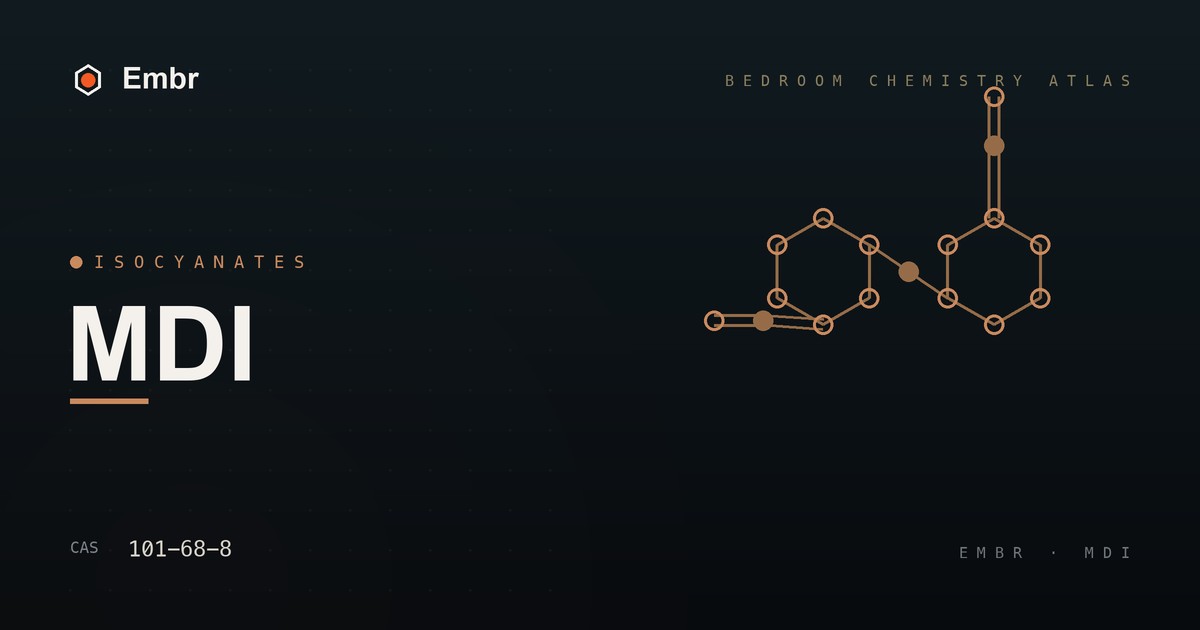
Methylene diphenyl diisocyanate is an aromatic diisocyanate — two phenyl-isocyanate units joined by a methylene bridge. It reacts with polyols to form polyurethane, exactly as TDI does, and it accounts for more than 60% of the global diisocyanate market. MDI is the isocyanate of rigid foams (building insulation), engineered-wood adhesives, and many specialty applications; TDI remains the dominant isocyanate for the flexible foam in mattresses, but the two share the same fundamental chemistry.
IARC evaluated 4,4'-MDI and polymeric MDI and placed them in Group 3 — not classifiable as to carcinogenicity to humans — meaning the evidence is insufficient to decide either way. Regulatory — IARC, Group 3 That neutral cancer rating should not be read as "harmless." MDI's documented hazard is sensitization: it is a potent respiratory and skin sensitizer and a major cause of occupational asthma. Regulatory — ATSDR, NIOSH
MDI's lower vapor pressure compared with TDI means it is less likely to build high airborne concentrations at room temperature — a reason it is often preferred industrially — but it is not therefore safe. Critically, skin contact is an important sensitization route: research shows dermal MDI exposure can prime the immune system for later airway responses. Peer-reviewed — Wisnewski 2011
How it relates to the bedroom
One of the two building blocks of foam
Polyurethane is isocyanate plus polyol. Where MDI is the isocyanate used, it is — like TDI — a raw material that becomes the foam, not an additive that lingers in it. In a cured product the isocyanate has reacted to form the polyurethane network. So MDI matters to the bedroom as part of understanding what polyurethane foam fundamentally is. Regulatory — ATSDR Tox Profile TDI/MDI
Foam insulation and finished products around the home
MDI's biggest single use is rigid spray-foam insulation. Freshly applied spray foam is a genuine isocyanate-exposure scenario during and shortly after installation — which is why professional spray-foam application has strict re-occupancy guidance. Once cured, the foam is largely inert. For the mattress specifically, MDI is less common than TDI but appears in some flexible and specialty foams. Inferred — finished-foam MDI emission is low; fresh spray-foam installation is the notable residential exposure window
Consumer exposure is low; occupational exposure is the documented harm
As with TDI, the well-characterised serious exposures are occupational — among workers and installers who handle liquid MDI. We are not aware of evidence that cured mattress or furniture foam exposes sleepers to MDI at concentrations of concern. Inferred
What the research says
Sensitization, not cancer, is the headline
MDI is a recognised potent lung and dermal sensitizer and a major worldwide cause of occupational asthma. Regulatory — NIOSH The mechanistic research is notable for establishing the skin-to-lung connection: dermal exposure can drive sensitization that later manifests as respiratory disease, which reframes MDI protection as a skin-and-airway problem rather than inhalation alone. Peer-reviewed — Wisnewski 2011
Carcinogenicity
The IARC Group 3 classification reflects insufficient evidence to classify MDI's carcinogenicity in either direction. Regulatory — IARC It is an honest "we don't know," not a clearance — and it is secondary to the sensitization concern in any case.
What helps reduce exposure
For finished products: air out new foam and ventilate. Cured foam emits little MDI, but the broader new-foam off-gassing mixture benefits from airing and ventilation in the early-life window.
For spray-foam insulation: follow professional re-occupancy guidance. The real residential MDI exposure window is during and shortly after spray-foam application — respect cure and ventilation timelines, and use trained installers with proper controls.
Consider non-polyurethane mattress constructions (natural latex, innerspring with natural-fiber comfort layers) to avoid isocyanate chemistry entirely — a material-choice lever, not a claim that finished PU foam is a major MDI source.
For trades and installers: dermal and respiratory controls both matter. Because skin exposure can drive sensitization, gloves and skin protection are as important as respiratory protection.
What does NOT help
- Reading "IARC Group 3" as "safe." Group 3 is "not classifiable" for cancer; MDI's real hazard is sensitization, which Group 3 says nothing about.
- Assuming low volatility means low risk. MDI sensitizes through skin as well as air; lower vapor pressure does not remove the dermal route.
- HEPA-only air purifiers. Particle filtration does not capture isocyanate vapor.
Open research questions
- Residual MDI emission from cured consumer foam under realistic in-use conditions. Speculation
- Contribution of home foam-insulation off-gassing to bedroom isocyanate exposure relative to mattress foam. Speculation
The Embr Exposure Ledger: Methylene diphenyl diisocyanate
One chemical, several public questions, answered from independent datasets and joined here — the environment it shows up in, the body burden it carries, how it is regulated, and what actually reduces it.
Detection and body-burden figures are occurrence data, not a personal measurement or a health diagnosis. Part of the Embr Exposure Ledger — an open, cross-dataset chemical join (download the data), reusable with attribution.
Citations
- IARC. 4,4'-Methylenediphenyl diisocyanate and polymeric MDI — not classifiable as to carcinogenicity (Group 3). Regulatory
- ATSDR. Toxicological Profile for Toluene Diisocyanate and Methylenediphenyl Diisocyanate (TDI/MDI). Regulatory
- NIOSH. Pocket Guide to Chemical Hazards — Methylene bisphenyl isocyanate (MDI). Regulatory
- Wisnewski AV, et al. (2011). Immune sensitization to MDI resulting from skin exposure. PMC3068988 Peer-reviewed
Frequently asked questions
What is MDI used for?
MDI (methylene diphenyl diisocyanate) is the most widely used diisocyanate — more than 60% of the global market. It reacts with polyols to make polyurethane, including rigid spray-foam insulation, adhesives, truck-bed liners, wood products, and some flexible foams. Like TDI, it is a building block of polyurethane rather than an additive that remains in the finished product in quantity.
Is MDI a carcinogen?
IARC classifies 4,4'-MDI and polymeric MDI as Group 3 — not classifiable as to carcinogenicity to humans, meaning the evidence is insufficient to classify it either way. MDI's well-documented hazard is not cancer; it is respiratory and skin sensitization leading to occupational asthma.
Is MDI safer than TDI?
MDI has lower vapor pressure than TDI, so it is less likely to reach high airborne concentrations at room temperature, which is one reason it is often preferred industrially. But MDI is still a potent respiratory and skin sensitizer and a recognised cause of occupational asthma. "Lower volatility" is not the same as "safe" — skin contact is an important sensitization route for MDI.
Is there MDI in my mattress?
MDI is a raw material used to make polyurethane, not a residue that remains in large amounts. In cured foam the isocyanate has reacted to form the polyurethane network. Most flexible mattress foam is made with TDI, while MDI is more common in rigid foams and some specialty flexible foams. Either way, consumer exposure is to finished foam, and the serious documented exposures are occupational.
Why does skin exposure matter for MDI?
Research shows that skin exposure to MDI can drive immune sensitization that later produces respiratory responses — the skin can be the route that sets up the airway reaction. This is why occupational protection for MDI emphasizes both respiratory and dermal controls, not inhalation alone.
Related compounds
Embr is a sleep environment company researching and addressing the chemistry of the bedroom. Research and product development in progress.
Last reviewed 2026-06-27. If you find a factual error, contact us.