At a glance
| Chemical family | Isocyanate (diisocyanate) — one of the two reactants that form polyurethane foam |
| CAS number | 584-84-9 (2,4-TDI); also 2,6-TDI and the 80/20 mixture (26471-62-5) |
| Classification | IARC Group 2B (possibly carcinogenic to humans); recognised respiratory sensitizer and a leading cause of occupational asthma; OSHA/NIOSH ceiling and TLV in low parts-per-billion |
| Where you encounter it | Manufacturing of flexible polyurethane foam (mattresses, furniture, automotive seating), coatings, adhesives, and elastomers; consumer exposure is to finished foam, in which most TDI has reacted |
| Sleep micro-environment relevance | TDI is the isocyanate that builds the mattress foam itself; residual unreacted TDI can off-gas from fresh foam, and its precursor/breakdown amine (TDA) is part of the broader isocyanate-chemistry picture |
| Activated carbon capture | Moderate — reactive and short-lived in air; the more persistent targets are the residual VOCs and amine catalysts that accompany foam off-gassing |
Regulatory & certification status
Where TDI (Toluene Diisocyanate) stands across the major regulatory systems and the certifications a bedroom product might carry. Each row links to the governing instrument; where a jurisdiction has no specific measure, that is stated plainly rather than left blank.
| European Union | Restricted under REACH Annex XVII entry 74 (diisocyanates), added by Commission Regulation (EU) 2020/1149. From 24 August 2023, diisocyanates may not be used on their own, as a constituent of other substances, or in mixtures for industrial/professional use unless the total diisocyanate concentration is below 0.1% by weight, or the user has successfully completed training on safe use (the restriction is grounded in respiratory sensitisation). TDI also carries a harmonised CLP classification (Annex VI, index 615-006-00-4): Carc. 2, Acute Tox. 1, Resp. Sens. 1 and Skin Sens. 1. TDI is not currently on the REACH SVHC Candidate List or the Annex XIV Authorisation List. Regulatory — EUR-Lex · ECHA |
| United States | Under TSCA, EPA proposed (January 2015) a Significant New Use Rule (SNUR) for toluene diisocyanates and related compounds that would designate any use in a consumer product as a significant new use, with an exception for coatings, elastomers, adhesives, binders and sealants resulting in 0.1% or less TDI by weight, requiring notice to EPA at least 90 days before the new use; EPA's current fact sheet still describes this rule as proposed and a final SNUR has not been independently confirmed as promulgated. Under California Proposition 65, 'Toluene diisocyanate' is listed as a carcinogen (listed 1 October 1989 via the Labor Code mechanism); the Proposition 65 list ties this entry to CAS 26471-62-5 (the 2,4-/2,6- mixed-isomer designation), with a No Significant Risk Level of 20 micrograms/day. Regulatory — Federal Register · US EPA |
| Canada | A screening assessment under the Chemicals Management Plan Challenge concluded that toluene diisocyanates (2,4-TDI 584-84-9, 2,6-TDI 91-08-7, mixed isomers 26471-62-5) are harmful to human health (meeting the paragraph 64(c) criterion of CEPA 1999), but not harmful to the environment, at the levels of exposure assessed; secondary regulatory profiles record TDIs as added to the CEPA Schedule 1 List of Toxic Substances under paragraph 'c'. A pollution-prevention (P2) planning notice for the polyurethane and other foam sector followed, requiring covered facilities to limit on-site TDI air releases (per CAREX, in force 2011; the exact final Schedule 1 listing year and instrument were not independently verified from the primary Order in this review). Regulatory — ECCC/Health Canada · CAREX Canada |
| Australia | Toluene diisocyanates were assessed by NICNAS (now AICIS) under the IMAP program (Human Health Tier II). The assessment is a hazard evaluation — it considers respiratory sensitisation, skin sensitisation, acute toxicity and irritation endpoints — rather than a use ban or marketing restriction. The specific recommended hazard categories were not independently re-verified against the source document in this review. Regulatory — AICIS |
| United Kingdom | Great Britain inherits the EU position: under UK REACH, diisocyanates are restricted under Annex XVII entry 74 (administered by HSE), so industrial/professional users of mixtures above 0.1% diisocyanate must have completed safe-use training from 24 August 2023. The restriction derives from retained Commission Regulation (EU) 2020/1149, and the GB CLP harmonised classification mirrors the EU entry (Carc. 2; Resp. Sens. 1; Skin Sens. 1). Regulatory — UK legislation · HSE |
| International | The International Agency for Research on Cancer (IARC) classifies toluene diisocyanates as Group 2B, possibly carcinogenic to humans, based on inadequate evidence in humans and sufficient evidence in experimental animals (Monographs Volume 71, 1999). No global treaty (Stockholm/Minamata) applies. Regulatory — IARC Monographs Vol. 71 (1 |
| Certifications | CertiPUR-US: per its published Technical Guidelines, certified polyurethane foam is screened for substances classified as carcinogens, mutagens or reproductive toxins (CMR) and tested for low VOC emissions (total VOC under 0.5 ppm), using an ISO 16000 emission chamber in which the foam is conditioned for 72 hours before measurement; the published emission table sets per-substance limits for VOCs such as formaldehyde, benzene, toluene and styrene but does not list a finished-foam residue limit specifically named for TDI. As a matter of polyurethane chemistry, the isocyanate (TDI) reacts during foam cure and is largely consumed, so it is principally a process/raw-material hazard rather than an expected finished-foam residue. OEKO-TEX Standard 100 is a textile content standard with no specific TDI limit; GREENGUARD/GREENGUARD Gold is a low-VOC emissions certification, not a content ban on TDI. Industry — CertiPUR-US |
| The 72-hour test window | Capturable during manufacture and cure. TDI is a relatively volatile, reactive monomer, so a short (~72h) chamber VOC test can detect free TDI off-gassing from uncured or freshly made foam; however, in properly cured finished foam the isocyanate has reacted into the polymer, so little or no free TDI remains to be measured. Inferred — from the compound's volatility/emission profile versus the VOC focus of short chamber tests |
What it is
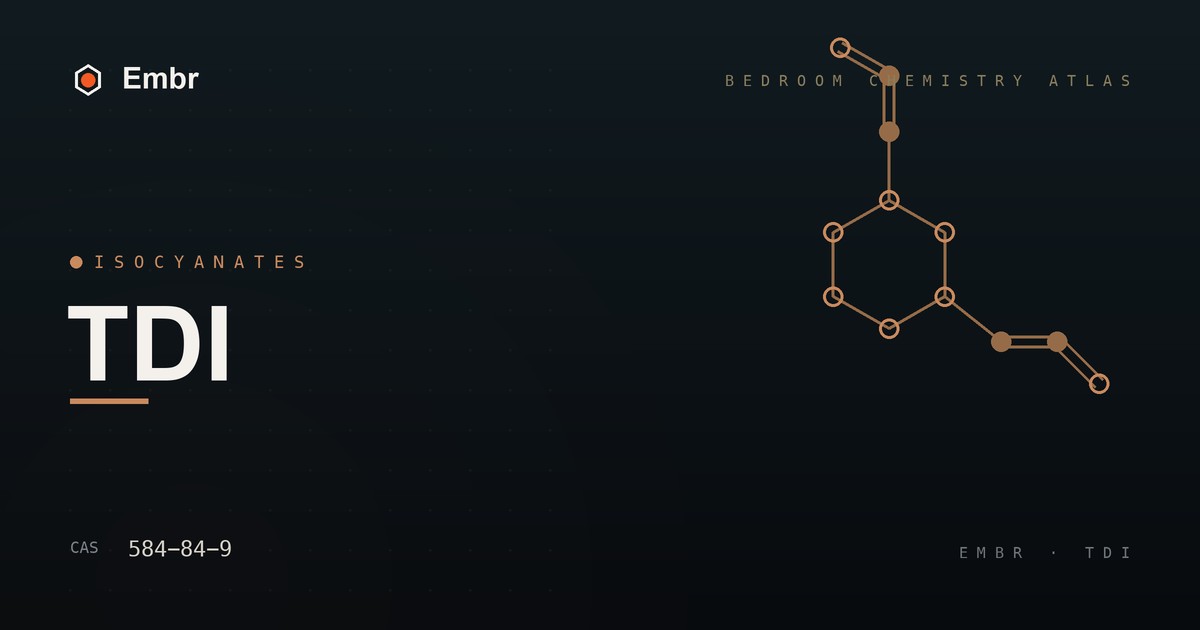
Toluene diisocyanate is an aromatic compound carrying two isocyanate (–N=C=O) groups, which are among the most reactive functional groups in industrial chemistry. Commercial TDI is usually an 80/20 mixture of the 2,4- and 2,6- isomers. Its defining job is to react with polyols: the isocyanate groups link polyol chains together, releasing the gas that blows the mixture into foam and building the polyurethane network in seconds. This is the chemistry behind nearly all flexible foam — the comfort layers of mattresses, sofa cushions, and car seats.
IARC classifies toluene diisocyanates as Group 2B — possibly carcinogenic to humans — based on inadequate evidence in humans and sufficient evidence in experimental animals. Regulatory — IARC, Group 2B But TDI's headline hazard is not cancer; it is respiratory sensitization. TDI is one of the most important causes of occupational asthma worldwide, and once a worker is sensitized they may react to airborne concentrations far below the occupational limit. Regulatory — NIOSH 96-111
The critical distinction for a sleep-environment atlas is between the raw material and the finished product. The serious, well-documented TDI harm is occupational — among the people who handle the liquid isocyanate in foam plants. In a cured mattress, the great majority of the TDI has already been consumed by the reaction with polyol. What remains is a much smaller question of residual off-gassing.
How it relates to the bedroom
It is the foam itself
Every flexible polyurethane foam mattress and topper exists because TDI (or MDI) reacted with polyol. So TDI is not a contaminant added to the mattress — it is one of the two building blocks the foam is made from. Understanding TDI is understanding what a polyurethane mattress fundamentally is. Regulatory — ATSDR Tox Profile TDI/MDI
Residual off-gassing from fresh foam
Properly cured foam has reacted nearly all of its isocyanate, so finished foam emits very little TDI. Fresh foam, however, can release trace residual TDI in its early life, which is part of why new foam is conventionally aired before sale and why a new mattress is best aired and ventilated. The amine catalysts and other VOCs used to make the foam contribute more to the recognizable new-foam smell than TDI does. Inferred — residual TDI from finished consumer foam is low and not a major characterised consumer exposure; the strong evidence is occupational
The TDA question
TDI is manufactured from toluenediamine (TDA), and TDI can hydrolyze back toward TDA in the presence of moisture. Some toluenediamine isomers carry their own carcinogenicity concerns. Trace TDA in foam is therefore part of the broader isocyanate-chemistry picture worth naming, although it is not a well-quantified consumer exposure from finished mattresses. Speculation — trace TDA in finished foam is plausible but not well characterised for consumers
What the research says
Respiratory sensitization is the documented harm
The strongest, clearest evidence is occupational: TDI is a potent respiratory sensitizer and one of the leading causes of work-related asthma. NIOSH built an entire alert around preventing asthma and death from diisocyanate exposure. Regulatory — NIOSH 96-111 Sensitization is the key mechanism — after it develops, extremely low exposures can trigger attacks — and it is why occupational limits are set in low parts-per-billion.
Carcinogenicity
The IARC Group 2B classification reflects animal evidence with inadequate human evidence. Regulatory — IARC For consumers, the cancer question is secondary to the sensitization question, and both are dominated by the occupational setting rather than finished-foam exposure.
Consumer exposure is low and under-characterised
We are not aware of evidence that finished mattress foam exposes sleepers to TDI at concentrations approaching occupational concern. The honest position is that TDI is the chemistry the mattress is built from, the dangerous exposures are occupational, and the residual-emission question for cured foam is small and not well quantified. Inferred
What helps reduce exposure
Air out new foam before use, and ventilate. Residual isocyanate and the accompanying VOCs are highest when foam is fresh. Airing a new mattress in a ventilated space and keeping the bedroom ventilated addresses the early-life emission window.
Consider lower-foam or non-polyurethane constructions. Natural latex, innerspring with natural-fiber comfort layers, and similar constructions avoid TDI/MDI chemistry entirely. This is a material-choice lever, not a claim that finished PU foam is a major TDI source.
For foam-industry and trades workers: the occupational controls are what matter. Engineering controls, respiratory protection, and medical surveillance are the documented protections — this is where TDI exposure is genuinely serious.
Activated-carbon filtration helps with the broader foam off-gassing mixture (residual VOCs and amine catalysts) more than with TDI specifically, which is reactive and short-lived in air.
What does NOT help
- Treating finished foam as a high TDI source. The serious TDI exposures are occupational; cured consumer foam emits little. Don't over-rotate on TDI relative to the residual VOCs and catalysts that actually dominate new-foam emissions.
- HEPA-only air purifiers. TDI is a gas; particle filtration does not address it.
- Assuming "CertiPUR-US" means isocyanate-free. The foam is still made with isocyanates; certifications address emissions and certain additives, not the fundamental polyurethane chemistry.
Open research questions
- Residual TDI and TDA emission from cured consumer foam under realistic sleep temperature and humidity. Speculation
- The contribution of foam-associated amine catalysts (versus TDI itself) to total new-mattress off-gassing in the breathing zone. Speculation
The Embr Exposure Ledger: Toluene diisocyanate
One chemical, several public questions, answered from independent datasets and joined here — the environment it shows up in, the body burden it carries, how it is regulated, and what actually reduces it.
Detection and body-burden figures are occurrence data, not a personal measurement or a health diagnosis. Part of the Embr Exposure Ledger — an open, cross-dataset chemical join (download the data), reusable with attribution.
Where you meet Tdi across your home
The same compound turns up in more than one place you live. Here's where it shows up in Embr — each links to the full breakdown for that part of your home.
Citations
- IARC. Toluene diisocyanates — Group 2B (possibly carcinogenic to humans). Regulatory
- ATSDR. Toxicological Profile for Toluene Diisocyanate and Methylenediphenyl Diisocyanate (TDI/MDI). Regulatory
- NIOSH. Preventing Asthma and Death from Diisocyanate Exposure (DHHS 96-111). NIOSH Regulatory
- EPA. 2,4-Toluene Diisocyanate (584-84-9) Hazard Summary. Regulatory
Frequently asked questions
What is TDI and what is it used for?
TDI (toluene diisocyanate) is a highly reactive isocyanate. Its main use is making flexible polyurethane foam — the foam in mattresses, upholstered furniture, and car seats — by reacting with polyols. It is one of the two workhorse isocyanates of the foam industry (the other is MDI). IARC classifies TDI as Group 2B, possibly carcinogenic to humans. Regulatory
Is there TDI in my mattress?
TDI is a raw material used to make the foam, not an ingredient that remains in large amounts. In properly cured foam, the great majority of the isocyanate has already reacted with polyol to form the polyurethane. Small amounts of unreacted (residual) TDI can off-gas from fresh foam, and the concern is highest during manufacturing and in the first period after production — which is one reason new foam is aired before sale.
Why is TDI considered dangerous?
TDI is a potent respiratory sensitizer and one of the leading causes of occupational asthma worldwide. Once a person is sensitized, they can react to extremely low airborne concentrations. It is also an eye, skin, and airway irritant. The serious documented harm is overwhelmingly occupational — among workers who handle the liquid isocyanate — rather than among consumers using finished foam products.
Does finished foam off-gas TDI?
Finished, cured foam emits very little TDI because the isocyanate is consumed in the curing reaction. Fresh foam can release trace residual TDI, and the related amine catalysts and other VOCs contribute more to the familiar new-foam smell. Airing new foam and ventilating the bedroom reduce early off-gassing.
What is TDA and why does it matter?
TDA (toluenediamine) is the amine that TDI is made from and the product TDI can break down to through hydrolysis. Some toluenediamine isomers carry their own carcinogenicity concerns, so trace TDA in foam is part of the broader isocyanate-chemistry picture, though it is not a major characterised consumer exposure from finished mattresses.
Related compounds
Embr is a sleep environment company researching and addressing the chemistry of the bedroom. Research and product development in progress.
Last reviewed 2026-06-27. If you find a factual error, contact us.