At a glance
| Chemical family | Aromatic amine (methyl-substituted aniline; also called 2-aminotoluene or 2-methylaniline). One of the 22 carcinogenic aromatic amines named in EU textile azo-dye restrictions. |
| CAS number | 95-53-4 |
| Classification | IARC Group 1 — carcinogenic to humans (urinary bladder cancer). Listed as a known human carcinogen in the US National Toxicology Program's Report on Carcinogens. |
| Where you encounter it | Not added directly; released by reductive cleavage (skin bacteria, sweat, liver metabolism) of certain azo dyes on textiles. Occupationally, from rubber-chemical and dye manufacturing; also a minor tobacco-smoke and pharmaceutical-metabolite source. |
| Sleep micro environment relevance | Potential release from azo-dyed sheets, pillowcases, and mattress covers through prolonged overnight skin contact and perspiration. |
| Certification screen | Restricted from release by EU REACH Annex XVII Entry 43 (30 mg/kg) and screened by OEKO-TEX Standard 100 at a stricter limit. Certified textiles are tested; uncertified imports are the gap. Inferred — the certification gap applies to untested imports, not to certified goods |
Regulatory & certification status
o-Toluidine's regulation follows the aromatic-amine model: the rules target the amount of amine a dye can release onto skin, not the dye itself. The rows below give the key instruments.
| EU REACH | Annex XVII Entry 43: textiles and leather in prolonged skin contact must not release o-toluidine (one of 22 listed carcinogenic aromatic amines) above 30 mg/kg from azo dyes. Regulatory — ECHA |
| OEKO-TEX Standard 100 | Screens for the banned aromatic amines, including o-toluidine, at a stricter limit than the EU regulatory threshold. A certified article has been tested for releasable amines. Industry — OEKO-TEX |
| United States | The National Toxicology Program lists o-toluidine as known to be a human carcinogen, and OSHA/NIOSH set occupational limits for its manufacture and handling — but there is no federal textile-specific azo-dye release restriction as in the EU. California: listed under Proposition 65 as a carcinogen (effective 1988). Regulatory — NTP |
| IARC | Group 1 — carcinogenic to humans, on sufficient evidence for bladder cancer (Monographs Vol. 100F, reaffirming earlier reviews). Regulatory — IARC |
What it is
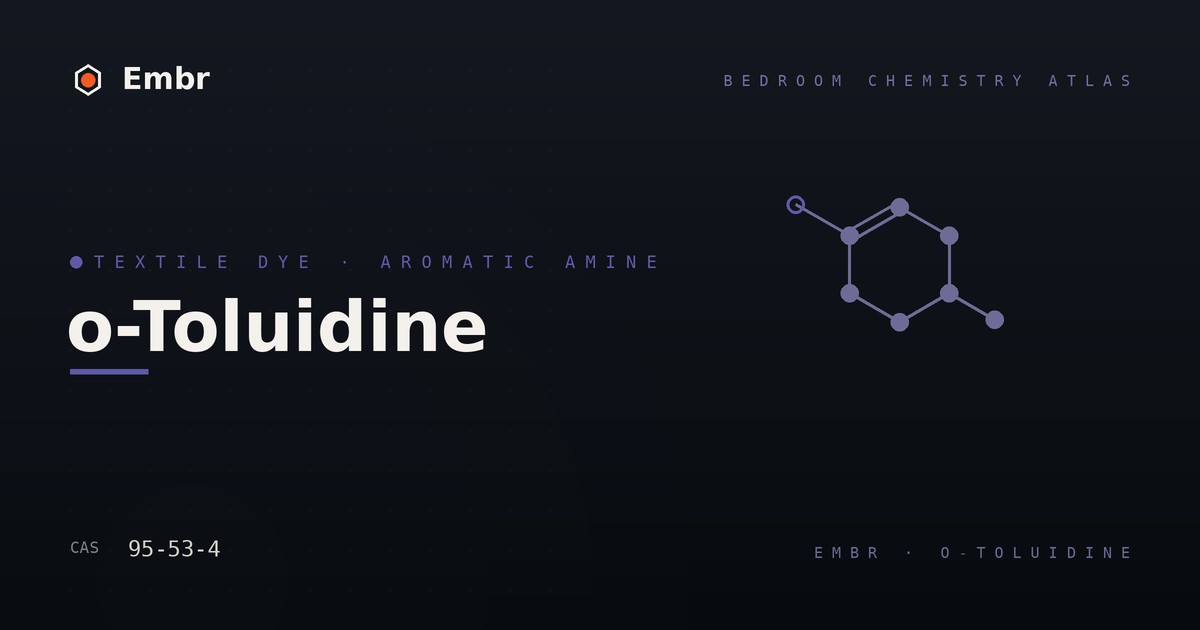
o-Toluidine is aniline with a methyl group in the ortho position — a small aromatic amine, a colorless-to-pale-yellow liquid that darkens on exposure to air and light. It has been a workhorse intermediate in the manufacture of dyes, pigments, rubber chemicals, and some pharmaceuticals. That industrial history is exactly where its cancer evidence comes from: cohorts of workers making rubber antioxidants and dyes from o-toluidine showed markedly elevated bladder-cancer rates, enough for IARC to place it in Group 1. Regulatory — IARC Monographs Vol. 100F
As with benzidine, the key point for the bedroom is that o-toluidine is not a bedding ingredient. It appears on the textile radar only as a released product — the amine that comes off certain azo dyes when the dye's azo bond is broken.
How it relates to the bedroom
Released from azo dyes, not added directly
Some azo dyes are built from o-toluidine, meaning the intact dye can regenerate it. The azo bond (-N=N-) that gives azo dyes their colour can be cleaved reductively — and prolonged skin contact supplies the conditions: skin bacteria and perspiration reduce the bond, and if the amine is absorbed, liver enzymes can complete the job. Sheets, pillowcases, and mattress ticking are the relevant surfaces because contact is close and lasts for hours each night.
Why the regulation targets the amine, not the dye
Multiple different azo dyes can release the same aromatic amine, and it is the amine that is carcinogenic — so the EU restriction is written around the 22 amines (o-toluidine among them) rather than a list of dyes. Regulatory — EU REACH Annex XVII, Entry 43 Compliance testing simulates the reductive cleavage and then measures the free amine released, against the 30 mg/kg limit (stricter under OEKO-TEX).
The risk is specific, not universal
Most modern textiles sold in regulated markets do not use o-toluidine-releasing dyes, and plenty of coloured fabric uses entirely different chemistry. The concern is specific dye formulations, and the practical gap is uncertified, brightly-dyed imports where the dye chemistry is unknown and untested. Inferred — certification gap for uncertified textile imports
What the research says
- Group 1 carcinogen with strong occupational evidence. Bladder-cancer excess in o-toluidine-exposed dye and rubber workers is the basis for the classification. Regulatory — IARC 2012
- Reductive cleavage of azo dyes releasing aromatic amines is well documented. The mechanism that applies to benzidine applies to o-toluidine-based dyes. Peer-reviewed
- EU/OEKO-TEX limits largely control the textile route in regulated markets. The 30 mg/kg release limit is enforced by standardized testing. Regulatory
What helps reduce it
Buy certified textiles. OEKO-TEX Standard 100 and EU REACH compliance both screen for releasable o-toluidine from azo dyes — a certification means the article was tested for it.
Be cautious with uncertified imports. Vividly dyed textiles from unregulated supply chains are where the residual risk sits, because the dye chemistry is unknown.
Wash new textiles before first use. Washing does not strip an azo dye from fibre, but it removes surface residues and is a sensible first-use precaution for any new bedding.
What does NOT help
- Avoiding all coloured bedding. The risk is tied to specific azo-dye chemistries, not to colour itself; undyed white fabric can carry other finishing chemicals instead.
- Assuming "natural" or "organic" means dye-safe. An organic-fibre claim covers the fibre, not the dye — the two address different questions.
Open questions
- Quantified dermal uptake of releasable o-toluidine from textiles under realistic overnight skin-contact and perspiration conditions. Speculation
- Prevalence of o-toluidine-releasing azo dyes in uncertified textile imports reaching North American markets. Speculation
The Embr Exposure Ledger: o-Toluidine
One chemical, several public questions, answered from independent datasets and joined here — the environment it shows up in, the body burden it carries, how it is regulated, and what actually reduces it.
Detection and body-burden figures are occurrence data, not a personal measurement or a health diagnosis. Part of the Embr Exposure Ledger — an open, cross-dataset chemical join (download the data), reusable with attribution.
Citations
- IARC (2012). o-Toluidine — Group 1 carcinogen (urinary bladder). IARC Monographs Vol. 100F. iarc.who.int Regulatory
- EU REACH Annex XVII, Entry 43 — azo dyes releasing carcinogenic aromatic amines in textiles (o-toluidine listed; 30 mg/kg). echa.europa.eu Regulatory
- National Toxicology Program. Report on Carcinogens — o-toluidine, known human carcinogen. ntp.niehs.nih.gov Regulatory
Frequently asked questions
Is o-toluidine in my sheets dangerous?
o-Toluidine is an IARC Group 1 carcinogen linked to bladder cancer, but it is not added to textiles on purpose — the concern is that certain azo dyes can release it when they break down on skin. Because of that, the EU restricts textiles from releasing o-toluidine above 30 mg/kg, and OEKO-TEX screens for it at a stricter limit. Bedding certified to OEKO-TEX Standard 100 or compliant with EU REACH has been tested for releasable o-toluidine. The residual risk sits with brightly-dyed, uncertified imports whose dye chemistry is unknown.
How does o-toluidine end up on textiles?
It is released, not applied. Certain azo dyes contain an azo bond (-N=N-) that can be cleaved reductively — broken apart under reducing conditions. Skin bacteria and perspiration provide those conditions during overnight contact, and liver enzymes can do the same after absorption. When the bond breaks, it liberates the parent aromatic amine — in this case o-toluidine. This is why textile regulations target the amine released rather than the intact dye.
Where else does o-toluidine exposure come from?
The strongest human evidence for o-toluidine and bladder cancer comes from occupational settings — workers in rubber-chemical and dye manufacturing had clearly elevated bladder-cancer rates. It is also a metabolite of some local-anesthetic and other pharmaceuticals, and a minor component of tobacco smoke. For most people the everyday routes are small; the textile pathway matters because it is a controllable, direct skin contact for many hours a night.
Related compounds
Embr researches the chemistry of where you live — including what the dyes in your bedding can release. See the methodology page for how this Atlas tags claims by evidence strength, and azo dyes for the mechanism behind the whole aromatic-amine family.
Last reviewed 2026-07-12. If you find a factual error, contact us.