At a glance
| What this is | The simplest aromatic amine; a high-production-volume feedstock for dyes, rubber chemicals, and the MDI used in polyurethane foam |
| CAS number | 62-53-3 |
| Carcinogen status | IARC Group 2A — probably carcinogenic (Vol. 127, 2021; reclassified from Group 3 on sufficient animal + strong mechanistic evidence) |
| Where you encounter it | Directly: the most-detected aromatic amine in dyed textiles, mainly synthetics. Indirectly: the feedstock for the MDI in mattress/furniture foam |
| How it reaches you | Dyed fabric in skin contact (skin bacteria/sweat free aromatic amines that absorb through skin) |
| Sleep micro-environment relevance | A Group 2A amine present in dyed bedding/sleepwear and upstream of the polyurethane foam supply chain |
| Regulation | REACH-registered; OEKO-TEX aromatic-amine limits; covered by the REACH azo-dye restriction where released by cleavable dyes |
Regulatory & certification status
Where aniline stands across the major regulatory systems and the certifications a bedroom product might carry. Each row links to the governing instrument; where a jurisdiction has no specific measure, that is stated plainly rather than left blank.
| European Union | Aniline carries a harmonised CLP classification (Annex VI, index 612-008-00-7): Carc. 2 (H351), Muta. 2 (H341), Acute Tox. 3 by all three routes (H301 oral / H311 dermal / H331 inhalation), STOT RE 1 (H372), Skin Sens. 1 (H317), Eye Dam. 1 (H318), and Aquatic Acute 1 / Aquatic Chronic 1. It is on the REACH PACT/RMOA list (a risk-management option analysis was completed in 2015), but is NOT on the SVHC Candidate List, NOT on the Authorisation List (Annex XIV), and NOT restricted under Annex XVII; aniline itself is not on the Entry 43 Appendix 8 list of aromatic amines (that list covers amines cleavable from azo dyes, not aniline). The EU POPs Regulation does not list aniline. Regulatory — ECHA |
| United States | Under TSCA, EPA designated aniline (benzenamine) as a High-Priority Substance and initiated a Section 6 risk evaluation on 18 December 2024; that risk evaluation is in progress, with no final risk determination or rule yet. Under California Proposition 65, aniline has been listed as a carcinogen (cancer endpoint) since 1 January 1990, via the Authoritative Bodies mechanism (US EPA), with a No Significant Risk Level of 100 micrograms/day. Regulatory — Federal Register · US EPA |
| Canada | Aniline was assessed under Canada's first Priority Substances List (PSL1) in the early 1990s; the assessment concluded that available data were insufficient to determine whether aniline meets the CEPA definition of 'toxic.' Aniline was subsequently removed from the Priority Substances List and is NOT on CEPA Schedule 1 (the List of Toxic Substances). Note this is an older, now-archived assessment rather than a current re-evaluation. Regulatory — Government of Canada |
| Australia | AICIS completed an evaluation of aniline and its salts (EVA00097, 26 June 2023) and recommended amending the GHS carcinogenicity classification from Category 2 (H351) to the more severe Category 1B (H350, 'may cause cancer'), based principally on two well-conducted 2-year carcinogenicity studies in F344 rats (aniline hydrochloride in the diet) together with mechanistic/genotoxicity evidence. Aniline remains on the AICIS Inventory and is regulated as an introduced industrial chemical; the 1B recommendation is an evaluation outcome (a step toward, not yet, a finalised mandatory classification). Regulatory — AICIS |
| United Kingdom | Post-Brexit, Great Britain assimilated the EU CLP harmonised classifications into GB law (operated by HSE), so the EU harmonised entry for aniline (Carc. 2, Muta. 2, Acute Tox. 3, STOT RE 1, Skin Sens. 1, Eye Dam. 1) was carried over into the GB Mandatory Classification & Labelling (GB MCL) list at the point of transition. Aniline is regulated under UK REACH; there is no UK SVHC/authorisation or restriction listing specific to aniline. (The specific GB MCL line for aniline is inherited from the EU Annex VI entry; the HSE pages cited here document the assimilation framework rather than displaying the per-substance entry.) Regulatory — HSE |
| International | IARC classifies aniline (and aniline hydrochloride) as Group 2A, 'probably carcinogenic to humans' (Monographs Volume 127; Working Group met 2020, volume published 2021). The classification rests on inadequate evidence in humans, sufficient evidence of carcinogenicity in experimental animals, and strong mechanistic evidence — aniline shares metabolic activation to DNA-binding electrophiles, genotoxicity, and target-organ carcinogenicity with aromatic amines already classified Group 1. No Stockholm Convention (POPs) or Minamata Convention listing applies. Regulatory — IARC · IARC Monographs Vol.127 |
| Certifications | OEKO-TEX Standard 100: aniline is a named, regulated parameter — it is tested both as a free residue and as an arylamine that can be cleaved from azo dyes, with product-class limit values set in the OEKO-TEX criteria catalogue (the exact numeric limits vary by edition and product class and are not reproduced here to avoid citing an unverified figure). CertiPUR-US: aniline is not a specifically named substance — the program caps total foam VOC emissions and restricts certain listed chemicals but publishes no aniline-specific limit. GREENGUARD / GREENGUARD Gold: a total-VOC emissions certification that does not screen for aniline as a named compound. Industry — OEKO-TEX · CertiPUR-US |
| The 72-hour test window | Largely captured. Aniline is a volatile organic compound (boiling point about 184 degrees C, well below the EU 250 degrees C upper VOC threshold), so it can off-gas and a short ~72-hour chamber emissions test can in principle detect it. It sits at the heavier, less-volatile end of the VOC range, so a meaningful fraction also partitions into settled dust rather than appearing solely in the air. Inferred — from the compound's volatility/emission profile versus the VOC focus of short chamber tests |
What it is
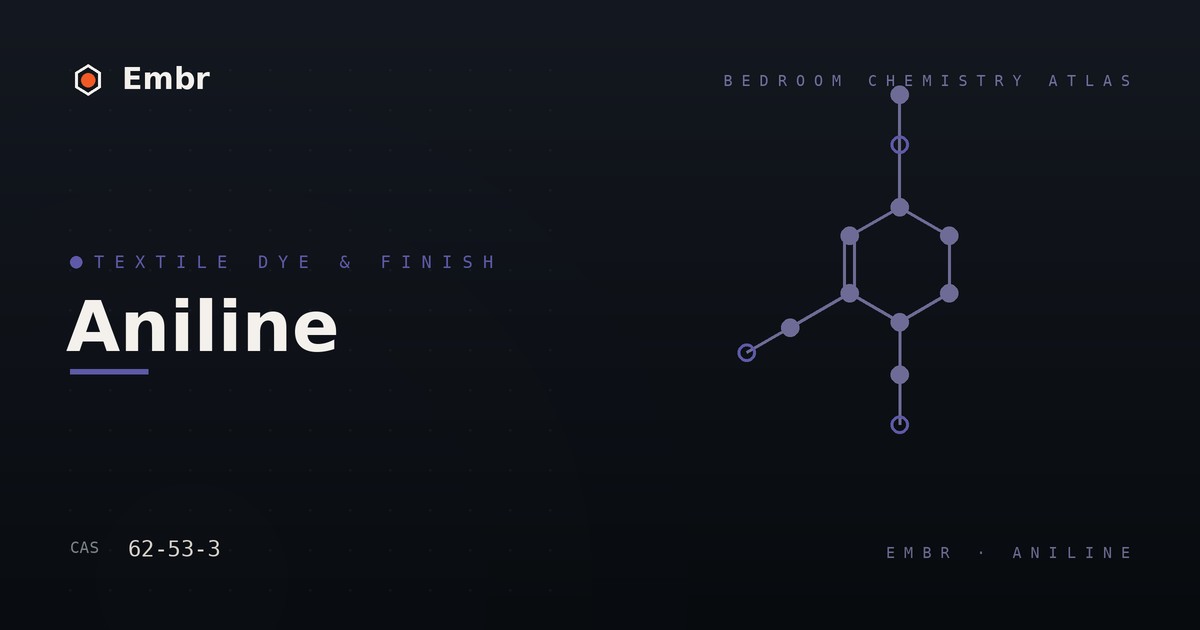
Aniline is a benzene ring with an amino group — small, reactive, and one of the most-produced organic chemicals in the world. Its industrial reach is enormous: dyes and pigments, rubber-processing chemicals, agricultural chemicals, and, above all by volume, the manufacture of MDI (methylene diphenyl diisocyanate), the isocyanate used to make a large share of polyurethane foam. Inferred — the dominant industrial use of aniline is as the feedstock for MDI, the principal isocyanate in polyurethane foam
For years aniline sat at IARC Group 3, "not classifiable." That changed in 2021: in Volume 127, the Working Group reclassified aniline to Group 2A, probably carcinogenic to humans, citing sufficient evidence in animals and strong mechanistic evidence — aniline is genotoxic and belongs to the aromatic-amine class whose members ortho-toluidine, 2-naphthylamine and 4-aminobiphenyl are established human carcinogens. Regulatory — IARC Monographs Vol. 127, Aniline — Group 2A
How it relates to the bedroom
The direct route: the most common amine in dyed textiles
Aniline is not a hypothetical textile contaminant — it is the one most often actually found. In a survey of 240 clothing items from two countries, aniline was the most commonly detected aromatic amine, present in 82% of items, with the higher concentrations in synthetic fabrics. Peer-reviewed — Souza et al. 2023 It gets there as a building block and cleavage product of azo dyes, and it reaches skin the same way the regulated amines do: skin bacteria and sweat split the parent dye, freeing aromatic amines that — unlike the bulky dye — absorb readily through skin. Peer-reviewed — Platzek et al. 1999 Peer-reviewed — Chung 2016 So a Group 2A amine is, measurably, in the dyed bedding and sleepwear against your skin.
The indirect route: upstream of your foam
The second connection is structural rather than residual. Aniline is the feedstock for MDI, and MDI is a principal isocyanate in the polyurethane foam of mattresses and furniture. Aniline is reacted away in making the foam — you are not sleeping on aniline — but it sits one step upstream of a core bedroom material, which is why it belongs in a complete map of bedroom chemistry. Inferred — aniline → MDI → polyurethane foam places it in the foam supply chain, though not as a foam residue
Keeping it in proportion
The textile residues are low-level and the foam connection is upstream, so this is not an acute exposure — but the 2021 reclassification matters because aniline is so ubiquitous and so frequently detected in skin-contact fabric. Peer-reviewed — Souza et al. 2023 The sensible response is the same as for the other textile amines: favour certified, well-dyed fabrics and wash new textiles before use.
The regulatory picture — worldwide
Aniline is regulated as both a hazardous industrial chemical and a textile contaminant.
Carcinogen classification. The 2021 IARC Group 2A evaluation is the headline change, feeding into hazard frameworks globally; aniline also carries an EU CLP harmonised classification and is registered under REACH. Regulatory — IARC Group 2A (Vol. 127, 2021); EU CLP; REACH registration
Textiles. Aniline is among the aromatic amines screened by OEKO-TEX Standard 100 limit values for certified textiles, and where it is released by a cleavable azo dye it falls under the REACH Annex XVII Entry 43 skin-contact textile restriction. Industry — OEKO-TEX Standard 100 aromatic-amine limits Regulatory — REACH Annex XVII Entry 43 (where aniline is a released amine)
Occupational. As a high-production-volume chemical with a skin-notation, aniline is subject to occupational exposure limits (e.g. OSHA/NIOSH), which historically targeted its acute hazard — methaemoglobinaemia — and now also reflect the carcinogen reclassification. Regulatory — OSHA/NIOSH occupational exposure limits for aniline (skin notation)
Where it is heading. The 2021 upgrade and the growing scrutiny of non-regulated aromatic amines in textiles point toward tighter textile screening that would capture aniline more explicitly than today's azo-dye-focused rules. Peer-reviewed — Souza et al. 2023 (non-regulated amines including aniline in clothing)
What the research says
- Reclassified to IARC Group 2A in 2021. Up from Group 3, on genotoxicity + aromatic-amine class evidence. Regulatory — IARC Vol. 127
- Most common amine in textiles. Detected in 82% of surveyed clothing, mainly synthetics. Peer-reviewed — Souza et al. 2023
- Delivered via skin from dyed fabric. Azo cleavage + ready dermal absorption of amines. Peer-reviewed — Platzek et al. 1999; Chung 2016
- Feedstock for foam (MDI). Upstream of polyurethane mattress/furniture foam. Inferred — aniline → MDI
What helps reduce it
Choose certified textiles. OEKO-TEX Standard 100 screens for aromatic amines including aniline. Industry — OEKO-TEX Standard 100
Wash new dyed bedding and sleepwear. Laundering removes unfixed surface dye and amine residue. Inferred — washing removes loosely bound dye/amine residue, standard textile-safety practice
Be cautious with deeply dyed, cheap synthetics. The highest amine loads concentrate in uncertified synthetic fabric. Peer-reviewed — Souza et al. 2023
What does NOT help
- Worrying about aniline "in the foam." Aniline is reacted into MDI and is not present as a foam residue; the foam concern is the isocyanate, not aniline. Inferred
- Air filtration for a dyed-fabric amine. Textile aniline reaches you by skin contact, not the air. Inferred
Open research questions
- Real dermal uptake of aniline from dyed bedding over a night of skin contact and sweat. Speculation
- Whether textile regulations will add aniline explicitly following the 2021 IARC upgrade. Speculation
- The health weight of the many non-regulated aromatic amines, aniline included, co-occurring in fabric. Speculation
The Embr Exposure Ledger: Aniline
One chemical, several public questions, answered from independent datasets and joined here — the environment it shows up in, the body burden it carries, how it is regulated, and what actually reduces it.
Detection and body-burden figures are occurrence data, not a personal measurement or a health diagnosis. Part of the Embr Exposure Ledger — an open, cross-dataset chemical join (download the data), reusable with attribution.
Citations
- IARC Monographs Vol. 127 (2021). Aniline. Group 2A, probably carcinogenic; reclassified from Group 3 on sufficient animal + strong mechanistic evidence. IARC list Regulatory
- Souza MCO, et al. (2023). Non-regulated aromatic amines in clothing purchased in Spain and Brazil. Environ. Res. Aniline the most commonly detected aromatic amine (82% of items), mainly in synthetics. Via Consensus. DOI 10.1016/j.jenvman.2023.117905 Peer-reviewed
- Platzek T, et al. (1999). Formation of a carcinogenic aromatic amine from an azo dye by human skin bacteria in vitro. Hum. Exp. Toxicol. Skin bacteria/sweat cleave azo dyes to readily-absorbed aromatic amines. Via Consensus. DOI 10.1191/096032799678845061 Peer-reviewed
- Chung K-T (2016). Azo dyes and human health: a review. J. Environ. Sci. Health C. Azo dyes cleaved by skin/gut microflora to genotoxic aromatic amines. Via Consensus. DOI 10.1080/10590501.2016.1236602 Peer-reviewed
Frequently asked questions
What is aniline?
Aniline is the simplest aromatic amine — a benzene ring with an amino group — and one of the most important industrial chemicals in the world. It is a building block for dyes and pigments, for rubber chemicals, and, most relevant to a bedroom, it is the feedstock from which MDI is made — the isocyanate used to make much of the polyurethane foam in mattresses and furniture. It also turns up directly in textiles, where it is the most commonly detected aromatic amine.
Is aniline a carcinogen?
In 2021 the International Agency for Research on Cancer reclassified aniline to Group 2A, probably carcinogenic to humans, an upgrade from its previous Group 3 ("not classifiable") status. The basis was sufficient evidence in animals plus strong mechanistic evidence — aniline is genotoxic and shares key properties with the aromatic amines already classified as known human carcinogens (Group 1), such as ortho-toluidine and 4-aminobiphenyl. So aniline now carries a "probably carcinogenic" flag.
How does it reach the bedroom?
Two ways. The direct route is dyed textiles: aniline is the most frequently detected aromatic amine in clothing, found in 82% of items in one survey, mostly in synthetic fabrics, and the skin bacteria and sweat that cleave azo dyes also free aromatic amines that absorb through skin. The indirect route is the foam supply chain: aniline is the feedstock for MDI, the isocyanate in polyurethane mattress and furniture foam — so it sits upstream of a major bedroom material, even though it is reacted away in the finished foam.
How is it regulated?
Aniline is registered and restricted under REACH, with an EU CLP harmonised classification reflecting its toxicity, and its 2021 IARC Group 2A status feeds into hazard frameworks worldwide. In textiles, aniline is among the aromatic amines screened by the OEKO-TEX Standard 100 limit values and is covered indirectly by the REACH azo-dye restriction (Annex XVII Entry 43) where it is released by cleavable dyes. As a high-production-volume chemical it is also subject to occupational exposure limits.
Related compounds
Embr is a sleep environment company researching and addressing the chemistry of the bedroom. Research and product development in progress. This page is informational and is not medical advice.
Last reviewed 2026-06-29. If you find a factual error, contact us.