A family, not one chemical
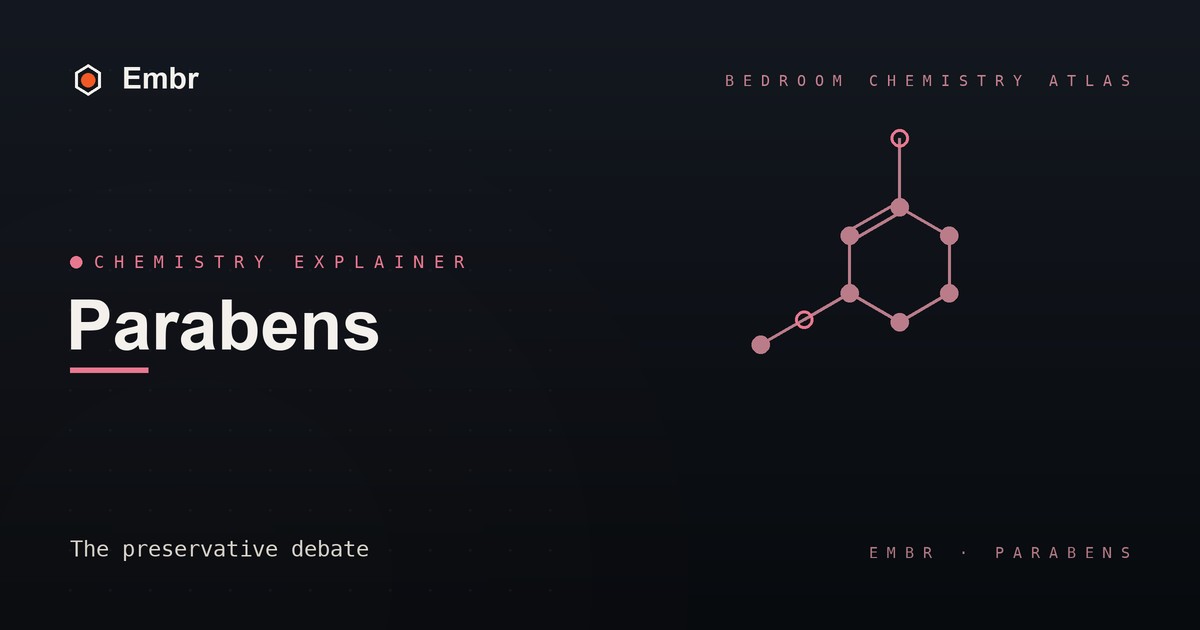
"Paraben" isn't a single substance — it's a family of closely related preservatives, the alkyl esters of p-hydroxybenzoic acid. The ones you'll actually see on labels are methylparaben, ethylparaben, propylparaben and butylparaben — listed in order of a lengthening carbon "tail." That tail matters more than anything else on this page: as the alkyl chain gets longer, the paraben gets both a stronger preservative and a stronger (still weak) estrogen-mimic. Methylparaben sits at the harmless end; butylparaben is the most potent of the common four.
They have been used for the better part of a century because they work at low concentrations against a broad range of mould and bacteria, and because their acute toxicity is very low — parabens are rapidly absorbed, broken down, and excreted rather than building up in the body.
Where you meet them in the bedroom
Parabens reach the sleep environment the same way most personal-care chemicals do: they're in the lotion, moisturiser, cleanser or cosmetic you put on before bed, and they transfer from your skin onto pillowcases and sheets through the night. They have also been measured in settled house dust, so there's a small ongoing background beyond what you apply directly. This is a transfer-and-contact exposure, not an off-gassing one — which is why it behaves differently from the foam VOCs elsewhere in the Atlas.
The estrogen question — the honest read
Here's the heart of the controversy, stated fairly. In laboratory assays — estrogen-receptor binding, breast-cancer-cell proliferation, the rodent uterotrophic test — parabens do show estrogenic activity, and it rises with chain length. That's real, and it's why the question gets asked.
Now the magnitudes, which the scare rarely includes. In the classic study that put parabens on the map, butylparaben — the most potent common one — competed with estradiol for the estrogen receptor with roughly 5 orders of magnitude lower affinity, and produced a uterotrophic response only when injected, at about 100,000 times lower potency than estradiol itself. Reviewing dose and potency together against real-world exposure, major toxicology reviews concluded it is "biologically implausible" that parabens from cosmetics could increase the risk of an estrogen-mediated effect. The honest characterisation is a genuine but extraordinarily weak hormonal signal, whose relevance at human exposure levels is contested rather than demonstrated.
The one place the evidence is less reassuring is high-dose developmental animal work: perinatal butylparaben at doses far above cosmetic exposure has reduced sperm counts in rats. That's the strand regulators took most seriously — and it's exactly why the longer-chain parabens, not the short ones, got restricted.
The breast-cancer claim, specifically
Because it's the single most repeated paraben headline, it deserves a direct answer: there is no evidence that parabens cause breast cancer. The idea traces to a 2004 paper that detected parabens in samples of breast-tumour tissue. But finding a chemical in a tissue is not evidence it caused anything; the study included no comparison of healthy tissue, couldn't establish a source, and subsequent reviews found the breast-cancer link unsupported. Weak estrogenicity is a reason to study parabens carefully — it is not, by itself, a cancer mechanism at these doses.
What the regulators actually did
Regulators didn't ban "parabens." They acted precisely on the chain-length gradient this page keeps returning to. In the EU, the Scientific Committee on Consumer Safety kept methyl- and ethylparaben permitted at up to 0.4% each (0.8% for a mixture), restricted the more-potent propyl- and butylparaben to a combined 0.14%, and in 2014 banned five longer or branched parabens — isopropyl-, isobutyl-, phenyl-, benzyl- and pentylparaben — for lack of safety data. In other words: the short, well-studied, weakly-active members stayed; the longer, more-active, less-studied members went. That's a proportionate, evidence-led outcome, not a blanket condemnation.
What you can reasonably do
- Don't panic-purge. For a typical adult, paraben-preserved products used as directed sit well within the margins regulators judge safe. The preservative is also doing a real job — an unpreserved cream can grow mould and bacteria, which is its own hazard.
- If you prefer to minimise, target the long-chain ones. The rational version of "avoiding parabens" is skipping propyl- and butylparaben (and the banned longer esters) where you can, rather than fearing methyl- and ethylparaben, which are the least active and best studied.
- Mind cumulative use, not single products. The realistic caution from the reviews is about using many paraben-containing products at once, especially around pregnancy and early childhood — not any one lotion.
And the overkill, said plainly: "paraben-free" on a label tells you nothing about whether a product is safer — it has simply been preserved with something else, which may be better studied or worse. The replacement matters as much as the thing replaced.
Frequently asked questions
What are parabens?+
A family of preservatives — alkyl esters of p-hydroxybenzoic acid — used to stop mould and bacteria growing in cosmetics, lotions and shampoos. The common members are methyl-, ethyl-, propyl- and butylparaben, used for decades because they work at low concentrations and have low acute toxicity.
Are parabens dangerous?+
At product levels, the regulatory view is that the short-chain parabens are safe. They are weakly estrogenic in lab tests and potency rises with chain length, but even butylparaben is roughly 10,000–100,000 times weaker than the body's own estradiol, and reviews call it biologically implausible for cosmetic parabens to drive estrogen-related effects. A real but very weak signal, contested human relevance.
Do parabens cause breast cancer?+
No — there's no evidence they do. The claim traces to a 2004 study that detected parabens in breast-tumour tissue, but detection isn't causation, the study had no healthy-tissue comparison, and later reviews found the link unsupported. Parabens are weakly estrogenic, which is why the question arises, but the dose and potency are far too low to credibly cause cancer.
Which parabens are restricted?+
The EU allows methyl- and ethylparaben up to 0.4% each (0.8% total), restricted propyl- and butylparaben to a combined 0.14%, and banned five longer or branched parabens (isopropyl-, isobutyl-, phenyl-, benzyl- and pentylparaben) in 2014 for lack of safety data. The action targeted the longer-chain, more-estrogenic members.
Sources informing this page: Soni et al. (2005, Food and Chemical Toxicology) safety assessment of parabens — low acute toxicity, rapid metabolism, estrogenicity rising with alkyl chain size; Golden et al. (2005, Critical Reviews in Toxicology) dose-and-potency review concluding cosmetic-paraben estrogenic risk is biologically implausible; Routledge et al. (1998, Toxicology and Applied Pharmacology) on parabens as weak estrogens, butylparaben most potent (~10⁵× weaker than estradiol); Boberg et al. (2016, Toxicological Sciences) on perinatal butylparaben and reduced rat sperm count; EU Scientific Committee on Consumer Safety opinions and EU Regulation 1004/2014 on paraben concentration limits and the 2014 ban of five parabens; Chen et al. (2018, Journal of Hazardous Materials) on parabens in U.S. indoor dust. Full citations and evidence grading are held in our internal evidence brief.
This page explains a class of compounds and how exposure works. It is not medical advice. Health statements are kept at the level the evidence supports — "associated with" / "research has found," not claims that any product causes disease in a person. See our methodology and editorial standardsThe Dose GapCorrections.