At a glance
| Chemical family | Volatile organic compound — a bicyclic monoterpene (the dominant scent of pine and turpentine) |
| CAS number | 80-56-8 |
| Classification | No IARC carcinogen classification and no animal carcinogenicity data; not genotoxic. Recognised as a skin and sensory irritant (and a skin sensitiser, especially once oxidised) |
| Where you encounter it | Emitted by wood and wood-based materials; the main component of turpentine; added as a "pine / fresh forest" fragrance to cleaning products, air fresheners and scented goods |
| Sleep micro-environment relevance | Low direct toxicity, but reacts with indoor ozone to generate ultrafine secondary organic-aerosol particles that carry lung-reaching reactive oxygen species |
| Activated carbon capture | Reasonable — terpenes are well-adsorbed; capturing alpha-pinene before it reacts with ozone is the useful angle |
Regulatory & certification status
Where Alpha-Pinene stands across the major regulatory systems and the certifications a bedroom product might carry. Each row links to the governing instrument; where a jurisdiction has no specific measure, that is stated plainly rather than left blank.
| European Union | Alpha-pinene (EC 201-291-9; ECHA name Pin-2(3)-ene) is REACH-registered at high tonnage - an EU data-collection sheet for CAS 80-56-8 and the IARC priorities report both put EEA production/import in the 10,000-100,000 tonnes/year band. It has NO harmonised CLP classification: that same EU sheet states verbatim "CLP: not included," so the hazard codes seen on SDSs (e.g. Flam. Liq. 3, Skin Sens. 1, or the H332/H319 self-classification shown on the sheet) are registrant self-classification, not Annex VI. Alpha-pinene was not identified on the REACH SVHC Candidate List, the Authorisation List (Annex XIV) or the Restriction list (Annex XVII), and is not listed under the EU POPs Regulation. (ECHA infocards are bot-blocked, so the SVHC/Annex negatives were not independently re-confirmed against the live ECHA database and remain a non-finding rather than a positive confirmation.) Regulatory — EU data-collection sheet, · ECHA |
| United States | Alpha-pinene is on the TSCA Inventory and has no EPA TSCA risk evaluation or regulatory action. The National Toxicology Program conducted short-term (3-month) inhalation toxicity studies in F344/N rats and B6C3F1/N mice (NTP Toxicity Report 81 / NTP TOX 81, CAS 80-56-8, May 2016); this is a toxicity study, not a carcinogenicity bioassay, and NTP has not listed alpha-pinene as a carcinogen. It is NOT on the California Proposition 65 list - no entry for pinene or CAS 80-56-8 appears in the OEHHA list (version dated December 5, 2025). Regulatory — OEHHA · NTP Technical Report on th |
| Canada | Alpha-pinene is on Canada's Domestic Substances List. In the DRAFT Screening Assessment for the Acyclic, Monocyclic and Bicyclic Monoterpenes Group, Environment and Climate Change Canada / Health Canada proposed that alpha-pinene does NOT meet any of the CEPA section 64 criteria: it is named among the substances proposed not to meet paragraph 64(c) (human health), and it falls within the 15 group substances proposed not to meet paragraphs 64(a) or (b) (environment). Only rose oil, mandarin oil, tangerine oil, turpentine oil and turpentine were proposed to meet a section 64 criterion (64(c)). Under the ecological risk classification (ERC) alpha-pinene was flagged as having 'moderate hazard potential' (bioaccumulation), but this was not pursued given low exposure. This is the DRAFT conclusion; no final assessment was located, and alpha-pinene is not on Schedule 1. Regulatory — Government of Canada |
| Australia | Alpha-pinene has been assessed by the Australian industrial chemicals regulator (NICNAS, now AICIS) in a Human Health Tier II assessment. The assessment's weight-of-evidence conclusion supports classification of alpha-pinene as a (weak) skin sensitiser - drawing on human/occupational sensitisation data and read-across from (-)-beta-pinene (a Category 1B skin sensitiser present above the 1% limit) - and it also addresses dermal/eye irritation. As a Tier II hazard assessment it does not itself constitute a binding Annex-VI-style classification mandate, and it did not impose an import or use ban; no specific IChEMS restriction was identified. (The primary PDF blocked automated retrieval; findings were verified from indexed extracts of the AICIS assessment text, not a full read of the conclusion section.) Regulatory — AICIS |
| United Kingdom | Post-Brexit, Great Britain inherited the EU starting position: alpha-pinene is regulated under UK REACH and GB CLP. No GB Mandatory Classification and Labelling (GB MCL / harmonised) entry for alpha-pinene was identified - consistent with the EU 'CLP: not included' status - and it was not found on a UK REACH authorisation or restriction list. No GB-specific restriction was identified. (Verification is against the absence of an entry; the GB MCL list was not exhaustively confirmed line-by-line.) Regulatory — HSE · EU data-collection sheet, |
| International | IARC has NOT previously evaluated or classified alpha-pinene into any carcinogen Group. The Advisory Group to Recommend Priorities for the IARC Monographs 2025-2029 placed alpha-pinene on the priority list at MEDIUM priority. The report states the mechanistic evidence 'does not support an evaluation of carcinogenicity of alpha-pinene,' notes that no human or chronic animal carcinogenicity studies were available, and records that a 2-year inhalation bioassay (F344/N rats and B6C3F1/N mice) is in preparation by the US NTP; the Group considered an IARC evaluation 'warranted if supported by these bioassay findings.' (The report's entry header carries the CAS 7785-26-4 - the (-)-enantiomer - but its body text and references use CAS 80-56-8 and the NTP TOX 81 study, so the entry is for alpha-pinene.) No Stockholm or Minamata Convention listing applies. Regulatory — IARC |
| Certifications | CertiPUR-US: alpha-pinene is not a named prohibited substance in the program's foam guidelines (the prohibited/restricted lists name flame retardants, certain phthalates, formaldehyde, heavy metals, etc., not pinene). However, the program's chamber emissions test conditions foam for 72 hours (ISO 16000-3/6/9/11) and reports 'all individual components ... that have a concentration >= 1 ug/m3' against a TVOC limit of <0.5 mg/m3, so emitted alpha-pinene would be captured in that VOC tally rather than ignored. GREENGUARD / GREENGUARD Gold (UL 2818): a low-VOC emissions certification that screens for many individual VOCs against a TVOC cap; alpha-pinene would be detected as one of the measured VOCs, but no published compound-specific pass/fail limit for alpha-pinene was identified (and no specific count of screened VOCs is asserted here from the primary standard). OEKO-TEX STANDARD 100: addresses VOCs/odour via its requirements, but no alpha-pinene-specific limit value was confirmed. Industry — CertiPUR-US · UL GREENGUARD |
| The 72-hour test window | Well captured. Alpha-pinene is a genuinely volatile VOC and a recognised indoor-air pollutant that off-gasses from foams, wood and consumer products, so a short ~72-hour chamber emissions test detects it readily. The EU data-collection sheet for CAS 80-56-8 explicitly uses alpha-pinene as the model substance underlying the RWI/RWII (LCI-type) guide values for bicyclic monoterpenes, confirming its role as the reference compound for that class in EU indoor-air guidance. Inferred — from the compound's volatility/emission profile versus the VOC focus of short chamber tests |
What it is
Alpha-pinene is a monoterpene — the compound most responsible for the smell of pine and the main constituent of turpentine. Like limonene, it is genuinely natural and genuinely pleasant, which is exactly why it is added to so many products marketed as fresh, clean or forest-scented. It is also emitted by wood and wood-based furnishings as part of normal off-gassing.
By itself, alpha-pinene is low-hazard. It is not genotoxic across several in vitro and in vivo tests, no animal carcinogenicity data exist for it, and it carries no IARC cancer classification. Regulatory — NICNAS IMAP assessment A short-term inhalation study by the U.S. National Toxicology Program found effects on the liver, kidney and nasal lining only at very high inhaled concentrations of 100 to 1,600 ppm — orders of magnitude above anything found in a home. Regulatory — NTP TOX-81 What it can do at ordinary levels is irritate: it is recognised as a skin and sensory irritant, and oxidised alpha-pinene is a known contact allergen. Regulatory — NICNAS IMAP The more interesting story, though, is what alpha-pinene does in indoor air.
How it relates to the bedroom
A wood emission and a deliberate fragrance
Alpha-pinene reaches bedroom air from two directions. It is released by wood, wood-based panels and other furnishings as they off-gas, and it is added deliberately as a pine fragrance to cleaning sprays, air fresheners and scented products. Regulatory — NICNAS IMAP So, as with limonene, your room usually gets it from both the materials and your cleaning routine.
The ozone reaction — the real point
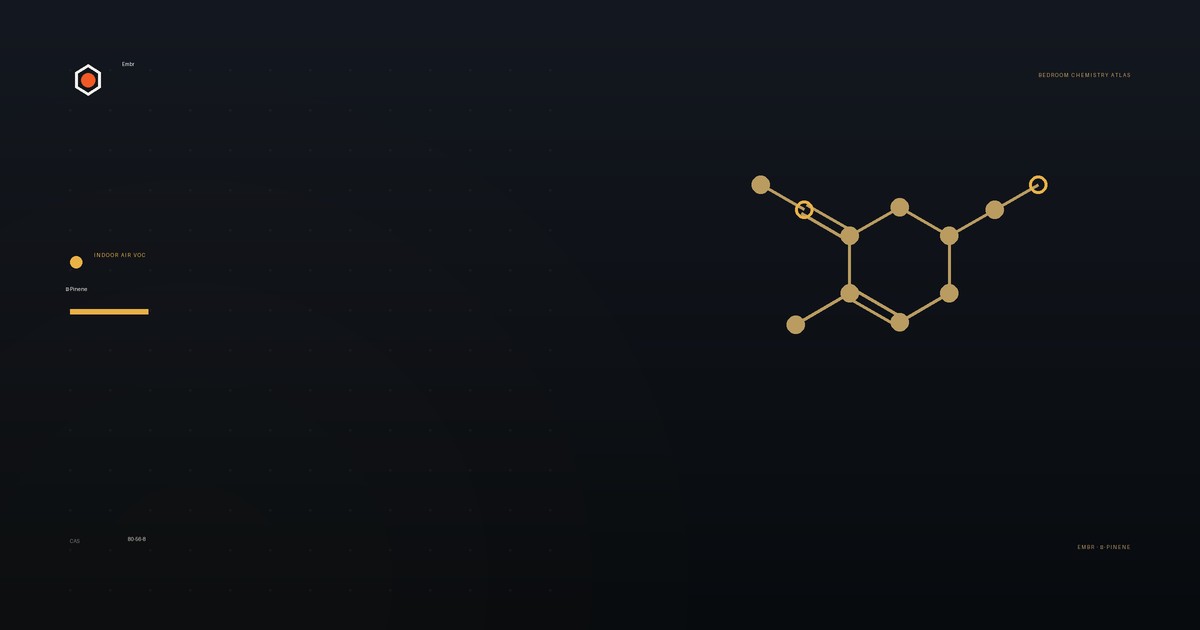
Alpha-pinene's molecule contains a reactive carbon–carbon double bond. Indoor air almost always contains some ozone — it drifts in from outdoors and is generated by certain "air-purifying" and ionising devices. When ozone meets alpha-pinene, it breaks that double bond and sets off a cascade that produces low-volatility products — pinonaldehyde, pinonic acid and others — which condense into ultrafine secondary organic-aerosol particles. A chamber study designed to simulate a ventilated indoor room, run at alpha-pinene and ozone concentrations relevant to real homes, confirmed this directly and went a step further: the particles formed carried particle-bound reactive oxygen species, at levels equivalent to roughly 1–7 nmol of hydrogen peroxide per cubic metre, capable of penetrating into the lungs and delivering oxidative stress to tissue. Peer-reviewed — Chen & Hopke 2009, Indoor Air A fragrant gas is converted into fine, oxidatively active particles.
Why this matters for how we think about the bedroom
This is the same lesson the limonene page makes, and alpha-pinene reinforces it: the sleep environment is a set of reactions, not a static ingredient list. A compound can be near-harmless on its own and still matter because of what it forms when it meets something else in the room. "Natural," "pine," and "fresh" are scent claims — they say nothing about the particles that scent can produce. Inferred — secondary-particle yield depends on ozone level, ventilation, and alpha-pinene concentration
What the research says
- Direct toxicity is low. Not genotoxic; no carcinogenicity data or IARC classification; animal effects only at very high inhaled concentrations. Regulatory — NICNAS IMAP; NTP TOX-81
- It is an irritant. Recognised as a skin and sensory irritant; oxidised forms are skin sensitisers. Regulatory — NICNAS IMAP
- Secondary particle formation is real and measured. Alpha-pinene + ozone reliably forms ultrafine particles indoors, carrying lung-reaching reactive oxygen species. Peer-reviewed — Chen & Hopke 2009
- The exposure scales with the room. More ozone, less ventilation, and higher alpha-pinene all increase secondary-particle formation. Inferred
What helps reduce it
Don't add ozone to the room. Avoid ozone-generating "air purifiers" and ionisers, especially alongside scented products — that combination is what drives secondary-particle formation. Peer-reviewed — Chen & Hopke 2009
Be skeptical of scent as a proxy for clean. A pine-fresh smell does not mean cleaner air; sometimes it means the opposite. Ventilation, not fragrance, is what improves air quality.
Ventilate. Fresh-air exchange removes both alpha-pinene and ozone before they react and dilutes any particles formed.
Capture before reaction. Alpha-pinene is reasonably well-adsorbed by activated carbon, so capturing it is a sensible angle where ventilation is limited.
What does NOT help
- Masking odours with more fragrance. Adding scented product to cover a smell adds more alpha-pinene (and other terpenes) to react with ozone. Inferred
- Ozone "shock" treatments. Deliberately ozonating a room full of fragrances is the worst case for secondary-particle formation. Inferred
Open research questions
- Typical bedroom secondary-particle and reactive-oxygen yields from realistic alpha-pinene and ozone levels overnight. Speculation
- The health relevance of chronic, low-level exposure to terpene-ozone secondary aerosols during sleep. Speculation
The Embr Exposure Ledger: Alpha-pinene
One chemical, several public questions, answered from independent datasets and joined here — the environment it shows up in, the body burden it carries, how it is regulated, and what actually reduces it.
Detection and body-burden figures are occurrence data, not a personal measurement or a health diagnosis. Part of the Embr Exposure Ledger — an open, cross-dataset chemical join (download the data), reusable with attribution.
Citations
- Chen X, Hopke PK (2009). Secondary organic aerosol from alpha-pinene ozonolysis in dynamic chamber system. Indoor Air, 19(4):335–345. DOI 10.1111/j.1600-0668.2009.00596.x (PMID 19500172). Via PubMed. Peer-reviewed
- U.S. National Toxicology Program (2016). Toxicity Studies of alpha-Pinene (CASRN 80-56-8) Administered by Inhalation to F344/N Rats and B6C3F1/N Mice (NTP TOX-81). Effects on liver, kidney/urinary system and nasal olfactory epithelium only at 100–1,600 ppm; a short-term toxicity study, not a carcinogenicity bioassay. ntp.niehs.nih.gov Regulatory
- Australian Government, NICNAS. IMAP Human Health Tier II Assessment: Alpha-pinene (CAS 80-56-8) (2018). No evidence of genotoxicity; no animal carcinogenicity data; critical health effects are local irritation, skin sensitisation and sensory irritation. industrialchemicals.gov.au Regulatory
Frequently asked questions
Is alpha-pinene harmful in the bedroom?
On its own, alpha-pinene is low in direct toxicity. It is not genotoxic, it has no animal carcinogenicity data and carries no IARC cancer classification, and the toxic effects seen in animal studies appeared only at very high inhaled concentrations far above indoor levels. Its real significance is indirect: like limonene, alpha-pinene reacts with indoor ozone to form ultrafine secondary particles — so a pine-fresh scent is not the same as clean air. It can also act as a skin and sensory irritant, especially once it has oxidised.
Why does alpha-pinene react with ozone?
Alpha-pinene is a monoterpene with a reactive carbon–carbon double bond. When ozone — which drifts in from outdoors or is produced by some "air-purifying" devices — meets that double bond, it breaks it and starts a cascade that produces low-volatility compounds (pinonaldehyde, pinonic acid and others) which condense into secondary organic aerosol. A chamber study at indoor-relevant concentrations found these particles carried reactive oxygen species capable of reaching and stressing lung tissue.
Where does the alpha-pinene in my bedroom come from?
Two main places: it is emitted naturally by wood and wood-based materials (it is the dominant scent of pine and a major component of turpentine), and it is added on purpose as a "pine" or "fresh forest" fragrance to cleaning products, air fresheners and scented goods. So both your furnishings and your cleaning routine put alpha-pinene into bedroom air.
Does a "pine" or "forest" scent mean cleaner air?
Not necessarily. Alpha-pinene is genuinely natural — it is what makes a pine forest smell like pine — but natural does not mean inert. Because it reacts with ozone to form ultrafine particles, adding a pine scent to a room that contains ozone can increase fine-particle exposure rather than improve air quality. Scent and air quality are different things; ventilation, not fragrance, is what cleans the air.
Related compounds
Embr is a sleep environment company researching and addressing the chemistry of the bedroom. Research and product development in progress.
Last reviewed 2026-06-27. If you find a factual error, contact us.