At a glance
| Chemical family | Volatile organic compound — a monoterpene (the dominant scent of citrus peel) |
| CAS number | 5989-27-5 (d-limonene) |
| Classification | IARC Group 3 (not classifiable as to carcinogenicity to humans). The male-rat kidney tumors used in some older risk discussions arise via the α2u-globulin mechanism, which is not relevant to humans |
| Where you encounter it | Mattress and polyurethane off-gassing; added as citrus fragrance to cleaning products, air fresheners, and scented goods; natural in citrus and many plants |
| Sleep micro-environment relevance | Low direct toxicity, but reacts with indoor ozone to generate ultrafine secondary organic-aerosol particles — a fine-particle exposure pathway |
| Activated carbon capture | Reasonable — limonene is well-adsorbed; capturing it before it reacts with ozone is the useful angle |
Regulatory & certification status
Where Limonene stands across the major regulatory systems and the certifications a bedroom product might carry. Each row links to the governing instrument; where a jurisdiction has no specific measure, that is stated plainly rather than left blank.
| European Union | d-Limonene ((R)-p-mentha-1,8-diene, CAS 5989-27-5; Index 601-029-00-7) carries a CLP Annex VI harmonised classification: Flam. Liq. 3 (H226), Skin Irrit. 2 (H315), skin sensitiser Skin Sens. 1B (H317), Asp. Tox. 1 (H304) and Aquatic Acute 1 / Aquatic Chronic 1 (H400/H410). It is NOT a REACH Substance of Very High Concern (not on the Candidate List) and is not on the Authorisation List (Annex XIV). The only Annex XVII restriction that reaches it is the generic tattoo-ink / permanent make-up restriction (entry 75), which limits any substance classified as a skin sensitiser (Cat. 1, 1A or 1B) to a concentration of 0.001% or more in tattoo/PMU mixtures; that restriction is not specific to limonene and does not apply to bedding. Regulatory — PubChem GHS Classification · UK legislation |
| United States | d-Limonene is NOT listed on California Proposition 65 (verified absent from the OEHHA list dated 5 December 2025, for both CAS 5989-27-5 and the racemic 138-86-3). EPA regulates it as a pesticide active ingredient under FIFRA (a biochemical/biopesticide, with tolerance exemptions for food uses) rather than under a TSCA risk evaluation; it has not been assessed by EPA's IRIS program. Regulatory — OEHHA · Federal Register |
| Canada | Limonene was assessed under the Chemicals Management Plan within the Terpenes and Terpenoids (Acyclic, Monocyclic and Bicyclic Monoterpenes) Group final screening assessment (ECCC/Health Canada, 2020; scientific-considerations notice in Canada Gazette Part I, 14 March 2020). No health effects of concern were identified for limonene specifically, and limonene is NOT on CEPA Schedule 1 (List of Toxic Substances). (Some other substances in that 15-substance group were flagged as potentially harmful, but not limonene.) Limonene also has registered pest-control-product uses regulated by the PMRA under the Pest Control Products Act, separate from the CEPA assessment. Regulatory — Government of Canada |
| Australia | Limonene is an industrial chemical listed on the Australian Inventory (regulated by AICIS, formerly NICNAS), and is referenced within NICNAS IMAP terpene assessments, but no specific AICIS/NICNAS restriction or Poisons Standard (SUSMP) schedule entry singling out limonene was confirmed against a primary source. Agricultural/veterinary uses of limonene fall under the APVMA rather than AICIS. Regulatory — AICIS |
| United Kingdom | Great Britain carries over the EU harmonised classification: the GB Mandatory Classification and Labelling list (retained from CLP Annex VI) classifies d-limonene as Flam. Liq. 3 (H226), Skin Irrit. 2 (H315), Skin Sens. 1B (H317), Asp. Tox. 1 (H304) and Aquatic Acute/Chronic 1 (H400/H410). Limonene is not on the UK REACH Candidate List of SVHCs (HSE has made no post-Brexit additions that include it). Regulatory — HSE · PubChem GHS Classification |
| International | IARC classifies d-limonene in Group 3 (not classifiable as to its carcinogenicity to humans). There is inadequate evidence in humans and sufficient evidence in experimental animals (male-rat kidney tumours via an alpha-2u-globulin mechanism judged not relevant to humans); the Group 3 outcome reflects that mechanism. Evaluated in IARC Monographs Vol. 56 (1993) and re-evaluated in Vol. 73 (1999). No Stockholm Convention (POPs) or Minamata Convention listing applies. Regulatory — IARC Monographs Vol. 73 (1 · IARC Monographs Vol. 56 (1 |
| Certifications | Limonene is not a named compound-specific limit in the major sleep-product certifications. GREENGUARD / GREENGUARD Gold (UL 2818) is built on the California CDPH Standard Method v1.2 (Section 01350): limonene is NOT one of the 35 target CREL VOCs in that method's Table 4-1 and has no compound-specific allowable concentration there. The method does require laboratories to identify and report individual (including non-listed, abundant) VOCs by GC-MS, so a low-emission certification would still detect and report limonene as a non-target VOC, but it is not evaluated against a chronic reference exposure level. CertiPUR-US caps total VOC emissions from foam at less than 0.5 ppm (small-chamber test, 72-hour conditioning) and sets no compound-specific limonene limit. OEKO-TEX Standard 100 limits total VOC emissions and regulates certain sensitising/allergenic substances, but no limonene-specific limit was confirmed against a primary source. Industry — CDPH · CertiPUR-US |
| The 72-hour test window | Readily captured. Limonene is a volatile monoterpene VOC and one of the most commonly detected off-gassing compounds in indoor air, so it evaporates into the chamber and is reliably picked up by a short ~72-hour VOC emissions test (thermal-desorption GC-MS). Inferred — from the compound's volatility/emission profile versus the VOC focus of short chamber tests |
What it is
d-Limonene is a monoterpene — the compound responsible for the smell of citrus peel. It is genuinely natural and genuinely pleasant, which is exactly why it is added to so many products marketed as fresh or clean. It is also emitted by polyurethane mattress materials as part of normal off-gassing.
By itself, limonene is low-hazard. IARC places d-limonene in Group 3 — not classifiable as to carcinogenicity to humans. Regulatory — IARC Group 3 Older risk discussions sometimes cite kidney tumors in male rats, but those proceed through the α2u-globulin pathway, a rat-specific mechanism that does not occur in humans. So the direct-toxicity story is reassuring. The interesting part is what limonene does in indoor air.
How it relates to the bedroom
A foam emission and a deliberate fragrance
A 2019 study measuring VOC emissions from polyurethane mattresses identified limonene among the compounds released under realistic conditions. Peer-reviewed — Oz et al. 2019, Environ. Sci. Technol. On top of that mattress source, limonene is added on purpose to cleaning sprays, air fresheners, and scented products — so your bedroom usually gets it from both the materials and your cleaning routine.
The ozone reaction — the real point
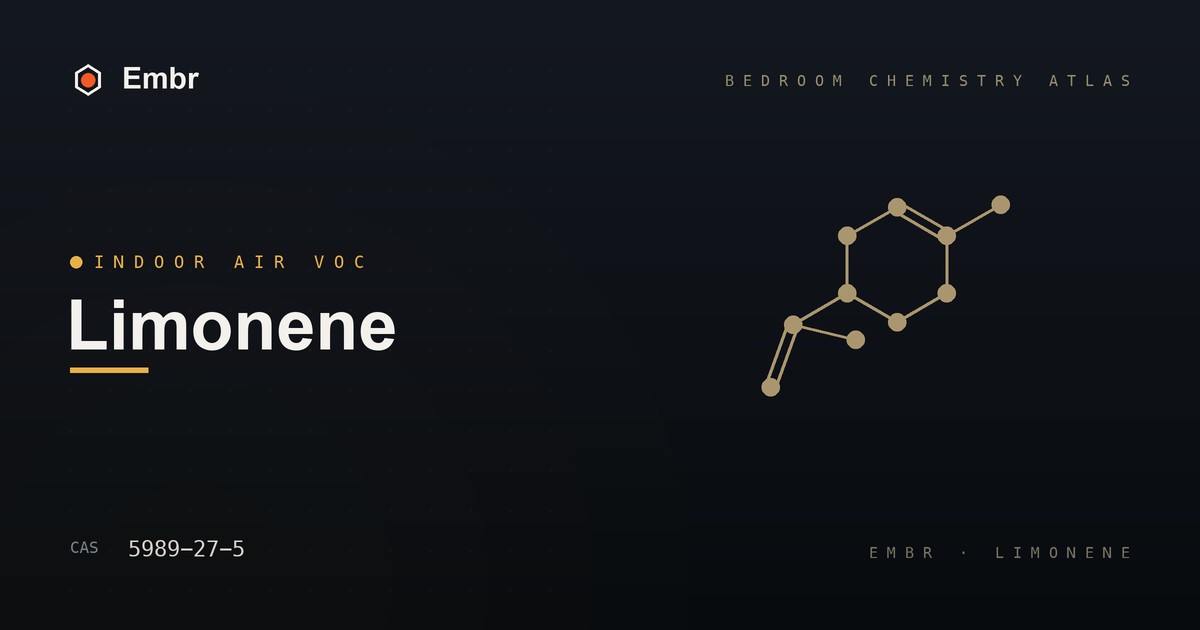
Limonene's molecule contains reactive carbon–carbon double bonds. Indoor air almost always contains some ozone — it drifts in from outdoors and is generated by certain "air-purifying" and ionizing devices. When ozone meets limonene, it attacks those double bonds, and the products include ultrafine secondary organic-aerosol particles. A 2000 indoor-air study demonstrated this directly: limonene plus ozone produced measurable submicron particles, concentrated in the 0.1–0.3 micrometre range. Peer-reviewed — Wainman et al. 2000, Environ. Health Perspect. In other words, a fragrant gas is converted into fine particles small enough to reach deep into the lungs.
Why this matters for how we think about the bedroom
This is the cleanest example of a theme that runs through the Atlas: the sleep environment is a set of reactions, not a static ingredient list. A compound can be near-harmless on its own and still matter because of what it forms when it meets something else in the room. "Natural," "citrus," and "fresh" are scent claims — they say nothing about the particles that scent can produce. Inferred — secondary-particle yield depends on ozone level, ventilation, and limonene concentration
What the research says
- Direct toxicity is low. Group 3; the rat kidney mechanism is not human-relevant. Regulatory
- Secondary particle formation is real and measured. Limonene + ozone reliably forms submicron particles indoors. Peer-reviewed — Wainman 2000
- The exposure scales with the room. More ozone, less ventilation, and higher limonene all increase secondary-particle formation. Inferred
What helps reduce it
Don't add ozone to the room. Avoid ozone-generating "air purifiers" and ionizers, especially alongside scented products — that combination is what drives secondary-particle formation.
Be skeptical of scent as a proxy for clean. A citrus-fresh smell does not mean cleaner air; sometimes it means the opposite. Ventilation, not fragrance, is what improves air quality.
Ventilate. Fresh-air exchange removes both limonene and ozone before they react and dilutes any particles formed.
Capture before reaction. Limonene is reasonably well-adsorbed by activated carbon, so capturing it is a sensible angle where ventilation is limited.
What does NOT help
- Masking odors with more fragrance. Adding scented product to cover a smell adds more limonene (and other terpenes) to react with ozone.
- Ozone "shock" treatments. Deliberately ozonating a room full of fragrances is the worst case for secondary-particle formation.
Open research questions
- Typical bedroom secondary-particle yields from realistic limonene and ozone levels overnight. Speculation
- The full slate of gas-phase oxidation products from limonene ozonolysis at indoor concentrations. Speculation
The Embr Exposure Ledger: Limonene (d-limonene)
One chemical, several public questions, answered from independent datasets and joined here — the environment it shows up in, the body burden it carries, how it is regulated, and what actually reduces it.
Detection and body-burden figures are occurrence data, not a personal measurement or a health diagnosis. Part of the Embr Exposure Ledger — an open, cross-dataset chemical join (download the data), reusable with attribution.
Citations
- Oz K, et al. (2019). Volatile Organic Compound Emissions from Polyurethane Mattresses under Variable Environmental Conditions. Environmental Science & Technology. DOI 10.1021/acs.est.9b01557 Peer-reviewed
- Wainman T, Zhang J, Weschler CJ, Lioy PJ (2000). Ozone and limonene in indoor air: a source of submicron particle exposure. Environmental Health Perspectives, 108(12):1139–1145. PMC1240194 Peer-reviewed
- IARC. d-Limonene — Group 3 (not classifiable). Male-rat kidney tumors proceed via the α2u-globulin mechanism, not relevant to humans. Regulatory
Frequently asked questions
Is limonene harmful in a mattress?
On its own, limonene is low-hazard. IARC classifies d-limonene as Group 3 — not classifiable as to carcinogenicity to humans; the kidney tumors seen in male rats proceed through a mechanism (α2u-globulin) that does not apply to people. The more interesting issue is indirect: limonene reacts with indoor ozone to form ultrafine secondary particles, so a citrus scent is not the same as clean air.
Why does limonene react with ozone?
Limonene is a terpene with reactive carbon–carbon double bonds. When indoor air contains ozone — which drifts in from outdoors or is produced by some "air purifying" devices — it attacks those double bonds. A 2000 study showed that limonene and ozone together generate measurable submicron particles indoors. The reaction turns a pleasant-smelling gas into fine airborne particles.
Where does the limonene in my bedroom come from?
Two main places: it is emitted by polyurethane and mattress materials as part of off-gassing, and it is deliberately added as a citrus fragrance to cleaning products, air fresheners, and scented goods. So both your mattress and your cleaning routine put limonene into bedroom air.
Does a "natural" or citrus scent mean cleaner air?
Not necessarily. Limonene is genuinely a natural compound — it is what makes citrus peels smell like citrus — but "natural" does not mean inert. Because it reacts with ozone to form ultrafine particles, adding a citrus scent to a room with ozone present can increase fine-particle exposure rather than improve air quality. The honest takeaway: scent and air quality are different things.
Related compounds
Embr is a sleep environment company researching and addressing the chemistry of the bedroom. Research and product development in progress.
Last reviewed 2026-06-27. If you find a factual error, contact us.