At a glance
| Chemical family | A dihydroxybenzene (1,3-benzenediol); the colour-forming coupler in oxidative (permanent) hair dyes. Filed as a personal-care residue that deposits on bedding rather than a volatile |
| CAS number | 108-46-3 |
| Classification | Not a classified carcinogen — IARC Group 3 (not classifiable). Skin sensitizer (contact allergen); thyroid-disrupting endocrine compound; a regulated hair-dye ingredient in the EU |
| Where you encounter it | Permanent/oxidative hair dyes (the dominant use); some acne and dandruff treatments and chemical peels; industrially in resorcinol-formaldehyde resins that bond rubber and textiles |
| Sleep micro-environment relevance | After colouring, residual resorcinol on scalp and hair transfers onto the pillowcase through nightly contact; hairdressers have the highest occupational exposure |
| Activated carbon capture | Not the lever — resorcinol is a fabric-deposit residue, not an airborne gas; a washable pillowcase, thorough rinsing, and product choice address it |
What it is
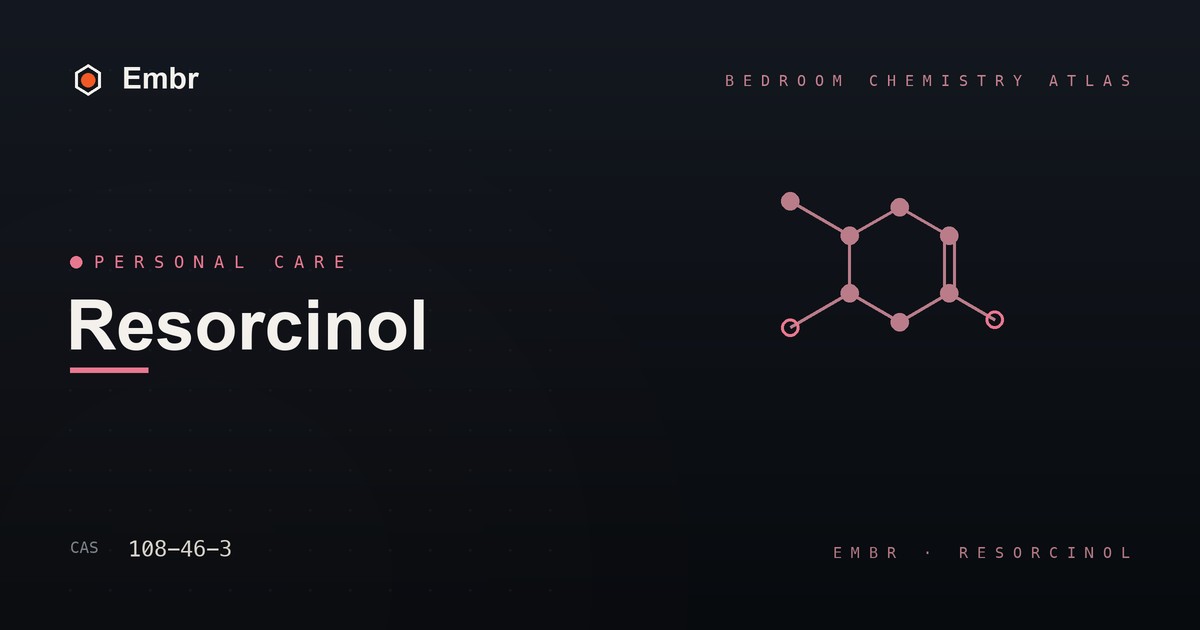
Resorcinol is 1,3-dihydroxybenzene, a small phenol with two hydroxyl groups. Its dominant consumer use is as the colour "coupler" in oxidative (permanent) hair dyes, where it reacts with a developer such as a p-phenylenediamine-type primary and hydrogen peroxide to build the final pigment inside the hair. It also appears in some anti-acne and anti-dandruff products and chemical peels, and industrially in resorcinol-formaldehyde resins used to bond rubber to textile in tyres and belts. Regulatory — IARC Monograph
The single most useful correction this page makes is about cancer. IARC evaluated resorcinol itself and placed it in Group 3 — not classifiable as to carcinogenicity to humans, citing inadequate evidence in animals and no human data. The "Group 2A" label often attached to it belongs to a different IARC entry, "occupational exposures as a hairdresser or barber," which classifies the profession as a whole, not resorcinol the chemical. Regulatory — IARC Monograph Its real flags are elsewhere: skin sensitization and thyroid disruption.
How it relates to the bedroom
The pillowcase route, not the air
Unlike a volatile siloxane that evaporates off hair into room air, resorcinol is not appreciably volatile. The bedroom-relevant route is deposition: after a permanent dye, residual resorcinol on the scalp and hair shaft can transfer onto the pillowcase through the hours of direct contact during sleep, the same deposit-on-fabric mechanism documented for other personal-care residues. Inferred — resorcinol-specific transfer from hair to bedding has not been directly measured; the mechanism is extrapolated from personal-care residues that deposit on fabric This is why a washable pillowcase, not air filtration, is the relevant lever.
The thyroid signal
Resorcinol's most-studied concern is the thyroid. It has thyroid-disrupting properties that decrease thyroid-hormone synthesis, which is why a French occupational-health group is running a biomonitoring study of resorcinol exposure and thyroid parameters in hairdressers, a workforce that is about 90% women, most of reproductive age. Peer-reviewed — Radauceanu et al. 2026 That study is a protocol, so results are not in yet and the human dose-response in hairdressers is still being measured; the thyroid-disrupting property itself is established background, and the concern is greatest for frequent or occupational exposure and during pregnancy. Speculation — whether occasional at-home dye use reaches a thyroid-relevant dose is not established
A recognised skin sensitizer
Resorcinol is a recognised contact allergen: repeated skin contact can drive allergic contact dermatitis, and hairdressers, who handle oxidative dyes daily, carry high rates of occupational hand dermatitis from the hair-dye chemicals as a group. Inferred — resorcinol is an established hair-dye contact allergen; the occupational-dermatitis burden in hairdressers is documented for hair-dye chemistry broadly rather than isolated to resorcinol This sensitization is part of why permanent hair dyes carry allergy warnings and patch-test advice.
What the research says
- Not a classified carcinogen. IARC Group 3 — not classifiable; the "2A" figure is the hairdressing profession, not the chemical. Regulatory — IARC Monograph
- Thyroid-disrupting endocrine compound. Decreases thyroid-hormone synthesis; occupational biomonitoring in hairdressers underway. Peer-reviewed — Radauceanu et al. 2026
- A deposit-on-fabric residue, not an inhaled gas. The bedroom route is transfer from freshly-dyed hair to the pillowcase. Inferred
- Recognised contact allergen. Behind the sensitization warnings on permanent hair dye. Inferred
What helps reduce it
Rinse thoroughly and wait before bed after colouring. Removing residual dye from hair and scalp cuts what can transfer to the pillow. Inferred
Use a dedicated, washable pillowcase for the first nights after a dye. A launderable fabric barrier is the direct lever for a deposit-on-fabric residue. Inferred
Choose resorcinol-free or lower-resorcinol formulations. Many permanent dyes now market resorcinol-free chemistry. Inferred
What does NOT help
- Treating it as a cancer risk. Resorcinol is IARC Group 3, not a classified carcinogen; the real flags are sensitization and thyroid. Regulatory — IARC Monograph
- Air purifiers or carbon air filtration. Resorcinol is not volatile; it does not fill room air, so air capture is not the lever. Inferred
Open research questions
- Whether residual resorcinol measurably transfers from freshly-dyed hair onto bedding at exposure-relevant levels — not directly studied. Speculation
- Whether occasional at-home dye users, as opposed to occupationally-exposed hairdressers, reach any thyroid-relevant dose. Speculation
The Embr Exposure Ledger: Resorcinol
One chemical, several public questions, answered from independent datasets and joined here — the environment it shows up in, the body burden it carries, how it is regulated, and what actually reduces it.
Detection and body-burden figures are occurrence data, not a personal measurement or a health diagnosis. Part of the Embr Exposure Ledger — an open, cross-dataset chemical join (download the data), reusable with attribution.
Citations
- IARC Monographs Vol. 71, Re-evaluation of Some Organic Chemicals, Hydrazine and Hydrogen Peroxide. Resorcinol (CAS 108-46-3) evaluated as Group 3 — not classifiable as to carcinogenicity to humans; inadequate evidence in experimental animals; no human data. NCBI Bookshelf Regulatory
- Radauceanu A, et al. (2026). Occupational Exposure to Resorcinol and Thyroid-Disrupting Effects: Protocol for an Exploratory Field Study in French Hairdressers. JMIR Research Protocols 15:e65833. Establishes resorcinol as an oxidative hair dye with thyroid-disrupting properties (decreased thyroid-hormone synthesis) and hairdressers as an occupationally exposed group; biomonitoring study underway. PMID 41915798. doi.org/10.2196/65833 Peer-reviewed
Frequently asked questions
What is resorcinol?
Resorcinol (1,3-dihydroxybenzene) is a phenol used mainly as the colour-forming "coupler" in permanent, oxidative hair dyes, and in some acne and dandruff treatments and skin peels. Industrially it is also used to make resorcinol-formaldehyde resins that bond rubber and textiles. In the bedroom, the relevant route is residual dye on freshly-coloured hair transferring onto the pillowcase.
Is resorcinol a carcinogen?
No. IARC evaluated resorcinol itself and placed it in Group 3, "not classifiable as to carcinogenicity to humans," citing inadequate evidence of carcinogenicity in animals and no human data. The "Group 2A" figure often seen refers to "occupational exposures as a hairdresser or barber" — a classification of the profession as a whole, not of resorcinol the chemical. Its real concerns are skin sensitization and thyroid/endocrine disruption, not cancer.
How does resorcinol get into my bedroom?
Chiefly through hair. After a permanent dye, residual resorcinol on the scalp and hair shaft can transfer onto the pillowcase through the hours of direct contact during sleep, the same deposit-on-fabric route as other personal-care residues. It is not a volatile that fills the room air, so this is a contact-and-fabric pathway rather than an inhaled one. Hairdressers, who handle it daily, have the highest documented exposure.
Should I be worried about it?
For an occasional at-home hair-dye user the exposure is small and intermittent, and resorcinol is not a classified carcinogen. The stronger signals are skin sensitization (it is a recognised contact allergen, which is why EU hair dyes carry warnings) and thyroid-hormone disruption, which matters most for frequent or occupational exposure and during pregnancy. Practical steps: rinse thoroughly after colouring, use a dedicated washable pillowcase for the first nights, and consider resorcinol-free formulations.
Related compounds
Embr is a sleep environment company researching and addressing the chemistry of the bedroom. Research and product development in progress.
Last reviewed 2026-07-14. If you find a factual error, contact us.