If you're pregnant with a second child, or a friend just offered you the crib mattress their toddler outgrew, or you found a nearly-new one on a local resale group, you've probably run into the same wall of conflicting advice. One source says never use a secondhand crib mattress. Another says it's fine and you're wasting money buying new. Neither usually explains why, and the two are often answering different questions without saying so.
Here's the frame that makes it make sense: a crib mattress carries two separate safety questions, and a used mattress moves them in opposite directions.
- The chemistry question — what the mattress emits into the air a sleeping infant breathes. A used mattress has already done most of its off-gassing, so on this axis, used is usually better than new.
- The safe-sleep / integrity question — firmness, fit, and the condition of the waterproof barrier, which relate to the far more serious and well-established risk of sudden infant death. On this axis, a degraded or unknown-history used mattress can be worse.
Most blanket "never buy used" advice is really about the second question. Most "it's fine, save your money" advice is really about the first. Both can be right at once. The useful answer is: it depends on the specific mattress, and you can actually check.
The chemistry axis: a used mattress off-gasses less
This is the part that surprises people, so it goes first: on the compounds a mattress releases into the air, new is the higher-exposure state, not used.
In 2014, a research team led by Brandon Boor published a study in Environmental Science & Technology that did something specific to this question: they measured volatile organic compound emissions directly from crib mattresses, including how those emissions behaved with the mattress's age and with an infant's body heat. Two findings matter here. First, emissions were highest from new mattresses and declined as mattresses aged — a used crib mattress emitted less than a comparable new one. Second, warming the mattress surface to an infant's body temperature increased emission rates, which is why the sleeping micro-environment matters more than a showroom sniff test. Peer-reviewed
This lines up with what the broader emissions literature shows and with our own longer piece on how long mattress off-gassing actually lasts: emissions of the lighter volatile compounds are front-loaded to a product's early life and taper over weeks to months. The heavier semi-volatile compounds (SVOCs) — the plasticizers and flame retardants measured in the 2025 University of Toronto children's-mattress study — persist far longer and cling to dust rather than airing out, so age helps less with those. But even there, a used mattress isn't adding chemistry; it's a few years further along the same decay curve than a new one. Peer-reviewed
If off-gassing is your main worry, a used crib mattress is generally the lower-exposure choice — provided it's structurally sound (see the next section).
- VOC emissions from mattress foam are highest when new and decline with age Peer-reviewed
- Body heat raises emission rates — real sleeping conditions matter more than a static sniff test Peer-reviewed
- A used mattress is further along the same off-gassing curve; it does not generate new chemistry
- Heavier SVOCs (plasticizers, flame retardants) linger longer, so age helps less with those
Sources: Boor BE et al. (2014), Environmental Science & Technology; Vaezafshar S et al. (2025), Environmental Science & Technology.
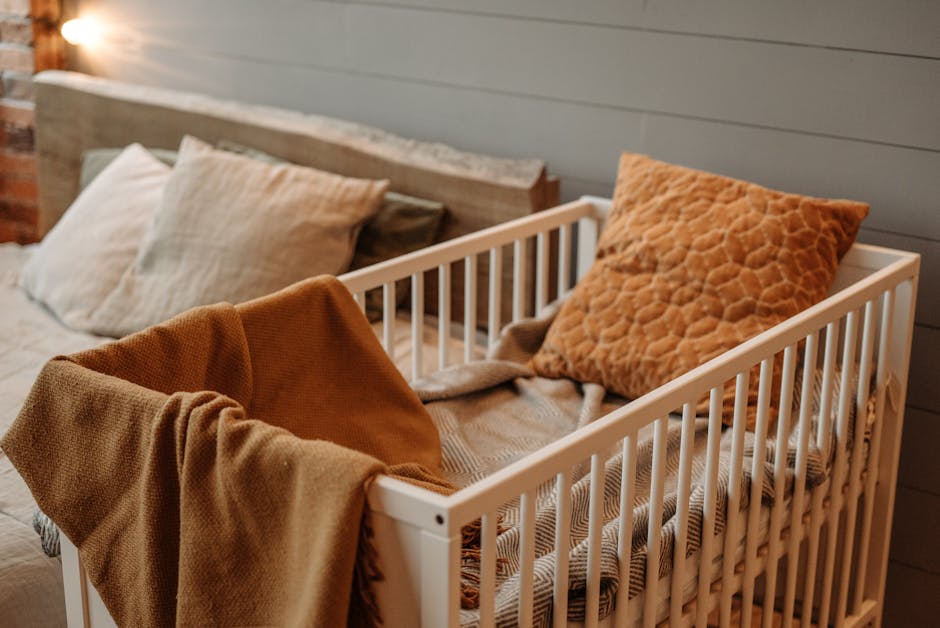
There's one caveat that belongs to chemistry but points forward to the next section: a used mattress tells you nothing about what was in it to begin with. If the original mattress was an inexpensive foam unit that used a chemical fiberglass or flame-retardant fire barrier, buying it used doesn't remove that — it just means the volatile fraction has calmed down. Provenance still matters. Which is the whole point of the second axis.
The safe-sleep axis: firmness, fit, and the debated used-mattress signal
This is the axis the cautious advice is really about, and it deserves to be taken more seriously than the chemistry — because the risk it relates to, sudden infant death, is far better established than any mattress-chemistry health outcome.
The American Academy of Pediatrics' safe-sleep guidance is unambiguous on the mattress itself: infants should sleep on a firm, flat surface that fits the crib tightly, with a fitted sheet and nothing else — no soft bedding, bumpers, or toys. A firm surface reduces the risk of a sleeping infant's face sinking in and rebreathing exhaled air. This is where a used mattress can genuinely fail: foam and springs soften with years of use and body weight, and a mattress that has lost its firmness, developed a permanent body impression, or begun to sag is no longer meeting the recommendation — new or used. Regulatory
Two more integrity points that age and reuse threaten:
- Fit. A crib mattress should fit snugly — the common rule of thumb is no more than about two fingers between the mattress edge and the crib frame. A hand-me-down mattress sized for a different crib can leave a gap an infant's head or limb can wedge into.
- The waterproof barrier. The surface layer that keeps fluids out of the core is what lets a mattress be cleaned and kept hygienic. Once it cracks, splits, or tears — which happens with age, cleaning, and flexing — moisture and microbes reach the interior, and it can't be reliably cleaned again.
Then there's the specific question that hangs over this whole topic: is a previously-used mattress itself a SIDS risk factor, independent of its condition? There is a signal in the literature, and it is genuinely unsettled. A Scottish case-control study by Tappin and colleagues, published in the BMJ in 2002, reported an association between infants sleeping on a mattress previously used by another child and increased SIDS risk, with the association strongest when the mattress came from a different household. Peer-reviewed
That study is why "don't use a used mattress" entered the safe-sleep advice in some countries. But it has never been cleanly replicated, the proposed mechanisms (bacterial colonization, degraded materials) were never confirmed, and other analyses have not found the effect to hold up. Major guidance bodies have generally not adopted a blanket prohibition on used mattresses; the AAP's emphasis is on firmness, fit, and a clean, intact surface rather than on prior ownership as such. We think the right way to hold this is as a reason for caution about mattresses of unknown history and questionable condition — not as a proven hazard that makes every hand-me-down dangerous.
What the evidence does not establish
Being straight about the limits here matters more than usual, because this is a topic where fear fills the vacuum left by uncertainty.
- The 2002 used-mattress SIDS association was a single case-control study that was not consistently reproduced, and no causal mechanism was ever established. It is a signal, not a settled fact.
- The chemistry studies (Boor 2014; Vaezafshar 2025) measured emissions and exposure potential — not health outcomes in specific children. "Lower emissions from a used mattress" is a statement about exposure, not a promise about any child's health.
- None of this tells you what a particular secondhand mattress was made of, how it was stored, or whether it was ever soaked, flooded, or kept in a damp space. Provenance you can't verify is a real limit.
- We can't rank secondhand-vs-new against SIDS with precision, because the strongest, best-established levers — firmness, fit, back-sleeping, a bare sleep surface — apply to any mattress and swamp the mattress's newness either way.
A decision framework: when a secondhand crib mattress is reasonable
Putting both axes together, here's the honest split. This isn't a rule handed down from a standard — it's how we'd weigh it, stated so you can disagree with a specific line.
- You know its history — your own, or a trusted family member's
- Still firm, flat, with no permanent body impression or sag
- Fits the crib snugly (roughly a two-finger gap or less)
- Waterproof surface fully intact — no cracks, splits, or tears
- No history of flooding, soaking, or damp storage; no musty smell or visible mold
- Cleans up fully and dries completely before use
- Unknown provenance — you can't say where it's been or how it was stored
- Soft, sagging, or holding a permanent impression
- Waterproof layer cracked, peeling, or torn; stains that reach the core
- Any musty odor, visible mold, or water-damage history
- Doesn't fit the crib snugly
- You can't get a straight answer about its age or origin
Notice that almost every line in the "pass" column is about condition and provenance, not about chemistry or the mere fact of prior use. That's the signal to trust: a firm, clean, well-fitting mattress whose history you know is a reasonable choice; a degraded or mystery mattress is not — and buying new doesn't fix a condition problem you'd tolerate in a hand-me-down.
How to inspect and clean a secondhand crib mattress
If a used mattress clears the framework above, here's the practical pass before it goes in the crib.
- Press across the whole surface — it should be uniformly firm, springing back with no soft spots or lasting dents.
- Run your hand over the waterproof layer looking for cracks, peeling, seam splits, or punctures. A compromised barrier is a retire-it signal.
- Check for stains that have soaked through to the core, and for any musty or mildew smell — both mean moisture got inside.
- Set it in the crib and check the gap: no more than about two fingers on any side.
- Read the law tag for the fire-barrier material and manufacture date; if it's a budget foam unit, see our fiberglass guide.
- Vacuum both sides with a HEPA vacuum to lift settled dust — where heavier SVOCs concentrate.
- Wipe the waterproof surface with mild soap and warm water; avoid soaking the core, which traps moisture and grows mold.
- Let it air out and dry completely — a full day with ventilation, and some sunlight if you can — before use.
- Use a fresh, well-fitting fitted sheet. Skip added mattress toppers, pads, and "protectors" that soften the sleep surface.
One thing not to over-rotate on: the smell of a new mattress airing out is a poor guide to safety in either direction. As the Boor work showed, odor and measured emissions don't track neatly, and body heat changes the picture. Judge a used mattress on firmness, fit, and the integrity of its surface — the things that actually relate to established risk.
Reusing your own mattress for a second baby
This is the most common version of the question, and it's the easiest to answer well, because it removes the biggest unknown: provenance. If the mattress is your own, you know whether it was ever soaked, how it was stored, and roughly how much use it's had.
Run it through the same framework. If it's still firm, the waterproof layer is intact, it fits the crib, and it cleans up and dries fully — reusing it for a second child is a reasonable, low-risk choice, and on chemistry it's now lower-emission than a new replacement would be. If it's been through years of hard use, holds a body impression, or the surface has started to crack, retire it — and that's true whether the next baby is yours or the mattress is headed to someone else's crib. The decision is about the mattress's condition, not about whether a second child "deserves" a new one.
If you do decide to replace it and you're weighing what to buy, our guide to choosing a non-toxic crib mattress walks through the certifications (GOTS, GOLS, MADE SAFE, GreenGuard Gold) that actually exclude the compound classes found in the 2025 Toronto study, and our breakdown of that study covers what those researchers actually found.
Frequently asked questions
Is it safe to use a secondhand crib mattress?
It depends on two separate questions. On chemistry, a used crib mattress is usually the safer bet — a peer-reviewed study measured lower VOC emissions from older mattresses than from new ones, because most off-gassing happens early. On the safe-sleep side, the guidance is more cautious: the mattress must still be firm, fit the crib with no more than a roughly two-finger gap, have an intact and clean waterproof surface, and come from a source you trust. One Scottish case-control study reported an association between mattresses previously used by another child and higher SIDS risk, but the finding was not consistently replicated and no mechanism was established. A firm, clean, well-fitting used mattress of known history is reasonable; a soft, degraded, or unknown-provenance one is not.
Can you reuse a crib mattress for a second baby?
Yes, in most cases — reusing your own crib mattress for a second child is lower-risk than accepting one from an unknown source, because you know its history. Check that it's still firm (no permanent body impressions or sagging), that the waterproof cover is intact, and that it fits the crib snugly. Clean the surface and let it dry completely to prevent mold. On chemistry, a mattress that's a few years old has already off-gassed most of its volatile compounds, so ongoing emissions are lower than a new one.
Do crib mattresses expire?
Crib mattresses don't carry a legal expiry date, but they degrade. The two things that fail with age and use are firmness (foam and springs soften, which matters for safe sleep) and the waterproof barrier (which can crack or tear, letting fluid and microbes into the core). A mattress that has lost firmness or whose cover is compromised should be retired regardless of its age. Chemistry is the opposite: an older mattress off-gasses less, not more.
How do you clean a secondhand baby mattress?
Vacuum both sides with a HEPA vacuum. Wipe the waterproof surface with mild soap and warm water and wipe clean — avoid soaking the core, which can trap moisture and grow mold. Let the mattress air out and dry completely, ideally with ventilation and some sunlight, for at least a full day before use. Inspect for tears, stains that reach the core, and soft or sagging spots. If the waterproof layer is broken or the core is stained through, retire it.
Does a used crib mattress off-gas less than a new one?
Generally yes. VOC emissions from mattress foam are highest when the mattress is new and decline over time as the compounds deplete. A 2014 peer-reviewed study measuring crib mattress emissions found older mattresses emitted less than new ones, while an infant's body heat raised emission rates. This is the counterintuitive part of the secondhand question: on chemistry alone, used is often lower-exposure than new.
Should I worry about the used-mattress SIDS study?
Treat it as a reason for caution about unknown-history mattresses, not as settled science. The 2002 Scottish case-control study reported an association, but it wasn't consistently replicated and no mechanism was confirmed, and major guidance bodies haven't adopted a blanket ban on used mattresses. The strongest, best-established safe-sleep levers — a firm, flat, well-fitting surface, back-sleeping, and nothing soft in the crib — apply to any mattress and matter far more than whether it's new or used.
Citations
- Boor BE, Järnström H, Novoselac A, Xu Y (2014). "Infant Exposure to Emissions of Volatile Organic Compounds from Crib Mattresses." Environmental Science & Technology 48(6): 3541–3549. DOI 10.1021/es405625q Peer-reviewed
- Vaezafshar S et al. (2025). "Are Sleeping Children Exposed to Plasticizers, Flame Retardants, and UV-Filters from Their Mattresses?" Environmental Science & Technology 59(16): 7909–7918. DOI 10.1021/acs.est.5c03560 Peer-reviewed
- Tappin D, Brooke H, Ecob R, Gibson A (2002). "Used infant mattresses and sudden infant death syndrome in Scotland: case-control study." BMJ 325(7371): 1007. DOI 10.1136/bmj.325.7371.1007 Peer-reviewed
- Moon RY, Carlin RF, Hand I; AAP Task Force on Sudden Infant Death Syndrome (2022). "Sleep-Related Infant Deaths: Updated 2022 Recommendations for Reducing Infant Deaths in the Sleep Environment." Pediatrics 150(1). Regulatory
- American Academy of Pediatrics. "A Parent's Guide to Safe Sleep." healthychildren.org Regulatory
- U.S. Consumer Product Safety Commission. Federal mattress flammability standards, 16 CFR Part 1632 (cigarette ignition) and 16 CFR Part 1633 (open-flame). Regulatory