At a glance
| Chemical family | A benzopyrone (1,2-benzopyrone). NOT an anticoagulant — warfarin and dicoumarol are 4-hydroxycoumarin derivatives, a different chemistry |
| CAS number | 91-64-5 |
| Classification | IARC Group 3 — not classifiable as to carcinogenicity (Sup. 7, Vol. 77). A Fragrance Mix II contact allergen and an EU-declared fragrance allergen. Liver toxicity is a real but genotype-dependent question, not a general one |
| Where you encounter it | Fragrance in perfumes, soaps, detergents and fabric softeners; naturally in tonka beans, sweet clover and cassia cinnamon; restricted as a direct food additive |
| Sleep micro-environment relevance | A very common laundry and fabric-softener fragrance note, so it sits on bedding at the skin and breathing zone all night |
| Activated carbon capture | Partly — as a semi-volatile fragrance it can be captured from air, but fragrance-free laundry products are the cleaner lever |
What it is
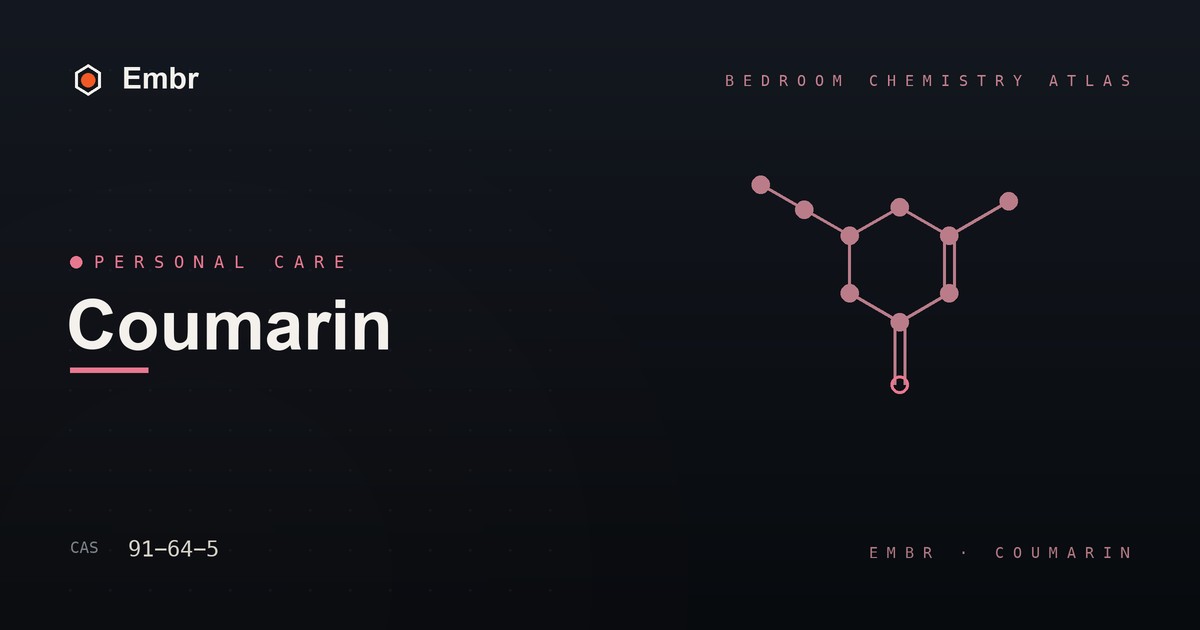
Coumarin is a benzopyrone with the sweet, warm smell of new-mown hay or vanilla. It occurs naturally in tonka beans, sweet clover and cassia cinnamon, and it is one of the workhorse fragrance notes in perfumes, soaps, detergents and fabric softeners. IARC evaluated it and placed it in Group 3 — not classifiable as to carcinogenicity to humans. Regulatory — IARC Classifications (Sup. 7, Vol. 77)
The single most important correction on this page: coumarin is not an anticoagulant. It has no blood-thinning activity of its own. The anticoagulant drugs people are thinking of — warfarin and dicoumarol — are 4-hydroxycoumarin derivatives, a chemically distinct family that shares part of the name. The confusion traces to spoiled sweet-clover hay, where mould converts coumarin into dicoumarol, which then does cause bleeding in cattle. The precursor is not the drug. Inferred — from the established chemistry: coumarin (1,2-benzopyrone) lacks the 4-hydroxy substitution that confers vitamin-K-antagonist activity in warfarin and dicoumarol
How it relates to the bedroom
The fragrance that survives the wash
Coumarin is a staple of the "clean laundry" accord itself — it is heavily used in detergents and fabric softeners, and laundry fragrance is engineered to persist on fabric. So it sits on washed bedding at the skin and breathing zone. Inferred — from coumarin's documented use as a detergent and fabric-softener fragrance and the designed persistence of laundry scent; coumarin specifically has not been measured on laundered bedding For most sleepers this is unremarkable. For the fragrance-allergic, it is nightly occluded contact.
A Fragrance Mix II allergen — and a modest one
Coumarin is one of the six constituents of Fragrance Mix II, the mix developed to catch fragrance allergies that Fragrance Mix I misses. In an IVDK series of 35,633 patients, 4.9% reacted to Fragrance Mix II. Peer-reviewed — Krautheim et al. 2010
Within that mix, coumarin is a comparatively minor player, and honesty requires saying so. Of 367 FM II-positive patients given a full breakdown test, 2.7% reacted to coumarin — against 47.7% for hydroxyisohexyl 3-cyclohexene carboxaldehyde, the dominant allergen in the mix, and 16.1% for citral. Peer-reviewed — Krautheim et al. 2010 So coumarin is a real fragrance allergen, but it is not the one doing most of the damage in its own mix.
The liver question depends on your genes
Coumarin's other reputation is liver toxicity, and here the honest answer is "mostly no, but genuinely yes for some people." A pharmacokinetic risk assessment estimated average dietary coumarin intake at 1–3 mg/day and concluded there is low or negligible concern for coumarin-induced hepatotoxicity at that level, because humans clear it rapidly by CYP2A6-mediated 7-hydroxylation, keeping plasma levels well below those that damage rat liver. Peer-reviewed — Yamada et al. 2022
The caveat is the interesting part. CYP2A6 is genetically polymorphic, so detoxification varies between individuals, and the authors concluded that human subpopulations exist that are highly sensitive to coumarin and that a more precise risk assessment is needed. Peer-reviewed — Yamada et al. 2022 That is a real finding, and it is also not a reason for the general population to fear a hay-scented soap. Inferred — the ALARA reading: the susceptible-subpopulation finding argues for caution in poor CYP2A6 metabolizers, not for population-wide avoidance
Coumarin is also an EU-declared fragrance allergen and must be named on cosmetic labels above threshold (0.001% leave-on, 0.01% rinse-off), with compliance from 31 July 2026. Regulatory — EU 2023/1545
What the research says
- IARC Group 3 — not classifiable. Coumarin is not a classified carcinogen. Regulatory — IARC (Sup. 7, Vol. 77)
- NOT an anticoagulant. Warfarin and dicoumarol are 4-hydroxycoumarin derivatives; coumarin itself does not thin blood. Inferred — from the established chemistry
- A Fragrance Mix II constituent, and a modest one. 4.9% of 35,633 patients reacted to FM II; only 2.7% of FM II-positives reacted to coumarin, vs 47.7% for the dominant allergen. Peer-reviewed — Krautheim et al. 2010
- Liver risk is low at dietary intake. 1–3 mg/day average; rapid CYP2A6 clearance; low or negligible hepatotoxicity concern. Peer-reviewed — Yamada et al. 2022
- But a susceptible subpopulation exists. CYP2A6 is polymorphic; poor metabolizers may be genuinely more sensitive. Peer-reviewed — Yamada et al. 2022
What helps reduce it
Use fragrance-free detergent and fabric softener on bedding. Coumarin is a staple of the "clean laundry" accord, so this is where it actually reaches you. Inferred
If you are fragrance-allergic, note that FM I can miss it. Coumarin sits in Fragrance Mix II, which exists precisely to catch what FM I misses. Peer-reviewed — Krautheim et al. 2010
Read the EU allergen declarations. Coumarin must be named above threshold. Regulatory — EU 2023/1545
What does NOT help
- Believing it thins your blood. It does not. Warfarin and dicoumarol are derivatives, not coumarin itself. Inferred — from the chemistry
- Fearing coumarin-induced liver damage as a general risk. At dietary intakes the concern is low or negligible for typical metabolizers. Peer-reviewed — Yamada et al. 2022
Open research questions
- How much coumarin actually persists on laundered bedding from detergent and softener fragrance — not measured. Speculation
- Whether poor CYP2A6 metabolizers face any meaningful added risk from dermal (fragrance) coumarin, as opposed to the dietary route the risk assessment modelled. Speculation
The Embr Exposure Ledger: Coumarin
One chemical, several public questions, answered from independent datasets and joined here — the environment it shows up in, the body burden it carries, how it is regulated, and what actually reduces it.
Detection and body-burden figures are occurrence data, not a personal measurement or a health diagnosis. Part of the Embr Exposure Ledger — an open, cross-dataset chemical join (download the data), reusable with attribution.
Citations
- IARC Monographs, Agents Classified by the IARC Monographs. Coumarin (CAS 91-64-5) evaluated as Group 3 — not classifiable as to its carcinogenicity to humans (Supplement 7, Vol. 77). IARC classification list Regulatory
- Krautheim A, Uter W, Frosch P, Schnuch A, Geier J (2010). Patch testing with fragrance mix II: results of the IVDK 2005–2008. Contact Dermatitis 63(5):262–269. Of 35,633 patients patch-tested with Fragrance Mix II, 1,742 (4.9%) reacted positively. In 367 FM II-positive patients given a full breakdown, 2.7% reacted to coumarin, versus 47.7% to hydroxyisohexyl 3-cyclohexene carboxaldehyde and 16.1% to citral. PMID 20946454. doi.org/10.1111/j.1600-0536.2010.01753.x Peer-reviewed
- Yamada T, et al. (2022). Combined risk assessment of food-derived coumarin. Food Safety (Tokyo) 10(3):73–82. Average dietary coumarin intake 1–3 mg/day; rapid CYP2A6-mediated 7-hydroxylation gives low or negligible concern for hepatotoxicity in typical metabolizers, but CYP2A6 polymorphism implies a highly sensitive human subpopulation. PMID 36237397. doi.org/10.14252/foodsafetyfscj.D-21-00015 Peer-reviewed
- Commission Regulation (EU) 2023/1545 amending Regulation (EC) No 1223/2009 as regards labelling of fragrance allergens (Annex III). Coumarin must be declared on cosmetic labels above 0.001% (leave-on) / 0.01% (rinse-off); compliance from 31 July 2026. EUR-Lex Regulatory
Frequently asked questions
What is coumarin?
Coumarin is a benzopyrone with the sweet smell of new-mown hay or vanilla. It occurs naturally in tonka beans, sweet clover and cassia cinnamon, and it is widely used as a fragrance in perfumes, soaps, detergents and fabric softeners. In the bedroom it reaches you as fragrance that persists on laundered bedding.
Is coumarin a blood thinner?
No. This is the most common misconception about it. Coumarin itself has no anticoagulant activity. The blood-thinning drugs — warfarin and dicoumarol — are 4-hydroxycoumarin derivatives, a chemically different family that happens to share the coumarin name. The confusion traces to spoiled sweet-clover hay, where mould converts coumarin into dicoumarol, which does cause bleeding in cattle. The precursor is not the drug, and coumarin in a fabric softener is not thinning anyone's blood.
How allergenic is it?
Coumarin is one of the six constituents of Fragrance Mix II, the mix developed to catch fragrance allergies that Fragrance Mix I misses. In an IVDK series of 35,633 patients, 4.9% reacted to Fragrance Mix II. Coumarin is a comparatively minor contributor within that mix: of 367 FM II-positive patients given a full breakdown test, 2.7% reacted to coumarin, against 47.7% for the dominant allergen in the mix.
Should I be worried about it?
For most people, no. Coumarin is IARC Group 3, it is not an anticoagulant, and a pharmacokinetic risk assessment found low or negligible concern for coumarin-induced liver toxicity at average dietary intakes, because humans clear it rapidly by CYP2A6 7-hydroxylation. The honest caveat is that CYP2A6 is genetically polymorphic, so a subpopulation clears coumarin poorly and may be genuinely more susceptible. If you are fragrance-allergic, the ordinary advice applies: fragrance-free bedding laundry.
Related compounds
Embr is a sleep environment company researching and addressing the chemistry of the bedroom. Research and product development in progress.
Last reviewed 2026-07-14. If you find a factual error, contact us.