At a glance
| Chemical family | A phenylpropene; the main constituent of clove oil, and the parent compound of methyleugenol (which is its methyl ether) |
| CAS number | 97-53-0 |
| Classification | IARC Group 3 — not classifiable as to carcinogenicity (Vol. 36, Sup. 7). NOT to be confused with methyleugenol (Group 2B). A recognised contact allergen and an EU-declared fragrance allergen |
| Where you encounter it | Clove oil and clove/spice scents; fragrance in perfumes, soaps and detergents; a food flavouring; dental cements (zinc oxide–eugenol) |
| Sleep micro-environment relevance | Fragrance that survives laundering and sits on bedding at the skin and breathing zone; also spice-scented personal care and diffusers |
| Activated carbon capture | Partly — as a semi-volatile fragrance it can be captured from air, but fragrance-free laundry products are the cleaner lever |
What it is
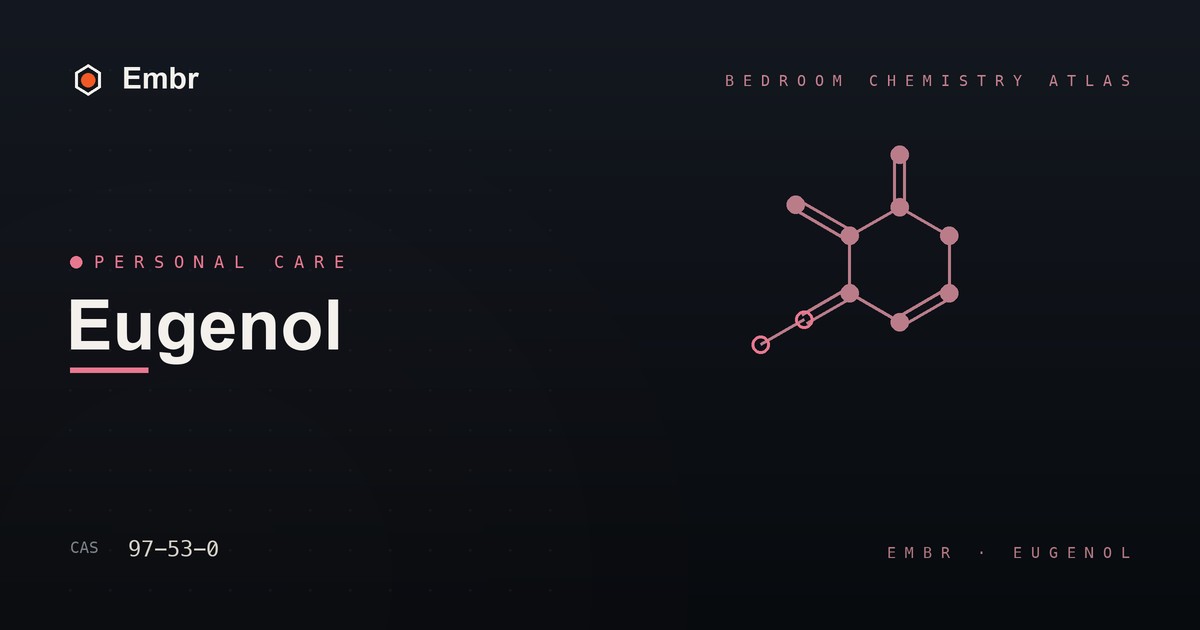
Eugenol is a phenylpropene and the dominant constituent of clove oil. It is used as a fragrance in perfumes, soaps and detergents, as a flavouring in food, and in dentistry, where zinc oxide–eugenol cements and temporary fillings give a dental surgery its characteristic clove smell. Regulatory — IARC Classifications (Vol. 36, Sup. 7)
The single most important correction on this page is a naming trap. Eugenol is IARC Group 3, not classifiable as to carcinogenicity to humans. Regulatory — IARC Classifications (Vol. 36, Sup. 7) Methyleugenol — eugenol with a methyl group on the phenol oxygen — is a different compound that IARC places in Group 2B, possibly carcinogenic. One prefix, one whole category of difference. Treating a clove-scented soap as though it contained a Group 2B carcinogen, or vice versa, is a mistake we see made in both directions. Inferred — the two compounds carry distinct IARC evaluations; the conflation is a common error corrected here
How it relates to the bedroom
The fragrance that survives the wash
Eugenol's bedroom route is ordinary fragrance. It is used in soaps and detergents, and laundry scent is engineered to persist on fabric, so it remains on washed bedding at the skin and breathing zone. Inferred — from eugenol's documented use as a soap and detergent fragrance and the designed persistence of laundry scent; eugenol specifically has not been measured on laundered bedding For most sleepers this is unremarkable. For someone with fragrance contact allergy, a pillowcase is eight hours of occluded skin contact with the allergen.
A Fragrance Mix I allergen
Eugenol is one of the eight constituents of Fragrance Mix I, the standard screening mix dermatologists use to detect fragrance allergy. In a series of 23,660 patients patch-tested to the European standard series, 7.7% reacted to Fragrance Mix I. Peer-reviewed — Buckley et al. 2006 Eugenol produces isolated reactions often enough that the authors concluded it must keep being tested separately rather than relying on the mix, so a eugenol allergy can exist even where the mix reads negative. Peer-reviewed — Buckley et al. 2006
Declared on EU labels
Eugenol is one of the fragrance allergens the EU requires to be declared on cosmetic labels above set thresholds (0.001% leave-on, 0.01% rinse-off), under Commission Regulation (EU) 2023/1545, with full compliance from 31 July 2026. Regulatory — EU 2023/1545 If you have a diagnosed fragrance allergy, that label is the practical tool for avoiding it.
What the research says
- IARC Group 3 — not classifiable. Eugenol is not a classified carcinogen. Regulatory — IARC (Vol. 36, Sup. 7)
- It is NOT methyleugenol. Its methyl ether is a separate compound in IARC Group 2B. Do not conflate them. Regulatory — IARC
- A Fragrance Mix I constituent. 7.7% of 23,660 patch-tested patients reacted to Fragrance Mix I. Peer-reviewed — Buckley et al. 2006
- Worth testing separately. Isolated eugenol reactions occur, so an allergy can be missed by the mix alone. Peer-reviewed — Buckley et al. 2006
- EU-declared allergen. Must be named on cosmetic labels above threshold. Regulatory — EU 2023/1545
What helps reduce it
Use fragrance-free detergent on bedding. If you are fragrance-allergic, the pillowcase is the highest-contact surface you own. Inferred
If you suspect fragrance allergy, ask for patch testing that includes eugenol separately. The mix alone can miss it. Peer-reviewed — Buckley et al. 2006
Read the EU allergen declarations. Eugenol must be named above threshold. Regulatory — EU 2023/1545
What does NOT help
- Treating eugenol as a carcinogen. It is IARC Group 3, not classifiable. The cancer concern belongs to methyleugenol, a different compound. Regulatory — IARC
- Avoiding cloves in food. The documented issue is skin contact allergy from fragrance, not dietary clove. Inferred
Open research questions
- How much eugenol actually persists on laundered bedding from detergent fragrance — not measured. Speculation
- Whether prolonged occluded contact with a fragranced pillowcase contributes to sensitization, as opposed to merely eliciting reactions in the already-sensitized. Speculation
The Embr Exposure Ledger: Eugenol
One chemical, several public questions, answered from independent datasets and joined here — the environment it shows up in, the body burden it carries, how it is regulated, and what actually reduces it.
Detection and body-burden figures are occurrence data, not a personal measurement or a health diagnosis. Part of the Embr Exposure Ledger — an open, cross-dataset chemical join (download the data), reusable with attribution.
Citations
- IARC Monographs, Agents Classified by the IARC Monographs. Eugenol (CAS 97-53-0) evaluated as Group 3 — not classifiable as to its carcinogenicity to humans (Vol. 36, Supplement 7). Distinct from methyleugenol (CAS 93-15-2), which is Group 2B. IARC classification list Regulatory
- Buckley DA, Basketter DA, Smith Pease CK, Rycroft RJG, White IR, McFadden JP (2006). Simultaneous sensitivity to fragrances. British Journal of Dermatology 154(5):885–888. Of 23,660 patients patch-tested to the European standard series, 1,811 (7.7%) reacted to Fragrance Mix I; eugenol is one of its constituents and produces isolated reactions often enough to warrant separate testing. PMID 16634891. doi.org/10.1111/j.1365-2133.2006.07170.x Peer-reviewed
- Commission Regulation (EU) 2023/1545 amending Regulation (EC) No 1223/2009 as regards labelling of fragrance allergens (Annex III). Eugenol must be declared on cosmetic labels above 0.001% (leave-on) / 0.01% (rinse-off); compliance from 31 July 2026. EUR-Lex Regulatory
Frequently asked questions
What is eugenol?
Eugenol is a phenylpropene and the main constituent of clove oil. It is used as a fragrance in perfumes, soaps and detergents, as a food flavouring, and in dentistry (zinc oxide–eugenol cements and temporary fillings, which is why a dental surgery smells of cloves). In the bedroom it reaches you mainly as fragrance on laundered bedding and from spice-scented personal-care products.
Is eugenol a carcinogen? Is it the same as methyleugenol?
No, and no. IARC evaluated eugenol and placed it in Group 3, not classifiable as to its carcinogenicity to humans. It is a different compound from methyleugenol, which is eugenol's methyl ether and which IARC classifies as Group 2B, possibly carcinogenic. The names differ by one prefix and the classifications differ by a full category, so the two should never be treated as interchangeable. Eugenol's documented concern is contact allergy, not cancer.
How allergenic is it?
Eugenol is one of the eight constituents of Fragrance Mix I, the standard screening mix for fragrance allergy. In a 23,660-patient series patch-tested to the European standard series, 7.7% reacted to Fragrance Mix I. Eugenol produces isolated reactions often enough that dermatologists keep testing it separately rather than relying on the mix alone.
Should I be worried about it?
For most people, no. Eugenol is not a classified carcinogen and clove is an ordinary spice. The group that benefits from avoiding it is people with fragrance contact allergy, for whom eugenol is a genuine and well-documented allergen. Fragrance-free detergent on bedding is the simple step, and the EU now requires eugenol to be declared on cosmetic labels.
Related compounds
Embr is a sleep environment company researching and addressing the chemistry of the bedroom. Research and product development in progress.
Last reviewed 2026-07-14. If you find a factual error, contact us.