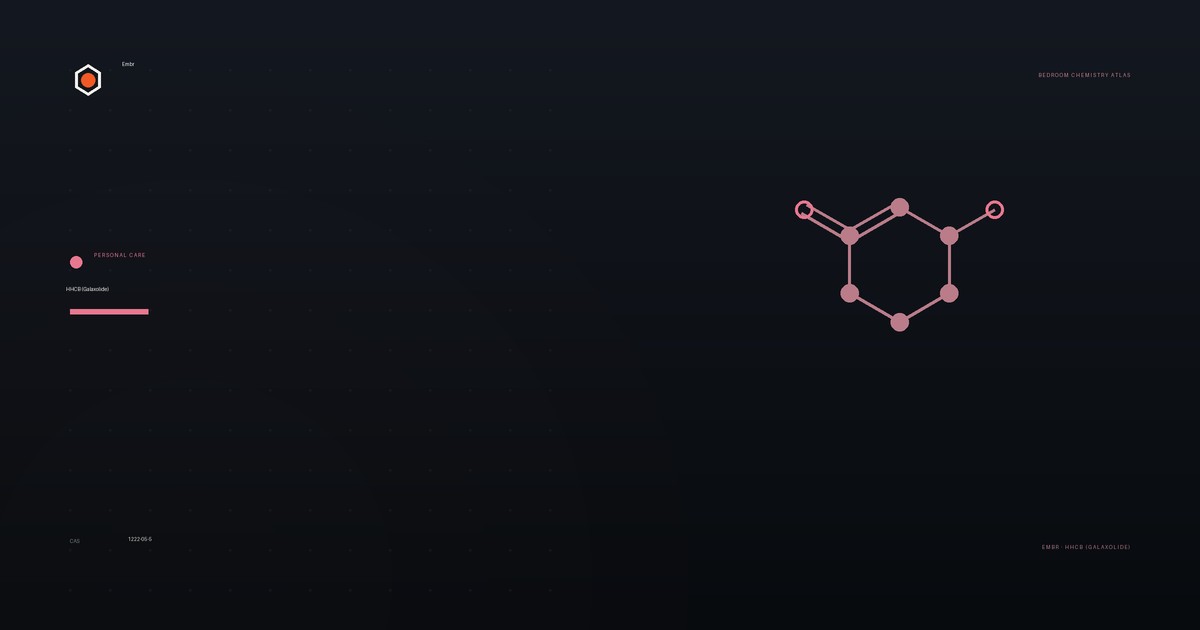
At a glance
| Chemical family | A polycyclic synthetic musk (fragrance); trade name Galaxolide. With AHTN it dominates the synthetic-musk market |
| CAS number | 1222-05-5 |
| Classification | Already EU-classified as very toxic to aquatic life. ANSES has proposed Reproductive toxicity Category 1B (H360Df) under CLP; under assessment as a suspected PBT and endocrine disruptor |
| Where you encounter it | Laundry detergents and fabric softeners, perfumes, cosmetics, air fresheners. The bedroom route is fabric deposition from scented laundry, plus transfer from skin-applied scented products |
| Sleep micro-environment relevance | Designed to persist on fabric, so it stays on bedding through repeated nights of skin contact; bioaccumulative, with HHCB the dominant musk found in human breast milk |
| Activated carbon capture | Not the lever — choosing fragrance-free laundry and personal-care products removes it at the source |
Regulatory & certification status
Where HHCB (Galaxolide) stands across the major regulatory systems and the certifications a bedroom product might carry. Each row links to the governing instrument; where a jurisdiction has no specific measure, that is stated plainly rather than left blank.
| European Union | HHCB (galaxolide; CAS 1222-05-5; EC 214-946-9; CLP Index 603-212-00-7) has a FINAL harmonised classification in Annex VI to CLP for environmental hazard only: Aquatic Acute 1 (H400) and Aquatic Chronic 1 (H410, very toxic to aquatic life with long-lasting effects). Separately, France/ANSES submitted a CLH proposal to add Repr. 1B (toxic to reproduction; proposed labelling H360Df) — the public consultation closed 28 March 2025 and the dossier has since moved through ECHA's Committee for Risk Assessment (RAC). As of this writing that reproductive-toxicity classification is a proposal working through the CLH process and is NOT yet a binding Annex VI entry (no Commission delegated act/ATP confirmed). HHCB is not on the REACH SVHC Candidate List, not on the Authorisation List (Annex XIV) and not restricted under Annex XVII. Regulatory — ECHA · ANSES |
| United States | Under TSCA, EPA released a final Work Plan Chemical Risk Assessment for HHCB on 28 August 2014 — an ecological/aquatic assessment of its fragrance use — which found no concern for that use (environmental exposure concentrations one to two orders of magnitude below hazard concentrations); it led to no TSCA restriction. HHCB is on the TSCA Inventory. It is NOT listed on California Proposition 65 (no carcinogen or reproductive-toxicant listing for galaxolide / HHCB / CAS 1222-05-5). Regulatory — US EPA · OEHHA |
| Canada | HHCB (CAS 1222-05-5) is named as a substance prioritized for future assessment under CEPA in Environment and Climate Change Canada's Plan of Priorities (2025), on the basis of potential aquatic exposure via wastewater. This is a prioritization for assessment, not a completed (final) screening assessment, and HHCB is not on CEPA Schedule 1. Regulatory — Government of Canada |
| Australia | AICIS published an Evaluation Statement (EVA00039, 14 September 2021) covering galaxolide (CAS 1222-05-5) and a related polycyclic musk (CAS 1922-67-4), initiated because the selection analysis indicated a potential environmental risk and focused on the environmental hazards of their industrial use. HHCB is an assessed industrial chemical; no consumer/AICIS prohibition specific to it was identified. Regulatory — AICIS |
| United Kingdom | Post-Brexit, the EU Annex VI harmonised classification was carried over into the GB Mandatory Classification and Labelling list, so under GB CLP galaxolide is expected to carry the same environmental classification (Aquatic Acute 1 / Aquatic Chronic 1, H400/H410). No distinct GB REACH restriction or authorisation specific to HHCB was identified. (The specific GB MCL entry was not independently confirmed against a primary GB list, hence partial.) Regulatory — HSE |
| Certifications | HHCB is not specifically named in the published criteria of the common sleep-product certifications. CertiPUR-US screens foam-relevant substances (PBDEs and other flame retardants such as TCEP/TDCPP/DMMP, certain phthalates, formaldehyde, heavy metals, ozone depleters) plus a GHS-based CMR screen — it does not set a named limit for a fragrance musk like HHCB. OEKO-TEX Standard 100 and GREENGUARD/GREENGUARD Gold likewise do not single out HHCB by name (GREENGUARD is a low-VOC emissions program and HHCB is a semi-volatile additive). Any control of galaxolide as a fragrance ingredient would come from fragrance-sector frameworks rather than these foam/textile/emissions certifications. Industry — CertiPUR-US |
| The 72-hour test window | Largely missed. HHCB is a semi-volatile synthetic musk (an SVOC additive) that partitions onto dust, surfaces and skin and off-gasses only slowly, so a short ~72-hour VOC chamber test does not reliably capture it. Inferred — from the compound's volatility/emission profile versus the VOC focus of short chamber tests |
What it is
HHCB is a polycyclic synthetic musk — a lab-made replacement for the natural musks once harvested from animals. Sold under the name Galaxolide, it is, together with its sibling AHTN (Tonalide), the workhorse of the modern fragrance world: the two account for the large majority of polycyclic musks used. Peer-reviewed — Luo et al. 2023 It turns up in perfumes and cosmetics, but also — and this is what matters for sleep — in laundry detergents, fabric softeners, ironing aids and air fresheners. Regulatory — ANSES 2025
Two properties define its place in this Atlas. First, it is meant to last on fabric — that is the point of a laundry fragrance. Second, it is bioaccumulative: residues turn up in human fat, blood and breast milk, where HHCB is typically the dominant musk measured. Peer-reviewed — Lignell et al. 2008 A fragrance that persists on your sheets and persists in your body is a different proposition from one that simply smells nice and fades.
How it relates to the bedroom
The laundry pathway
This is the cleanest bedroom story in the personal-care family. A study of synthetic musks in mothers' milk found that women with high perfume use had elevated HHCB, and that use of perfumed laundry detergent was associated with elevated levels of the sibling musk AHTN — direct evidence that scented laundry products are a real source of body burden, not just a smell. Peer-reviewed — Lignell et al. 2008 Your sheets and pillowcase are in contact with your skin for a third of every day, so a fragrance engineered to cling to fabric has an unusually long and intimate exposure window. Inferred — combining the fabric-persistence design with bedding contact time
Skin is the bigger door
Laundry is the bedding-specific route, but across all exposures the dominant pathway is the skin: a 2023 review estimated that dermal contact with synthetic-musk-containing personal-care products accounts for roughly 82–93% of daily human intake. Peer-reviewed — Luo et al. 2023 Lotions, shampoos and deodorants applied before bed both dose you directly and transfer musk onto the bedding you then lie on. As with the other personal-care entries, the bedroom is downstream of the bathroom shelf — and, here, the laundry room too.
The honest weight of the hazard
The regulatory picture has sharpened. Galaxolide is already classified in the EU as very toxic to aquatic life, and in 2025 France's health agency ANSES proposed classifying it as a Category 1B reproductive toxicant — "may damage the unborn child; suspected of damaging fertility" — under the CLP Regulation, with the substance also under assessment as a suspected persistent, bioaccumulative and toxic compound and endocrine disruptor. Regulatory — ANSES 2025 (proposal, in EU consultation) That is a proposal moving through the European process, not yet a final classification, and the honest counterweight matters: reviews of the human data note that measured exposures have generally stayed below the doses that produced clear effects in laboratory studies. Peer-reviewed — Luo et al. 2023 The reasonable reading is a reduce-where-easy compound — with extra reason for care during pregnancy and nursing, given the breast-milk enrichment. Inferred — weighing the bioaccumulation and proposed reprotox classification against the exposure-margin data
What the research says
- It is bioaccumulative. The dominant synthetic musk in human breast milk, fat and blood. Peer-reviewed — Lignell et al. 2008
- Scented laundry and skin products are the sources. Perfumed products drive body burden; dermal contact is ~82–93% of intake. Peer-reviewed — Lignell 2008; Luo 2023
- EU regulators have proposed a reproductive-toxicity classification. ANSES proposal of Repr. 1B (H360Df); already classified for aquatic toxicity. Regulatory — ANSES 2025
- Measured exposures sit below clear-effect doses. A reduce-where-easy compound, not an acute hazard. Peer-reviewed — Luo et al. 2023
What helps reduce it
Wash bedding in fragrance-free detergent. The single most effective bedroom step, since laundry fragrance is engineered to stay on the fabric you sleep against. Peer-reviewed — Lignell et al. 2008
Skip scented fabric softener and dryer sheets. Their entire purpose is to deposit fragrance — including musks — onto fabric. Inferred — softeners and dryer sheets are designed for fabric fragrance deposition
Choose fragrance-free skin and hair products for bedtime. Because dermal contact dominates intake, this does most of the work. Peer-reviewed — Luo et al. 2023
What does NOT help
- Trusting the word "unscented." Musks are often added to "unscented" products to mask other odors; the meaningful label is "fragrance-free." Inferred — "unscented" can still contain masking musks
- Air purifiers. HHCB arrives on fabric and skin, not as an air pollutant to be filtered. Inferred
Open research questions
- How much HHCB actually transfers from fragranced bedding to skin over a night's sleep, and how it compares with the dermal dose from leave-on products. Speculation
- The outcome and timeline of the EU reproductive-toxicity classification process, and how it reshapes use of HHCB in consumer laundry products. Speculation
Related reading: Is laundry detergent toxic? The honest answer covers how galaxolide reaches you through bedding, and why "unscented" is not the label to trust.
The Embr Exposure Ledger: Galaxolide (HHCB)
One chemical, several public questions, answered from independent datasets and joined here — the environment it shows up in, the body burden it carries, how it is regulated, and what actually reduces it.
Detection and body-burden figures are occurrence data, not a personal measurement or a health diagnosis. Part of the Embr Exposure Ledger — an open, cross-dataset chemical join (download the data), reusable with attribution.
Citations
- Lignell S, et al. (2008). Temporal trends of synthetic musk compounds in mother's milk and associations with personal use of perfumed products. Environmental Science & Technology. HHCB the highest-concentration musk in breast milk; perfume use → HHCB, perfumed laundry detergent → AHTN. Via Consensus. DOI 10.1021/es800626n Peer-reviewed
- Luo N, et al. (2023). A critical review of environmental exposure, metabolic transformation, and the human health risks of synthetic musks. Critical Reviews in Environmental Science and Technology. Dermal contact ~82–93% of intake; endocrine/mutagenic signals; exposures generally below clear-effect doses. Via Consensus. DOI 10.1080/10643389.2023.2217068 Peer-reviewed
- ANSES (2025). Proposal to classify galaxolide (HHCB) as toxic for reproduction (Category 1B, H360Df) under the EU CLP Regulation. Already classified for aquatic toxicity; under assessment as suspected PBT and endocrine disruptor; used in detergents, softeners, cosmetics; residues in breast milk and fat. anses.fr Regulatory
Frequently asked questions
What is HHCB, and why is it in my bedroom?
HHCB — trade name Galaxolide — is the most widely used synthetic musk, a fragrance and odor-masking ingredient. With its sibling AHTN it makes up the large majority of the polycyclic-musk market. It is in perfumes and cosmetics, but for the bedroom the key route is laundry: it is added to detergents and fabric softeners, deposits onto fabric, and persists on your sheets and pillowcases. You can also carry it onto bedding from scented products applied to skin before bed.
Is HHCB dangerous?
It is bioaccumulative — detected in human fat, blood and, notably, breast milk, where HHCB is usually the dominant musk. EU regulators (via ANSES) have proposed classifying it as a Category 1B reproductive toxicant under the CLP Regulation, and it is under assessment as a suspected persistent, bioaccumulative and toxic substance and endocrine disruptor. That said, reviews note that measured human exposures have generally been below the doses that caused clear effects in laboratory studies, so this is a reduce-where-easy compound, not an acute hazard — with extra reason for caution during pregnancy and nursing.
Does "unscented" mean it is free of musks like HHCB?
No — and this is the crucial label trap. Synthetic musks are often added to products labeled "unscented" specifically to mask the smell of other ingredients. The label that means a product was made without added fragrance is "fragrance-free," not "unscented." If you want to avoid HHCB on your bedding, fragrance-free detergent is the meaningful choice.
How do I reduce HHCB on my bedding?
Wash sheets and pillowcases in a fragrance-free detergent and skip scented fabric softener and dryer sheets, which are designed to leave fragrance on fabric. Choosing fragrance-free skin and hair products for use before bed reduces the amount transferred onto bedding overnight. Because dermal contact with scented personal-care products is the dominant exposure route, those product swaps do most of the work.
Related compounds
Embr is a sleep environment company researching and addressing the chemistry of the bedroom. Research and product development in progress.
Last reviewed 2026-06-27. If you find a factual error, contact us.