At a glance
| Chemical family | A monoterpene alcohol; a rose/citrus note from rose, geranium and citronella oils |
| CAS number | 106-22-9 |
| Classification | Not IARC-classified (absence of evaluation, not a safety finding). The smallest allergen in Fragrance Mix II (2.5% of FM II-positives); an EU-declared fragrance allergen |
| Where you encounter it | Detergents, soaps, personal-care products and insect repellents; naturally in rose, geranium and citronella oils |
| Sleep micro-environment relevance | A common laundry and personal-care fragrance, so it sits on bedding at the skin and breathing zone; as a terpene it also oxidizes over time into stronger sensitizers |
| Activated carbon capture | Partly — as a semi-volatile fragrance it can be captured from air, but fragrance-free laundry products are the cleaner lever |
What it is
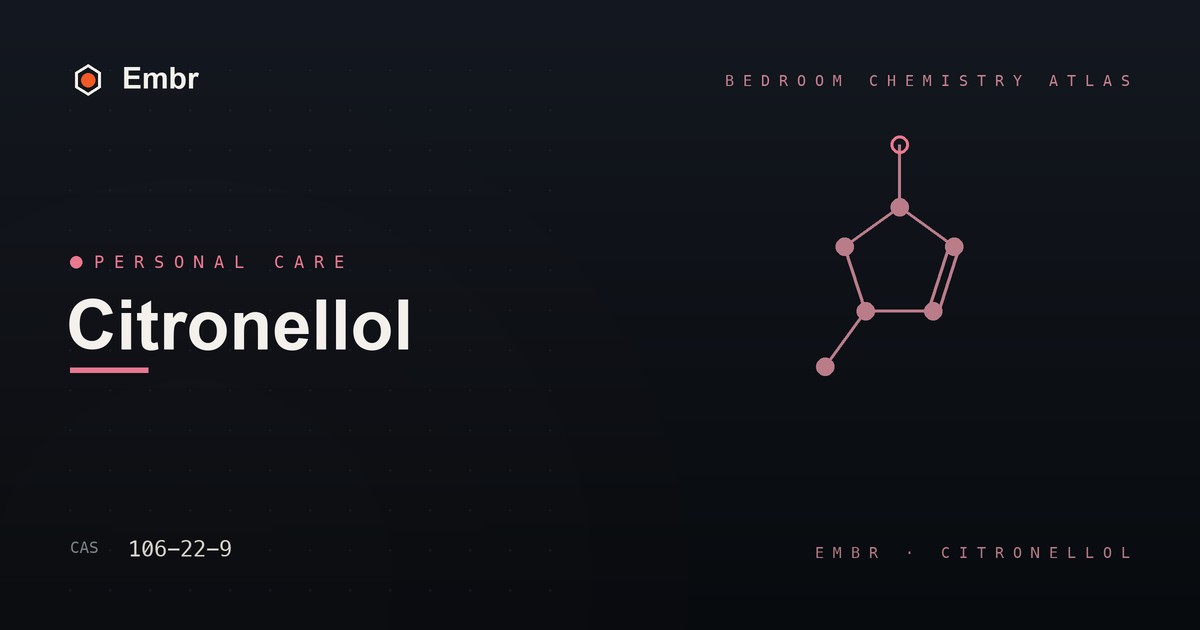
Citronellol is a monoterpene alcohol with a soft rose-and-citrus odour. It occurs in rose, geranium and citronella oils and is used widely as a fragrance in detergents, soaps and personal-care products, and in insect repellents. Peer-reviewed — Krautheim et al. 2010
Citronellol is not IARC-classified; it does not appear in the IARC list of classified agents. Inferred — citronellol does not appear in the IARC list of classified agents; that is an absence of evaluation, not a finding of safety So this is not a cancer page, and it is a fairly gentle allergy page too: within the Fragrance Mix II panel citronellol is the smallest contributor. We say that plainly, because an atlas that treats every ingredient as equally alarming is not much use to anyone.
How it relates to the bedroom
The fragrance that survives the wash
Citral is one of the defining notes of "fresh" and "lemon" cleaning and laundry products, and laundry fragrance is engineered to persist on fabric. So it sits on washed bedding at the skin and breathing zone, and it is also in the air from cleaning products used in the room. Inferred — from citral's documented use as a detergent and cleaner fragrance and the designed persistence of laundry scent; citral specifically has not been measured on laundered bedding
The smallest allergen in Fragrance Mix II
Citral is one of the six constituents of Fragrance Mix II, the mix developed to catch fragrance allergies that Fragrance Mix I misses. In an IVDK series of 35,633 patients, 4.9% reacted to Fragrance Mix II. Peer-reviewed — Krautheim et al. 2010
Within that mix, citronellol is the lightest player. Of 367 FM II-positive patients given a full breakdown test, only 2.5% reacted to citronellol — the lowest of the six, against 47.7% for hydroxyisohexyl 3-cyclohexene carboxaldehyde, 16.1% for citral and 2.7% for coumarin. Peer-reviewed — Krautheim et al. 2010 So if you react to a rose- or citronella-scented product, citronellol is a possible cause but not the likeliest one in its own mix.
A terpene, so it gets worse with age
Citral is a terpene, and terpenes share an inconvenient habit: they autoxidize on contact with air. The pattern is best documented for linalool, where the fresh molecule showed no sensitizing potential but its air-exposed hydroperoxides were clearly positive sensitizers. Peer-reviewed — Sköld et al. 2004 The same air-oxidation chemistry applies to citral as an unsaturated terpene, so an aged, air-exposed product is a more potent sensitizer than a fresh one. Inferred — the autoxidation-to-hydroperoxide mechanism is directly demonstrated for linalool and limonene; extending it to citral follows from the shared terpene chemistry, but citral-specific oxidation data are not cited here
Citral is an EU-declared fragrance allergen and must be named on cosmetic labels above threshold (0.001% leave-on, 0.01% rinse-off), with compliance from 31 July 2026. Regulatory — EU 2023/1545
What the research says
- Not IARC-classified. Citronellol does not appear in the IARC list; an absence of evaluation, not a safety finding. Inferred
- The SMALLEST Fragrance Mix II allergen. Only 2.5% of FM II-positive patients reacted to citronellol, vs 47.7% for the top allergen and 16.1% for citral. Peer-reviewed — Krautheim et al. 2010
- FM II positivity is 4.9%. Of 35,633 patch-tested patients. Peer-reviewed — Krautheim et al. 2010
- A terpene, so it oxidizes. Air exposure converts terpenes into stronger sensitizers; aged product is more allergenic. Inferred — from the demonstrated linalool/limonene autoxidation mechanism
- EU-declared allergen. Must be named on cosmetic labels above threshold. Regulatory — EU 2023/1545
What helps reduce it
Use fragrance-free detergent on bedding. This is where citronellol actually reaches you, though it is a minor allergen. Inferred
If you are fragrance-allergic, look at the bigger FM II players first. Citronellol is the smallest contributor in its own mix. Peer-reviewed — Krautheim et al. 2010
Prefer fresh products over long-aged scented ones. Terpene oxidation raises allergenic potency with air exposure over time. Inferred
What does NOT help
- Treating it as a cancer risk. Citronellol is not IARC-classified; the documented hazard is contact allergy. Inferred
- Assuming "natural rose or citronella oil" is safer. Those oils are the richest natural sources of citronellol; natural origin does not reduce sensitization. Inferred
Open research questions
- How much citronellol actually persists on laundered bedding from detergent fragrance — not measured. Speculation
- Whether citronellol-specific autoxidation products have been characterized as thoroughly as those of linalool and limonene. Speculation
The Embr Exposure Ledger: Citronellol
One chemical, several public questions, answered from independent datasets and joined here — the environment it shows up in, the body burden it carries, how it is regulated, and what actually reduces it.
Detection and body-burden figures are occurrence data, not a personal measurement or a health diagnosis. Part of the Embr Exposure Ledger — an open, cross-dataset chemical join (download the data), reusable with attribution.
Citations
- Krautheim A, Uter W, Frosch P, Schnuch A, Geier J (2010). Patch testing with fragrance mix II: results of the IVDK 2005–2008. Contact Dermatitis 63(5):262–269. Of 35,633 patients patch-tested with Fragrance Mix II, 1,742 (4.9%) reacted positively. In 367 FM II-positive patients given a full breakdown, 2.5% reacted to citronellol — the smallest contributor in the mix, against 47.7% for hydroxyisohexyl 3-cyclohexene carboxaldehyde, 16.1% for citral and 2.7% for coumarin. PMID 20946454. doi.org/10.1111/j.1600-0536.2010.01753.x Peer-reviewed
- Sköld M, Börje A, Harambasic E, Karlberg A-T (2004). Contact allergens formed on air exposure of linalool. Chemical Research in Toxicology 17(12):1697–1705. Cited here for the terpene autoxidation mechanism: the fresh molecule showed no sensitizing potential, while its air-exposed hydroperoxides were clearly positive sensitizers. PMID 15606147. doi.org/10.1021/tx049831z Peer-reviewed
- Commission Regulation (EU) 2023/1545 amending Regulation (EC) No 1223/2009 as regards labelling of fragrance allergens (Annex III). Citral must be declared on cosmetic labels above 0.001% (leave-on) / 0.01% (rinse-off); compliance from 31 July 2026. EUR-Lex Regulatory
Frequently asked questions
What is citronellol?
Citronellol is a monoterpene alcohol with a soft rose-and-citrus odour. It occurs in rose, geranium and citronella oils and is widely used as a fragrance in detergents, soaps, personal-care products and insect repellents. In the bedroom it reaches you as fragrance that persists on laundered bedding.
Is citronellol a carcinogen?
Citronellol does not appear in the IARC list of classified agents, so it has no IARC carcinogenicity classification. That is an absence of evaluation rather than a finding of safety. Its documented hazard is skin sensitization, and on that measure it is a comparatively modest allergen.
How allergenic is it?
Modestly, and it is worth being straight about that. Citronellol is one of the six constituents of Fragrance Mix II. In an IVDK series of 35,633 patients, 4.9% reacted to Fragrance Mix II; of 367 FM II-positive patients given a full breakdown test, only 2.5% reacted to citronellol — the smallest contributor in the mix, against 47.7% for the dominant allergen and 16.1% for citral. It is a genuine allergen, but a minor one.
Should I be worried about it?
For most people, no — and even among the fragrance-allergic, citronellol is one of the less likely culprits. It is not IARC-classified and it is the smallest contributor in its own screening mix. The one thing worth knowing is that it is a terpene, so like limonene and linalool it oxidizes in air into stronger sensitizers as a product ages. If you are fragrance-allergic, fragrance-free bedding laundry remains the direct fix.
Related compounds
Embr is a sleep environment company researching and addressing the chemistry of the bedroom. Research and product development in progress.
Last reviewed 2026-07-14. If you find a factual error, contact us.